It is not quite clear where Piers Gaveston, the favorite of Edward II, spent his time abroad; the conditions of his exile in late 1311 banned him from staying in any of the lands of the English king.
This precluded both Aquitaine and Ireland, where he had spent his previous exiles.
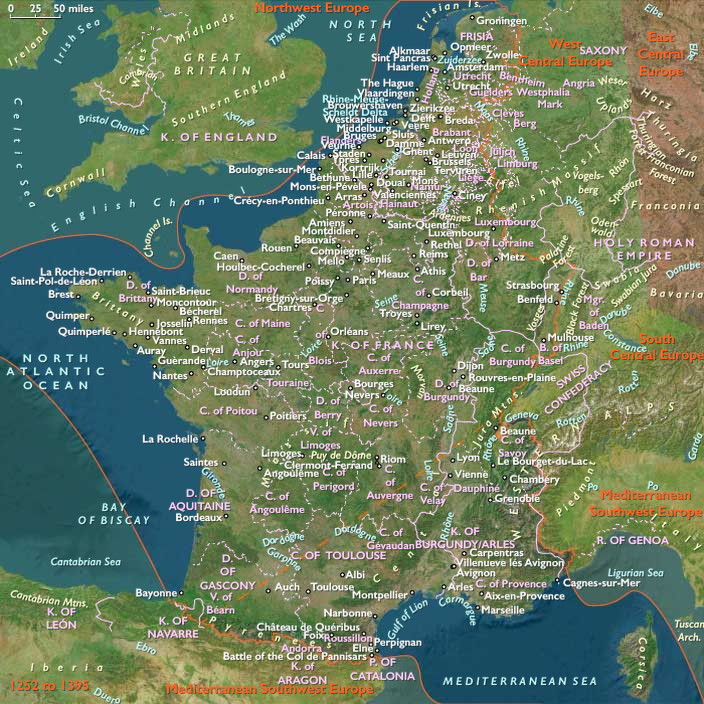
There is some evidence that he might have gone to France initially, but considering the French king's hostile attitude towards him, he is not likely to have stayed there long.
Flanders is a much more likely candidate for Gaveston's third and final exile.
This time his absence was even shorter than the second time, lasting no more than two months.
Returning around Christmas 1311, he is reunited with the King early in 1312, probably at Knaresborough on January 13.
The reason for his quick return might have been the birth of his child, a daughter named Joan, around this time.
On January 18, Edward declares the judgment against Gaveston unlawful, and restores all lands to him.
The royal and baronial parties now both begin preparations for war.
In March, Gaveston settles at Scarborough, and begins to fortify the castle.
Around the same time, he is pronounced excommunicate by Archbishop Winchelsey at St Paul's.
At the same meeting the barons—under the leadership of Lancaster—divide up the realm to oppose the King.
Pembroke and Warenne are given the responsibility of capturing Gaveston.
On May 4, the King and Gaveston are at Newcastle, and barely escape a force led by Lancaster, Henry Percy and Robert Clifford.Gaveston then returns to Scarborough, while the King leaves for York.
Scarborough is soon besieged by Pembroke, Warenne, Percy and Clifford, and on May 19 Gaveston surrenders to the besiegers.
The terms of the surrender are that Pembroke, Warenne and Percy will take Gaveston to York, where the barons will negotiate with the king.
If an agreement cannot be reached by August 1, Gaveston will be allowed to return to Scarborough.
The three swear an oath to guarantee his safety.
After an initial meeting with the King in York, Gaveston is left in the custody of Pembroke, who escorts him south for safekeeping.
On June 9, Pembroke leaves Gaveston at the rectory at Deddington in Oxfordshire, while he himself leaves to visit his wife.
When Warwick finds out about Gaveston's whereabouts, he immediately rides out to capture him.
The next morning he appears at the rectory, where he takes Gaveston captive and brings him back to his castle at Warwick.
Pembroke, whose honor has been affronted, appeals for justice both to Gaveston's brother-in-law Gloucester and to the University of Oxford, but to no avail.
At Warwick, Gaveston is condemned to death for violating the terms of the Ordinances, before an assembly of barons, including Warwick, Lancaster, Hereford and Arundel.
On June 19, he is taken out on the road towards Kenilworth as far as Blacklow Hill, which is on the Earl of Lancaster's land.
Here, two Welshmen run him through with a sword and behead him.
Gaveston's body is simply left behind at the site of his execution.
One chronicle tells of how four shoemakers brought it to Warwick, who refused to accept it, and ordered them to take it back outside his jurisdiction.
Eventually, a group of Dominican friars brought it to Oxford.
A proper burial could not be arranged while Gaveston was still excommunicate, and it will not be until January 2, 1315, after the King had secured a papal absolution for his favorite, that he could have his body buried in an elaborate ceremony at the Dominican foundation of King's Langley Priory; the tomb is now lost.
In 1823, a cross with inscription was erected at Blacklow Hill by local squire, Bertie Greathead, at the place believed to be the location of Gaveston's execution.
Edward also provides a generous endowment for Gaveston's widow Margaret, who in 1317 will marry Hugh de Audley, later Earl of Gloucester.
The King will try to find a suitable marriage for Piers' and Margaret's daughter Joan, but these arrangements come to nothing when Joan dies in 1325, at the age of thirteen.
There is also some evidence that Gaveston might have fathered another, extramarital daughter; one contemporary document refers to an "Amie filie Petri de Gaveston".
This Amie was a chamberlain of Edward III's wife, Queen Philippa, and later married John Driby, a yeoman of the royal family.