Pieter Bruegel the Elder
Netherlandish painter
Years: 1525 - 1569
Pieter Bruegel the Elder (c. 1525 – 9 September 1569) is a Netherlandish Renaissance painter and printmaker known for his landscapes and peasant scenes (Genre Painting).
He is sometimes referred to as "Peasant Bruegel" to distinguish him from other members of the Brueghel dynasty, but is also the one generally meant when the context does not make clear which "Bruegel" is being referred to.
From 1559 he drops the 'h' from his name and started signing his paintings as Bruegel.

Related Events
Filter results
Showing 10 events out of 11 total
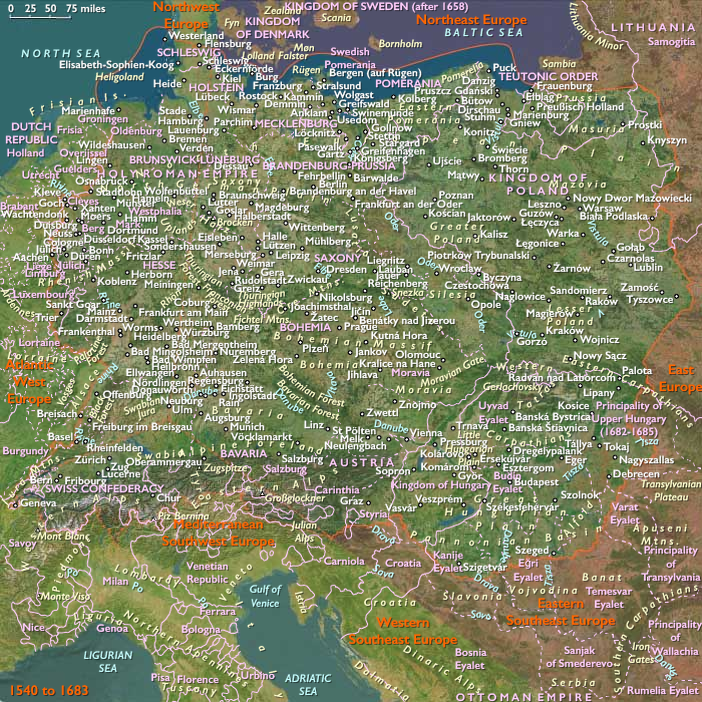
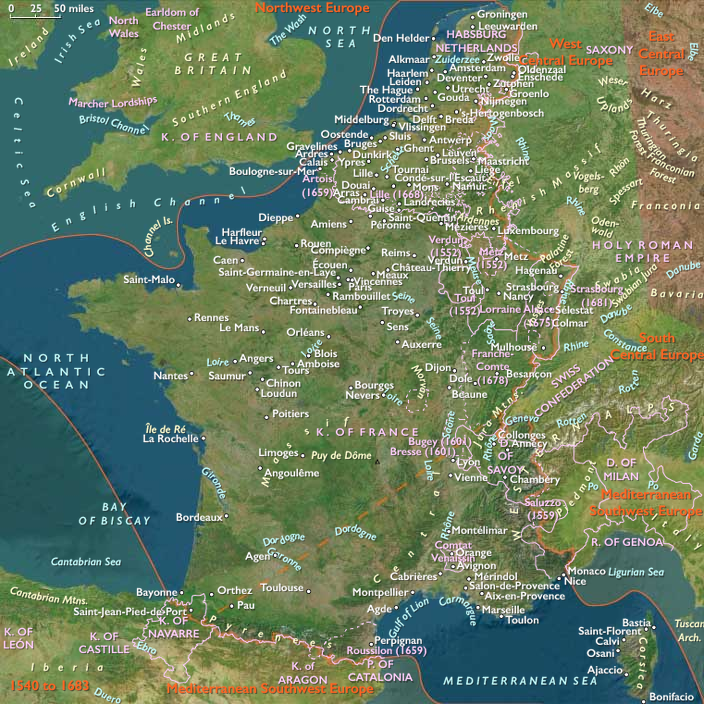
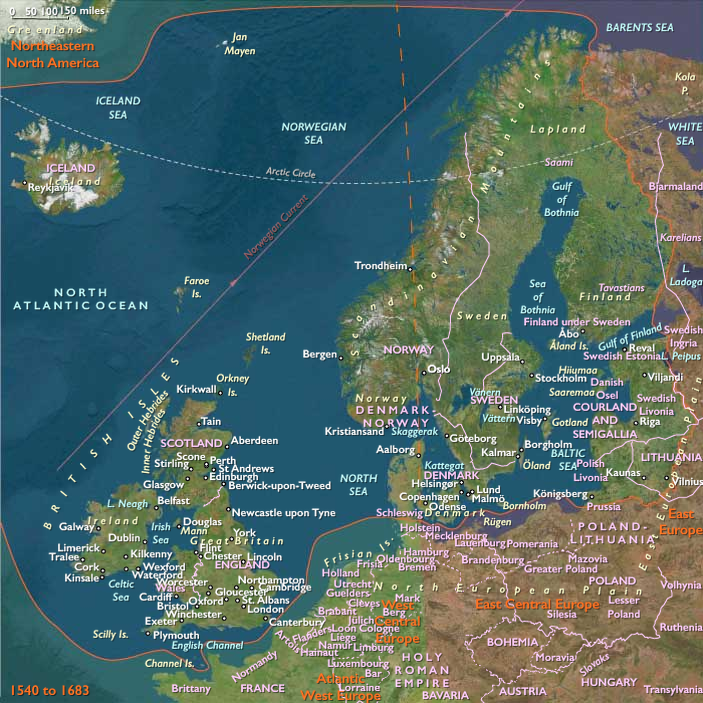
Atlantic West Europe (1540–1551): Religious Tensions, Economic Shifts, and Dynastic Ambitions
From 1540 to 1551, Atlantic West Europe—including northern France, the Low Countries (modern Belgium, the Netherlands, Luxembourg), and coastal territories facing the Atlantic and English Channel—underwent significant shifts marked by intensifying religious conflict, economic expansion driven by global trade, cultural flourishing, and dynastic struggles. This era, immediately following the height of Renaissance humanism, saw the onset of deeper religious divisions and growing centralization of political power, laying the groundwork for future upheavals.
Political and Military Developments
Francis I and Charles V: Dynastic Rivalries
-
France under King Francis I (r. 1515–1547) continued intense rivalry with the Habsburg Emperor Charles V, whose vast dominions included the Low Countries. The Italian Wars (1494–1559) repeatedly embroiled these territories, with intermittent battles and shifting alliances destabilizing the region politically.
-
The fragile Truce of Nice (1538) ended in 1542 as hostilities reignited between Francis and Charles, extending conflict from Italy into northern France and the Low Countries.
-
The resulting war (1542–1546) strained local economies, increased military taxation, and intensified regional alliances, leading to a temporary stalemate settled by the Treaty of Crépy (1544), which confirmed status quo borders but maintained underlying tensions.
Henry II’s Succession and Continued Conflict
-
Following Francis I’s death in 1547, his son, Henry II (r. 1547–1559), pursued aggressive anti-Habsburg policies, further heightening tensions in the Low Countries and along France’s northern borders.
-
Henry II strengthened French defenses, notably fortifying strategic cities and coastal ports like Boulogne and Calais, reinforcing Atlantic West Europe's militarization in anticipation of continued conflicts.
Economic and Maritime Expansion
Rise of Antwerp as Commercial Hub
-
Antwerp rose as Europe's premier commercial and financial center in this period, benefiting from its strategic location and openness to foreign merchants, including Portuguese spice traders and German banking families such as the Fuggers.
-
In 1549, Antwerp hosted the entry of Prince Philip (later Philip II of Spain), symbolically cementing the city's pivotal role within the Habsburg domains. Its bourse (stock exchange) further facilitated growth in banking, trade finance, and commodity markets.
Bordeaux and Maritime Trade Networks
-
Bordeaux’s wine industry thrived during this era, expanding exports of prized clarets to England, the Netherlands, and the Hanseatic cities. Robust maritime trade boosted the city’s economic vitality, reinforcing Atlantic commerce as a pillar of regional prosperity.
-
Coastal ports across Normandy, Brittany, and the Low Countries also intensified maritime commerce, driven by expanding European demand for salted fish, textiles, grain, and luxury goods, further integrating Atlantic West Europe into global trade networks.
Religious and Intellectual Developments
Rise of Protestantism and Early Repression
-
Protestant ideas, particularly Calvinism, spread rapidly through the Low Countries and northern France, driven by growing dissatisfaction with Catholic ecclesiastical authority. Antwerp and Ghent became early Protestant hubs, fostering clandestine communities of reformers.
-
Emperor Charles V intensified anti-Protestant measures during the 1540s, instituting the Edicts of 1540–1550, which sought severe penalties for heresy, including confiscation of property and execution. These edicts heightened regional tensions and foreshadowed deeper religious conflict.
Humanist Scholarship and Cultural Vibrancy
-
Despite religious strife, humanist scholarship thrived. The University of Leuven (Louvain) continued as a leading intellectual center, attracting humanist scholars who navigated carefully between reformist thought and Catholic orthodoxy.
-
In France, humanist culture flourished at royal courts in Paris and Fontainebleau, attracting scholars and artists who balanced classical Renaissance ideals with contemporary religious and political realities.
Cultural and Artistic Flourishing
Late Renaissance and Early Mannerism
-
Artistic and cultural vitality remained pronounced. The School of Fontainebleau, patronized by Francis I and subsequently Henry II, continued to introduce Italian-influenced Mannerist aesthetics into northern European art and architecture.
-
In the Low Countries, artists such as Pieter Bruegel the Elder (active from the early 1550s) prepared to redefine northern painting, though his major works appeared slightly later. Nevertheless, Flemish painting maintained prominence through artists like Frans Floris, who blended Renaissance naturalism with local traditions.
Literature and Language
-
French literary life was invigorated by figures such as the poet Clément Marot (d. 1544), whose innovative poetry and translations of the Psalms into French shaped the language and influenced Protestant communities.
-
Printing presses in Antwerp, Paris, and Lyon published influential religious, scholarly, and literary texts, significantly impacting intellectual life across Atlantic West Europe.
Social Developments and Urban Growth
Urbanization and Merchant Influence
-
Rapid urbanization continued, driven by trade and commerce, especially in cities such as Antwerp, Bordeaux, Bruges, Ghent, and Rouen. Urban merchant elites increasingly shaped local governance, economic policies, and cultural patronage.
-
However, heightened taxation due to prolonged warfare and imperial conflicts led to periodic urban unrest, particularly in cities burdened by Habsburg military requisitions.
Rural Economy and Social Tensions
-
The rural economy saw gradual changes, as larger landholdings increased productivity through improved farming methods, although rural poverty and social disparities persisted. Tensions occasionally erupted into small-scale rural uprisings and resistance to taxation.
Legacy and Significance
The years 1540–1551 marked the outset of critical transformations across Atlantic West Europe. Intense dynastic struggles between France and Habsburg domains, early stages of Protestant-Catholic conflict, and rapid economic expansion profoundly reshaped the region’s political, economic, and social landscape. This era set the stage for heightened religious conflicts, culminating in the brutal Wars of Religion later in the century, while consolidating economic foundations crucial for the subsequent rise of maritime powers and commercial capitalism.
Atlantic West Europe (1552–1563): Intensifying Conflicts, Religious Division, and Economic Dynamism
Between 1552 and 1563, Atlantic West Europe—encompassing northern France, the Low Countries (modern Belgium, Netherlands, Luxembourg), and coastal regions along the Atlantic and English Channel—experienced heightened religious conflicts, dynastic rivalries, and dynamic economic growth. This era saw escalating tensions between Catholic monarchies and Protestant movements, deepening political divisions, significant urban and maritime commercial expansion, and a vibrant cultural milieu shaped by the lingering Renaissance and the dawning of Counter-Reformation.
Political and Military Developments
Renewed Franco-Habsburg Warfare
-
The intense rivalry between France under Henry II (r. 1547–1559) and the Habsburg emperor Charles V resumed fiercely. The continuation of the Italian Wars (1551–1559) spilled over into northern France and the Low Countries, dramatically reshaping political boundaries.
-
French forces successfully captured the strategic bishoprics of Metz, Toul, and Verdun (1552), significantly strengthening France’s eastern frontier against Habsburg power and solidifying Henry II’s military prestige.
-
In 1557, a devastating French defeat at Saint-Quentin (in modern northern France) briefly exposed Paris and spurred urgent military reforms. Nonetheless, the subsequent French victory at Calais (1558), reclaiming the vital port from English control after two centuries, was celebrated as a national triumph, consolidating French territorial sovereignty.
Peace of Cateau-Cambrésis (1559)
-
After prolonged warfare and economic strain, the treaty Peace of Cateau-Cambrésis (1559) ended the Italian Wars, solidifying a tenuous peace between France and Spain (now led by Philip II after Charles V’s abdication in 1556).
-
The treaty reshaped Europe's political order, affirming Spanish Habsburg control over the Low Countries, while France secured important territorial gains, stabilizing its northern and eastern borders.
Economic and Maritime Expansion
Antwerp: Financial and Commercial Apex
-
Antwerp reached the height of its economic prominence, dominating European trade, finance, and commodities markets. Its dynamic bourse attracted merchants, bankers, and speculators from across Europe, facilitating international finance and trade innovations.
-
Merchants and financiers from Antwerp increasingly invested in global maritime enterprises, including Spanish and Portuguese voyages, establishing extensive trade networks linking the Low Countries with Asia, Africa, and the Americas.
Growth of Atlantic Trade and Industry
-
Maritime commerce along the Atlantic coast flourished. French ports, notably Bordeaux, La Rochelle, and Rouen, significantly expanded their overseas trade, exporting wines, textiles, salt, and luxury goods, reinforcing their regional and international economic influence.
-
Bordeaux’s wine industry continued its ascendancy, bolstered by growing demand from English and Dutch markets. The city’s merchants prospered, fueling local urban development and infrastructure investments.
-
Shipbuilding industries along the Norman, Breton, and Flemish coasts thrived, responding to increasing maritime commerce and naval demands, thereby stimulating urban economies in cities such as Saint-Malo, Dunkirk, and Ostend.
Religious and Intellectual Developments
Rise of Calvinism and Religious Tensions
-
Calvinist Protestantism rapidly spread throughout the Low Countries and northern France, gaining support particularly among urban middle classes, artisans, merchants, and local nobility. The Netherlands, especially Antwerp, Ghent, and Brussels, saw increasing Calvinist congregations openly challenging Catholic orthodoxy.
-
Intensified repression followed under Philip II, whose stringent anti-heresy edicts (1550–1560) aimed at suppressing Protestantism provoked widespread resentment, laying seeds for future open rebellion.
-
In France, Calvinist Huguenots gained significant followers, especially among nobility and urban bourgeoisie, setting the stage for the devastating French Wars of Religion (beginning officially in 1562).
Council of Trent and Catholic Counter-Reformation
-
The Catholic Church, alarmed by Protestant gains, responded vigorously through the Council of Trent (1545–1563). The Council reaffirmed Catholic doctrines, implemented ecclesiastical reforms, and intensified efforts against Protestant "heresy."
-
Northern French and Flemish clergy adopted Tridentine reforms, initiating revitalized religious instruction, tightened ecclesiastical discipline, and increased censorship to halt Protestant dissemination.
Cultural and Artistic Flourishing
Mannerism and Artistic Innovation
-
Artistic production flourished despite turbulent political and religious contexts. French court patronage, notably under Henry II and his queen, Catherine de' Medici, supported refined artistic developments at the Château de Fontainebleau, where the elaborate School of Fontainebleau evolved a distinct French Mannerist style blending Italian sophistication with northern aesthetics.
-
In the Low Countries, painters such as Pieter Bruegel the Elder emerged prominently during this era, introducing vivid depictions of everyday life, landscapes, and allegories, subtly reflecting social and religious tensions within northern society.
Humanist Scholarship and Print Culture
-
The humanist tradition continued robustly, supported by active printing centers in Antwerp, Paris, and Leuven, disseminating influential theological, literary, and philosophical works widely across Europe.
-
Influential humanist scholars, notably in Leuven and Paris, navigated increasing religious restrictions, maintaining intellectual exchange while carefully avoiding direct confrontation with ecclesiastical authorities.
Social Developments and Urban Dynamics
Urban Prosperity and Merchant Influence
-
Urban centers across Atlantic West Europe experienced remarkable growth. Antwerp’s commercial dominance attracted European merchants, bankers, and artisans, making it one of the continent's most cosmopolitan cities.
-
Increased urban wealth allowed merchant elites in cities like Antwerp, Bruges, Bordeaux, and Rouen to exert greater influence over municipal governments, shaping economic policies and regional politics.
Social Tensions and Rural Poverty
-
Prosperity remained unevenly distributed, deepening rural poverty and social disparities. Heightened taxation from prolonged warfare, rising food prices, and religious tensions fueled periodic unrest among peasants and urban poor, occasionally erupting into localized revolts.
Legacy and Significance
The era from 1552 to 1563 proved pivotal for Atlantic West Europe, profoundly shaping the region’s political, religious, and economic trajectories. Dynastic warfare solidified territorial boundaries that endured into modernity. Religious divisions intensified, foreshadowing prolonged conflicts of the later 16th century. Meanwhile, economic growth and maritime trade expanded rapidly, reinforcing the region’s role as a dynamic center of commercial capitalism and global connectivity. Cultural vibrancy persisted despite adversity, marking the continued flourishing of Renaissance humanism and artistic creativity, even amidst intensifying religious and social tensions.
Pieter Bruegel the Elder was born in about 1525 in Breda, Netherlands, but it is uncertain whether the Dutch town of Breda or the Belgian town of Bree, called Breda in Latin, is meant.
He was an apprentice of Pieter Coecke van Aelst, whose daughter Mayken he later married.
He had spent some time in France and Italy, and then gone to Antwerp, where in 1551 he had been accepted as a master in the painter's guild; traveling to Italy soon after, he then returned to Antwerp.
He paints in 1558 a Landscape with the Fall of Icarus, which is to become the subject of the poem "Musée des Beaux Arts" by W.H. Auden.
Proverbs are popular during Bruegel's time, during which a number of collections are published, including a famous work by Erasmus.
Rabelais in 1553 depicted a land of proverbs in his novel Pantagruel.
Frans Hogenberg had produced an engraving illustrating about forty proverbs in around 1558 and Bruegel himself had painted a collection of Twelve Proverbs on individual panels by 1558; he had also produced Big Fish Eat Little Fish in 1556, but his Netherlandish Proverbs in 1559 is thought to be the first large scale painting on the theme.
Bruegel's paintings feature themes of the absurdity, wickedness, and foolishness of mankind, and this painting is no exception.
The picture's original title, The Blue Cloak or The Folly of the World, indicates he was not intending to produce a mere collection of proverbs but rather a study of human stupidity.
Depicting a land populated with literal renditions of Flemish proverbs of the day, the picture, is overflowing with references and most of the representations can still be identified; while many of the proverbs have either been forgotten or never made the transition to the English language, some are still in use.
Many of the people depicted show the characteristic blank features that Bruegel uses to portray fools.His son, Pieter Brueghel the Younger, will specialize in making copies of his father's work, and paint up to twenty copies of Netherlandish Proverbs.
Not all versions of the painting, by father or son, show exactly the same proverbs, also differing in other details.
Breugel's The Triumph of Death, strongly influenced by the style of Hieronymus Bosch, is a panoramic landscape of death: the sky in the distance is blackened by smoke from burning cities and the sea is littered with shipwrecks.
Armies of skeletons advance on the hapless living, who either flee in terror or try vainly to fight back.
Skeletons kill people in a variety of ways: slitting throats, hanging, drowning, and even hunting with skeletal dogs.
In the foreground, skeletons haul a wagon full of skulls, and ring the bell that signifies the death knell of the world.
A fool plays the lute while a skeleton behind him plays along; a starving dog nibbles at the face of a child; a cross sits lonely and impotent in the center of the painting.
People are herded into a trap decorated with crosses, while a skeleton on horseback slaughters people with a scythe.
The painting depicts people of different social backgrounds -- from peasants and soldiers to nobles and even a king and a cardinal -- being taken by death indiscriminately.
The painting shows aspects of everyday European life in the mid-sixteenth century.
Clothes are clearly depicted, as are pastimes such as playing cards.
It shows a common method of execution for sixteenth-century criminals: being lashed to a cartwheel mounted on a vertical pole and objects such as musical instruments and an early mechanical clock, and scenes including a funeral service.
Breugel, despite the influence of his post-apprenticeship travels in Italy, continues to paint in a manner that is strongly Northern in both subject and style.
A multiplicity of small elements, an overall composition, and a bird's-eye perspective characterizes his works of this period, exemplified by his Netherlandish Proverbs, painted in 1559, a typically satiric rendering of human folly and sinfulness.
Children's Games, a famous painting executed in 1560 by Bruegel, depicts children playing with a number of toys (most of them still used today in almost identical forms).
A religious painting, the Suicide of Saul, painted by Bruegel in 1562 when he is thirty-eight, exemplifies the change that begins to take place in his style, and shows the Flemish artist’s practice of depicting religious subjects as contemporary events.
His compositions become increasingly concentrated and are often organized along diagonals; the main action is more frequently presented at eye level.
Patronized, by Cardinal Antoine Perrenot de Granville, advisor to Philip II, Breugel moves in about 1563 from Antwerp to …
…Brussels, the seat of the Spanish government in the Netherlands.
(Brueghel’s political convictions and religious beliefs remain unknown, although scholars will later interpret his paintings as disguised criticism of the harsh Spanish control of the Netherlands.)
Frans Floris applies his characteristic Romanist Mannerist style to a Last Judgment in 1565.
The boldness and force of the Flemish painter's works reflect the monumental style of their Italian models.
Their technical execution reveals a rapid hand, bright coloring, and a mastery of anatomy not always evident in Netherlandish art of the time.
Floris owes much of his repute to the cleverness with which his works are transferred to copper by Jerome Cock, Cornelis Cort, and Theodor Galle.
Pieter Breugel the Elder executes several paintings in 1565, including The Months, a cycle of probably 6 paintings of the months or seasons, of which five remain:
* The Hunters in the Snow (Dec.-Jan.), 1565, Kunsthistorisches Museum, Vienna
* The Gloomy Day (Feb.-Ma.), 1565, Kunsthistorisches Museum, Vienna
* The Hay Harvest (June–July), 1565, Lobkowicz Palace at the Prague Castle Complex, Czech Republic
* The Harvesters (Aug.-Sept.), 1565, Metropolitan Museum of Art, New York
* The Return of the Herd (Oct.-Nov.), 1565, Kunsthistorisches Museum, Vienna
Breugel’s winter landscapes of 1565 (e.g., Hunters in the Snow, are taken as corroborative evidence of the severity of winters during the Little Ice Age.
Hunters in the Snow displays the influence of his Alpine crossings on his artistic imagination, placing tall mountains in his panoramic background while depicting a typical Netherlandish setting and subject in the center and foreground.
Breugel paints a Massacre of the Innocents around 1566-67, setting the New Testament episode in contemporary village setting in winter.
The Peasant Wedding, a 1567 or 1568 painting by Brueghel the Elder, is one of his many depicting peasant life.
It is currently housed in the Kunsthistorisches Museum, Vienna.
The bride is under the canopy, and the groom is uncertain, but may be the man in black, to the left of the largest figure, leaning back, with a mug in hand.
Two pipers play the pijpzak (a type of two-droned Flemish bagpipe), and an unbreeched boy in the foreground licks a plate.
The feast is in a barn; two ears of corn with a rake reminding us of the work that harvesting involves, and the hard lot peasants have.
The plates are carried on a door off its hinges.
The main food is bread, porridge and soup.