Pocahontas
Virginia Indian chief's daughter
Years: 1595 - 1617
Pocahontas (c.1595 – March 21, 1617) is a Virginia Indian chief's daughter notable for having assisted colonial settlers at Jamestown.
She converts to Christianity and marries the English settler John Rolfe.
After they travel to London, she becomes famous in the last year of her life.
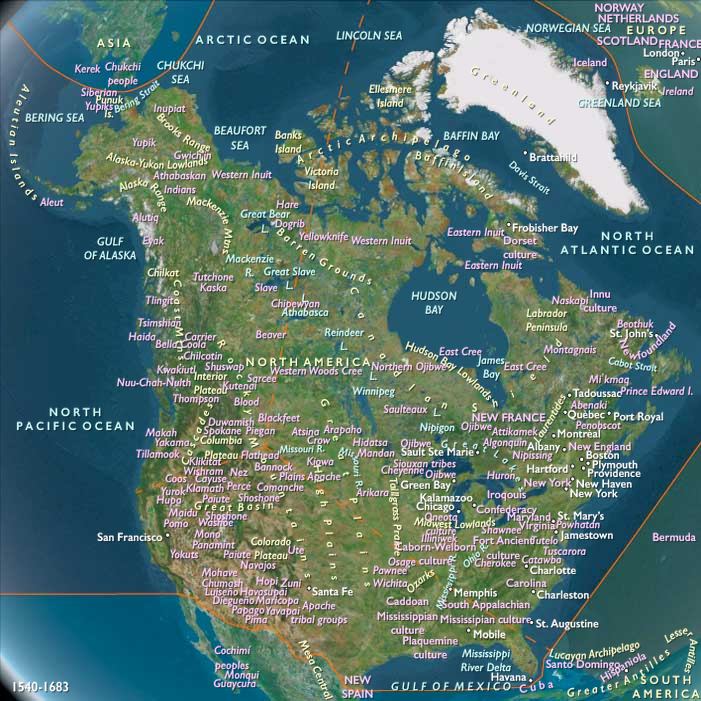
She is a daughter of Wahunsunacawh, better known as Chief or Emperor Powhatan (to indicate his primacy), who heads a network of tributary tribal nations in the Tidewater region of Virginia (called Tenakomakah by the Powhatan).
These tribes make up what is known as the Powhatan Chiefdom and speak a language of the Algonquian family.
Related Events
Filter results
Showing 8 events out of 8 total
Captain John Smith is constantly seeking a supply of food for the colonists, and, using the Discovery, the smallest of the three ships which had been left behind for their use, he successfully trades for food with the Nansemonds, who are located along the Nansemond River in the modern-day City of Suffolk, and several other groups.
With the coming arrival of the new supply fleet, Captain Smith feels the colony is sufficiently reinforced to engage the Powhatan directly with a diplomatic initiative aimed at securing at least a temporary respite from native sniping, kidnapping, and assaulting.
Taking a small escort, they make their way through a attacks to the capital of the Powhatan Confederacy.
While leading the expedition in December 1607 up the Chickahominy River west of Jamestown, his men are set upon by Powhatans.
As his party is being slaughtered around him, Smith straps his native guide in front of him as a shield and escapes with his life but is captured by Opechancanough, the Powhatan chief's half-brother.
Smith gives him a compass which pleases the warrior and makes him decide to let Smith live.
Smith is taken before Wahunsunacock, who is commonly referred to as Chief Powhatan, at the Powhatan Confederacy's seat of government at Werowocomoco on the York River.
However, seventeen years later, in 1624, Smith will first relate that when the chief decided to execute him, this course of action had been stopped by the pleas of Chief Powhatan's young daughter, Pocahontas, who was originally named Matoaka but whose nickname meant "Playful One."
Many historians today find this account dubious, especially as it was omitted in all his previous versions.
The life of Chief Powhatan's young daughter, Pocahontas, will be largely tied to the English after legend credits her with saving John Smith's life after his capture by Opechancanough, but her contacts with Smith himself are minimal.
Records indicate that she has become something of an emissary to the colonists at Jamestown Island.
During their first winter, Pocahontas brings food and clothing to the colonists.
She later negotiates with Smith for the release of Virginia natives who had been captured by the colonists during a raid to gain English weaponry.
The trade soon proves to Chief Powhatan the weakness of the English colony.
John Rolfe, who has left a wife and child buried in Bermuda, is among the survivors of the Sea Venture, who finally arrive to Jamestown on May 23, 1610.
Here, Rolfe will marry Chief Powhatan’s daughter Pocahontas.
The new arrivals, led by Gates (the new governor) and George Somers, had assumed they would find a thriving colony in Virginia.
Instead, they find the colony in ruins and practically abandoned.
Of the five hundred colonists living in Jamestown in the autumn, they find less than one hundred survivors with many of these sick or dying.
Worse yet, many supplies intended for Jamestown had been lost in the shipwreck at Bermuda, and Gates and Somers have brought along with them only a small food supply.
Bermuda, discovered in 1503 by Spanish explorer Juan de Bermúdez, is mentioned in Legatio Babylonica, published in 1511 by Peter Martyr d'Anghiera, and had also been included on Spanish charts of that year.
Both Spanish and Portuguese ships have used the islands as a replenishment spot for fresh meat and water, but legends of spirits and devils, now thought to have stemmed only from the callings of raucous birds (most likely the Bermuda Petrel, or Cahow), and of perpetual, storm-wracked conditions (most early visitors arrived under such conditions), have kept them from attempting any permanent settlement on the Isle of Devils.
Bermúdez and Gonzalo Fernández de Oviedo had ventured to Bermuda in 1515 with the intention of leaving a breeding stock of hogs on the island as a future stock of fresh meat for passing ships.
However, the inclement weather had prevented them from landing.
Some years later, a Portuguese ship on the way home from San Domingo had wedged itself between two rocks on the reef.
The crew had tried to salvage as much as they could and spent the next four months building a new hull from Bermuda cedar to return to their initial departure point.
One of these stranded sailors is most likely the person who carved the initials "R" and "P", "1543" into Spanish Rock which still sits at "Spittal Pond".
The initials probably stood for "Rex Portugalia" and later were incorrectly attributed to the Spanish, leading to the misnaming of this rocky outcrop of Bermuda.
For the next several decades, the island is believed to have been visited frequently but not permanently settled.
The first two British colonies in Virginia having failed, a more determined effort is initiated by King James I of England, who grants a Royal Charter to The Virginia Company.
A flotilla of ships had left England in 1609 under the Company's Admiral, Sir George Somers, to relieve the colony of Jamestown, settled two years before.
Somers had had previous experience sailing with both Sir Francis Drake and Sir Walter Raleigh.
The flotilla had been broken up by a storm, and the flagship, the Sea Venture, wrecked off Bermuda (as depicted on the territory's coat of arms), leaving the survivors in possession of a new territory.
(William Shakespeare's play The Tempest is thought to have been inspired by William Strachey's account of this shipwreck.)
The island had been claimed for the English Crown, and the charter of the Virginia Company was extended to include it.
Most of the survivors of the Sea Venture had carried on to Jamestown in 1610 aboard two Bermuda-built ships.
Among them was John Rolfe, who left a wife and child buried in Bermuda, but in Jamestown would marry Pocahontas, a daughter of Chief Powhatan.
Intentional settlement of Bermuda begins with the arrival of the Plough, in 1612.
St. George's, settled in this year and made Bermuda's first capital, is today the oldest continually inhabited English town in the Western Hemisphere.

Pocahontas, a daughter of Wahunsunacock (also known as Chief or Emperor Powhatan), who rules an area encompassing almost all of the neighboring tribes in the Tidewater region of Virginia (called Tenakomakah at this time), is residing in March 1613 at Passapatanzy, a village of the Patawomecks, a Native American tribe that does some trading with Powhatans.
They live in present-day Stafford County on the Potomac River near Fredericksburg, about sixty-five miles (one hundred and five kilometers) from Werowocomoco, her home town.
John Smith writes in his Generall Historie she had been in the care of the Patawomec chief, Japazaws (or Japazeus), since 1611 or 1612.
According to William Strachey, Pocahontas married a Powhatan warrior called Kocoum at some point before 1612; nothing more is known about this marriage.
When two English colonists began trading with the Patawomec, they had discovered Pocahontas' presence.
With the help of Japazaws, they trick Pocahontas into captivity.
Their purpose, as they soon explain in a letter, is to ransom her for some English prisoners held by Chief Powhatan, along with various weapons and tools the Powhatans had stolen.
Powhatan returns the prisoners, but fails to satisfy the colonists with the amount of weapons and tools he returns, and a long standoff ensues.
Samuel Argall brings the captured Pocahontas to Jamestown, where, in June, John Rolfe makes the first shipment of West Indian tobacco grown in Virginia to England.
Soon, Rolfe and others are exporting substantial quantities of the new cash crop, and new plantations begin growing along the James River, where export shipments can use wharfs along the river.
Pocahontas has meanwhile been kept at Henricus.
Little is known about her life here during the yearlong wait, although colonist Ralph Hamor wrote she received "extraordinary courteous usage."
An English minister, Alexander Whitaker, teaches her about Christianity and helps to improve her English.
After she is baptized, her name is changed to Rebecca.
The standoff builds in March 1614 to a violent confrontation between hundreds of English and Powhatan men on the Pamunkey River.
At the Powhatan town of Matchcot, the English encounter a group that includes some of the senior Powhatan leaders (but not Chief Powhatan himself, who is away).
The English permit Pocahontas to talk to her countrymen; however, according to the deputy governor, Thomas Dale, Pocahontas rebukes her absent father for valuing her "less than old swords, pieces, or axes" and tells them she prefers to live with the English.
During her stay in Henricus, Pocahontas has met the widowed John Rolfe, who has fallen in love with her.
A pious man who agonizes over the potential moral repercussions of marrying a heathen, he writes a long letter to the governor requesting permission to wed her, expressing both his love for her and his belief he would be saving her soul.
They are married on April 5, 1614 and Pocahontas is christened Lady Rebecca.
Pocahontas's feelings about Rolfe and the marriage are unknown.
Their child, Thomas Rolfe, will be born on January 30, 1615.
Their marriage is unsuccessful in winning the English captives back, but it does create a climate of peace between the Jamestown colonists and Powhatan's tribes for the next several years.
Pocahontas (now called Rebecca) arrives in England, with her husband, John Rolfe, their baby son, Thomas Rolfe, her sister Matachanna and brother-in-law "Tomocomo" (the shaman Uttmatomakkin).
The Virginia Colony's sponsors, finding it difficult to lure new colonists and investors to Jamestown, use Pocahontas as an enticement and as evidence to persuade people in Europe the New World's natives can be tamed, and the colony made safe.
Ten Powhatan Indians are brought by Sir Thomas Dale, the colonial governor, at the request of the Virginia Company, as a fund-raising stunt.
Dale, having been recalled under criticism, writes A True Relation of the State of Virginia, Left by Sir Thomas Dale, Knight, in May last, 1616 in a successful effort to redeem his leadership.
Neither Pocahontas or Dale will see Virginia again.
John Smith is living in London at the time and, while Pocahontas is in Plymouth, she learns he is still alive.
Smith does not meet Pocahontas at this point but, he writes a letter to Queen Anne urging Pocahontas be treated with respect as a royal visitor, because if she were treated badly, her "present love to us and Christianity might turn to… scorn and fury", and England might lose the chance to "rightly have a Kingdom by her means".