
Pope Leo IX
head of the Catholic Church
1002 CE to 1054 CE
Pope Leo IX (June 21, 1002 – April 19, 1054), born Bruno of Egisheim-Dagsburg, is head of the Catholic Church from 12 February 1049 to his death in 1054.
He was a German aristocrat and a powerful secular ruler of central Italy while holding the papacy.
He is regarded as a saint by the Roman Catholic Church, his feast day celebrated on 19 April.
Leo IX is widely considered the most historically significant German Pope of the Middle Ages.
His citing of the Donation of Constantine in a letter to the Patriarch of Constantinople brings about the Great Schism between the Catholic and Orthodox churches.
World
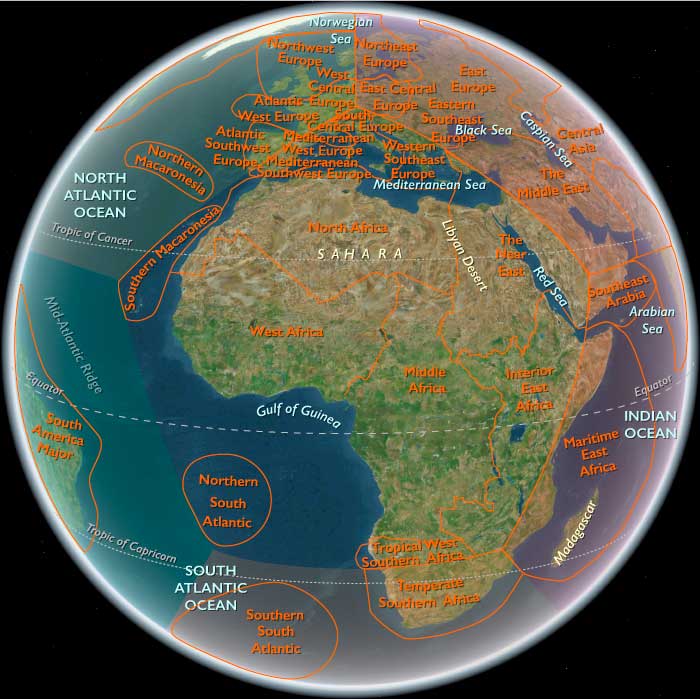
The Middle of The Earth
View →Related Events
Showing 10 events out of 29 total
Emperor Henry III, presiding over his empire from his castle at Goslar in Germany, has overawed the restive Saxon nobles and, through war and diplomacy, has induced the rulers of Poland, Bohemia, and Hungary to do homage.
He enlists reformers from Cluny, Peter Damian, and other churchmen to serve him as councilors and friends.
In an attempt to restrict private warfare, Henry has promulgated the Peace of God.
He has also endowed monasteries, and has participated in reformist councils, as well as retaining traditional controls over ecclesiastics and their institutions.
Henry has given Bavaria to one Cuno (Conrad) and, at Ulm in January 1048, Swabia to Otto of Schweinfurt, called the White, after a brief vacancy following the death of Otto II.
Henry meets Henry of France, probably at Ivois again, in October and at Christmas, envoys from Rome come to seek a new pope, Damasus having died.
Henry's most enduring papal selection is Bruno of Toul, who takes office as Leo IX, and under whom the Church will be divided between East and West.
Henry's final appointment of this long spate is a successor to Adalbert in Lorraine.
For this, he appoints the young Gerard of Chatenoy, a relative of Adalbert and Henry himself.
Pandulf IV, once again prince of Capua, is at war with Guaimar IV of Salerno in 1048.
On the death in this year of Rainulf II of Aversa (Rainulf Trincanocte), his succeeding son Herman, an infant, requires a regent.
The first appointment, Bellebouche, is a failure.
Richard Drengot, a cousin of Herman's, is at this time in a Melfitan prison for making war on Drogo.
Guaimar soon procures his release and personally brings him to Aversa, where he is installed as regent, and later as count in his own right.
Thus, Guaimar recaptures the allegiance of Aversa.
Bruno of Egisheim-Dagsburg, a native of Eguisheim, Upper Alsace, was born into family was of noble rank, and his father, Count Hugh, was a cousin of Emperor Conrad II (1024–1039).
He had been educated at Toul, where he had successively become canon and, in 1026, bishop.
In the latter capacity, he had rendered important political services to his relative Conrad II, and afterwards to Emperor Henry III.
He has become widely known as an earnest and reforming ecclesiastic by the zeal he showed in spreading the rule of the order of Cluny.
On the death of Pope Damasus II in 1048, Bruno had been selected as his successor by an assembly at Worms in December.
Both the Emperor and the Roman delegates had concurred.
However, Bruno apparently favored a canonical election and stipulated as a condition of his acceptance that he should first proceed to Rome and be freely elected by the voice of the clergy and people of Rome.
Setting out shortly after Christmas, he meets with abbot Hugh of Cluny at Besançon, where he is joined by the young tuscan Benedictine monk Ildebrando, or Hildebrand, the future Pope Gregory VII.
Arriving in pilgrim garb at Rome in the following February, he is received with much cordiality, and at his consecration assumed the name Leo IX.
With Leo IX’s appointment to the papacy, the movement of church reform, which had been gathering momentum in Burgundy and Lorraine, finally comes to Rome.
Leo has brought several reform-minded churchman to Rome, including Ildebrando, who, together with the diplomat and reformer Humbert of Silva Candida, and the Benedictine reformer Peter Damian, assist the new pope in his extensive reform program.
Leo IX favored traditional morality in his reformation of the Catholic Church.
One of his first public acts is to hold the well-known Easter synod of 1049, at which celibacy of the clergy (down to the rank of subdeacon) is required anew.
Also, the Easter synod is where the Pope at least succeeds in making clear his own convictions against every kind of simony.
Benedict IX refuses to appear on charges of simony in 1049 and is excommunicated.
The Campaigns of 1049: A Year of Triumph for Emperor Henry III
The year 1049 marked a turning point in Emperor Henry III’s reign, as he secured a series of military and political victories that strengthened imperial authority. One of his most significant triumphs was the defeat and death of Dirk IV of Holland, one of his most persistent adversaries in the Low Countries.
The Death of Dirk IV of Holland
- Dirk IV of Holland had been a major rebel against imperial rule, frequently raiding imperial territories and attacking pro-imperial bishops such as the Bishop of Utrecht.
- After Henry III’s earlier defeat at Flushing in 1047, Dirk had continued to challenge imperial authority, leading another round of rebellions.
- In 1049, Henry’s forces confronted Dirk, decisively defeating him in battle.
- Dirk IV was killed during the engagement, marking the end of his resistance and restoring imperial dominance over Holland.
Other Successes in 1049
- With Dirk IV eliminated, Henry III secured greater control over the Low Countries, reducing the threat of further insurrections from rebellious lords.
- The emperor continued his policy of appointing loyal bishops to key territories, further consolidating imperial governance in the region.
- These victories weakened the anti-imperial coalition, leaving Baldwin of Flanders and Godfrey the Bearded as the only major remaining threats to imperial rule in Lotharingia.
Significance and Impact
- Dirk IV’s death removed a key figure in the anti-imperial resistance, allowing Henry to refocus his attention on consolidating power elsewhere.
- The year 1049 cemented Henry’s military supremacy, proving his ability to crush rebellious vassals and enforce imperial rule.
- These victories paved the way for continued imperial authority in the Low Countries, reducing the number of major threats to Henry’s reign.
The death of Dirk IV was a decisive imperial victory, marking 1049 as a year of triumph for Henry III, as he continued to expand and reinforce the power of the Holy Roman Empire.
Imperial and Anglo-Danish Campaign Against Baldwin V of Flanders (1049)
In 1049, Emperor Henry III launched a naval offensive against Baldwin V of Flanders, one of his most persistent adversaries in the Low Countries. This imperial harassment by sea was strategically coordinated with King Edward the Confessor of England and King Sweyn II of Denmark, both of whom had personal grievances against Baldwin, as he had harbored their enemies.
The Strategic Alliance Against Baldwin V
- Henry III sought to weaken Baldwin V, who had been a key supporter of the Lotharingian rebels, particularly Godfrey the Bearded.
- Baldwin had previously given refuge to several exiles, including enemies of King Edward the Confessor of England and Sweyn II of Denmark.
- In retaliation, Sweyn and Edward joined Henry III, lending naval support to an imperial fleet that harassed Flemish ports and coastal settlements.
Naval and Military Actions
- The imperial fleet, supported by Anglo-Danish ships, conducted raids along the Flemish coast, disrupting Baldwin’s economic and military networks.
- Key trading ports were blockaded or attacked, cutting Baldwin off from maritime resources and trade routes.
- This multi-pronged assault forced Baldwin to defend both land and sea, stretching his military resources thin.
Consequences and Impact
- The naval attacks destabilized Baldwin’s hold on coastal Flanders, undermining his ability to support further rebellions against imperial rule.
- By aligning with England and Denmark, Henry III isolated Baldwin diplomatically, reducing his potential allies in the region.
- The campaign forced Baldwin to shift to a defensive posture, limiting his ability to engage in further hostilities against the empire.
Legacy
- This coordinated imperial, English, and Danish offensive marked a rare instance of international military cooperation against a rebellious vassal.
- The campaign demonstrated Henry III’s strategic reach, as he successfully leveraged naval power to suppress an inland rebellion.
- Although Baldwin V remained a formidable figure, his role as an anti-imperial leader was significantly weakened, setting the stage for further imperial consolidation in the Low Countries.
By harassing Baldwin V at sea, Henry III demonstrated his ability to project power beyond the empire’s borders, reinforcing his dominance in Lotharingia and further disrupting the rebel coalition that had long opposed him.
The End of War in the Low Countries and Lotharingia: A Fragile Peace (1050)
By 1050, after years of rebellion, military campaigns, and shifting alliances, war in the Low Countries and the Lorraines finally came to an end. Emperor Henry III had successfully subdued his rebellious vassals, including Godfrey the Bearded, Baldwin V of Flanders, and Dirk IV of Holland (who had been killed in battle in 1049). The result was a hard-won but fragile peace, which allowed imperial authority to stabilize in the region.
Key Factors Leading to Peace
-
The Death of Dirk IV of Holland (1049)
- Dirk IV had been a major instigator of rebellion, raiding imperial lands and attacking the Bishopric of Utrecht.
- His defeat and death in 1049 removed a key anti-imperial leader, reducing the number of active rebel factions.
-
Naval Attacks on Baldwin V of Flanders
- Henry III, along with Sweyn II of Denmark and King Edward the Confessor of England, had launched a series of naval raids against Baldwin.
- These attacks weakened Flanders’ ability to continue supporting rebellion, forcing Baldwin into a defensive position.
-
Godfrey the Bearded’s Submission
- Godfrey the Bearded, after years of leading the Lotharingian rebellion, had finally been reconciled with Henry III and restored to imperial favor.
- This move removed the main leader of resistance in Lotharingia, signaling the end of large-scale conflict.
-
Diplomatic and Ecclesiastical Appointments
- Henry III had strategically appointed loyal bishops in Metz, Verdun, and Utrecht, ensuring that imperial authority was reinforced through Church leadership.
- The division of Lorraine into Upper and Lower duchies under separate rulers loyal to the emperorreduced regional instability.
The Aftermath: A Stabilized But Watchful Empire
- Imperial authority was now firmly established, but Henry III remained watchful over the Low Countries and Lotharingia, as tensions could easily resurface.
- Baldwin V of Flanders remained a powerful figure, though now more cautious in his defiance of the emperor.
- Normandy and France were beginning to rise in influence, and Henry III would soon shift his diplomatic and military focus to broader European affairs.
Conclusion: A Period of Fragile Stability
The cessation of war in the Low Countries and Lorraine marked a significant triumph for Henry III, whose military and diplomatic efforts had finally quelled resistance. However, the peace was not absolute, as power struggles among the nobility and territorial ambitions of neighboring rulers continued to simmer beneath the surface.
For now, however, the empire enjoyed a much-needed respite, allowing Henry III to turn his attention to other matters of imperial governance and European diplomacy.
Adalbert of Bremen manages a peace with Bernard of Saxony and negotiates a treaty with the missionary monarch Sweyn II of Denmark.
The pope, at Cologne, excommunicates Godfrey, in revolt again, and Baldwin.
The former abandon his allies and is imprisoned by the emperor yet again.
Baldwin, too, gives in under the pressure of Henry's ravages.
Pope Leo IX had occupied the greater part of 1049 in one of those progresses through Italy, Germany and France that form a marked feature in his pontificate.
After presiding over a synod at Pavia, he had joined Henry III in Saxony and accompanied him to Cologne and Aachen.
He had also summoned a meeting of the higher clergy in Reims in which several important reforming decrees were passed.
At Mainz, he had held a council at which the Italian and French as well as the German clergy were represented, and ambassadors of the Greek emperor were present.
Here too, simony and the marriage of the clergy had been the principal matters dealt with.
After Leo’s return to Rome, he holds another Easter synod on April 29, 1050.
It is occupied largely with the controversy about the teachings of Berengar of Tours.
In the same year, he presides over provincial synods at Salerno, Siponto and Vercelli, and in September revisits his native Germany.