Pope Pius VI
head of the Catholic Church
1717 CE to 1799 CE
Pope Pius VI (25 December, 1717 – 29 August, 1799), born Count Giovanni Angelo Braschi, Pope from 1775 to 1799, was born at Cesena.
World
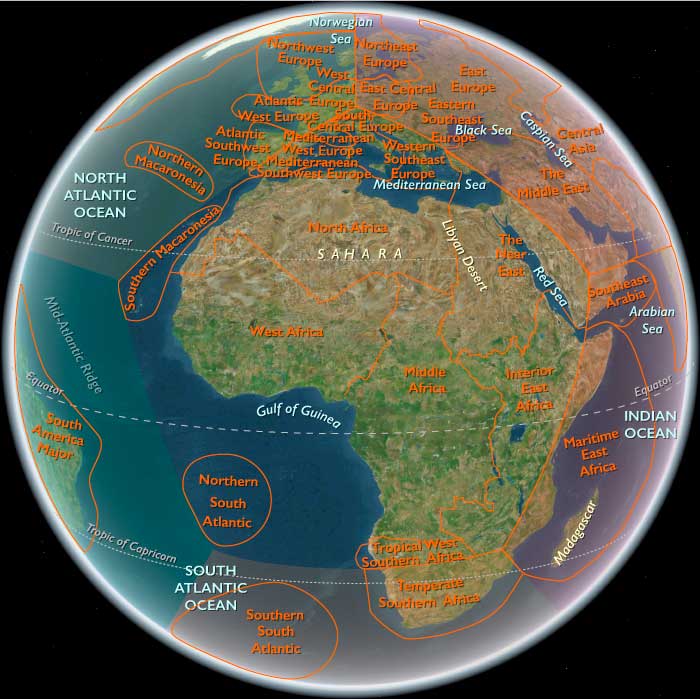
The Middle of The Earth
View →Related Events
Showing 10 events out of 17 total
Spain, France and Portugal drop all objections to the election of Giovanni Angelo Braschi, who is one of the more moderate opponents of the anti-Jesuit stance of the late pope.
Braschi was born in Cesena on Christmas in 1717 as the eldest of eight children to Count Marco Aurelio Tommaso Braschi and Ana Teresa Bandi.
His siblings are Felice Silvestro, Giulia Francesca, Cornelio Francesco, Maria Olimpia, Anna Maria Costanza, Giuseppe Luigi and Maria Lucia Margherita.
He was baptized in Cesena on the following December 27 and was given the baptismal name of Angelo Onofrio Melchiorre Natale Giovanni Antonio.
After he completed his studies in the Jesuit college of Cesena and receiving his doctorate of both canon and civil law in 1734, Braschi continued his studies at the University of Ferrara.
It was there that he became the private secretary of Cardinal Tommaso Ruffo, papal legate, in whose bishopric of Ostia and Velletri he held the post of auditor until 1753.
Cardinal Ruffo took him as his conclavist at the 1740 papal conclave and when the latter became the Dean of the Sacred College of Cardinals in 1740, Braschi was appointed as his auditor.
His skill in the conduct of a mission to the court of Naples won him the esteem of Pope Benedict XIV who appointed him as one of his secretaries in 1753 following the death of Cardinal Ruffo.
The pope also appointed him as a canon of St Peter's Basilica in 1755.
In 1758, putting an end to an engagement to be married he was ordained to the priesthood.
Braschi was also appointed as the Referendary of the Apostolic Signatura in 1758 and held that position until 1759.
He also became the auditor and secretary of Cardinal Carlo Rezzonico, the nephew of Pope Clement XIII. In 1766, he was appointed as the treasurer of the camera apostolica by Pope Clement XIII.
Those who suffered under his conscientious economics had managed to convince Pope Clement XIV to elevate him into the cardinalate.
Braschi had been elevated on April 26, 1773, in Rome as the Cardinal-Priest of Sant'Onofrio.
This was a promotion which rendered him innocuous for a brief period of time.
Braschi receives support from those who dislike the Jesuits and are of the belief he will continue the actions of Clement XIV and hold true to his brief Dominus ac Redemptor (1773) which had seen the dissolution of the order, but the zelanti faction—pro-Jesuit—believes that he is in secret sympathetic towards the Jesuits and expects reparation for the wrongs suffered in the previous reign.
As a result, Braschi—as pope—will be led into situations in which he gives little satisfaction to either side: it is perhaps due to him the Jesuits have managed to escape dissolution in White Russia and Silesia.
He is consecrated into the episcopate on February 22, 1775, by Cardinal Gian Francesco Albani and is crowned that same day by the Cardinal Protodeacon Alessandro Albani.
Pius VI first opens a jubilee his predecessor had convoked and it initiates the 1775 Jubilee Year.
The new pope elevates Romualdo Braschi-Onesti as the penultimate cardinal-nephew.
The earlier acts of Pius VI give fair promise of reformist rule and tackle the problem of corruption in the Papal States.
Though he is usually benevolent, Pius VI sometimes shows discrimination.
He had appointed his uncle Giovanni Carlo Bandi as Bishop of Imola in 1752, then as a member of the Roman Curia, cardinal in the consistory on May 29, 1775, but does not proffer any other members of his family.
He reprimands prince Potenziani, the governor of Rome, for failing to adequately deal with corruption in the city, appoints a council of cardinals to remedy the state of the finances and relieve the pressure of imposts, calls to account Nicolò Bischi for the spending of funds intended for the purchase of grain, reduces the annual disbursements by denying pensions to many prominent people, and adopts a reward system to encourage agriculture.
Johann Nikolaus von Hontheim, writing under the pseudonym of "Febronius", the chief German literary exponent of Gallican ideas of national Catholic Churches, is himself induced (not without scandal) publicly to retract his positions; but they are adopted in Austria nevertheless.
Johann Nikolaus von Hontheim, writing under the pseudonym of "Febronius", the chief German literary exponent of Gallican ideas of national Catholic Churches, had himself been induced (not without scandal) publicly to retract his positions; but they are adopted in Austria nevertheless.
Here the social and ecclesiastical reforms in the spirit of the Enlightenment which have been undertaken by Emperor Joseph II and his minister Kaunitz touch the supremacy of Rome so nearly that in the hope of staying them Pius VI adopts the exceptional course of visiting Vienna in person.
He leaves Rome on February 27, 1782 and, though magnificently received by the Emperor in July, his mission will prove a fiasco; he will, however, be able a few years later to curb those German archbishops who had shown a tendency towards independence in 1786 at the Congress of Ems.
After the Treaty of Paris, signed September 3, 1783, ended the war, Maryland clergy had delivered a petition to the Holy See, on November 6, 1783, for permission for the missionaries in the United States to nominate a superior who would have some of the powers of a bishop.
In response, Pope Pius VI on June 6, 1784, confirms Father John Carroll, who had been selected by his brother priests, as Superior of the Missions in the newly independent thirteen United States of North America, with power to give the sacrament of confirmation
This act establishes a hierarchy in the United States and removes the Catholic Church in the U.S. from the authority of the Vicar Apostolic of the London District.
The Holy See now establishes the Apostolic Prefecture of the United States on November 26, 1784.
The social and ecclesiastical reforms in the spirit of the Enlightenment which had been undertaken by Emperor Joseph II and his minister Kaunitz in Austria touches the supremacy of Rome so nearly that in the hope of staying them Pope Pius VI adopts the exceptional course of visiting Vienna in person.
He had left Rome on February 27, 1782 and, though magnificently received by the Emperor, his mission proved a fiasco; he is, however, able a few years later to curb those German archbishops who, in 1786 at the Congress of Ems, had shown a tendency towards independence.
French chemist Pierre-François Chabaneau was born in 1754 in Nontron, a village in the Dordogne department of France.
His uncle, a member of the order of Saint Anthony, had encouraged him to study theology.
While Chabaneau excelled in his studies, his distaste for metaphysical speculation had led him to antagonize his teachers, which in turn had caused him to be expelled from school.
Sympathetic towards Chabaneau's state of poverty, the director of a Jesuit college in Passy had offered him a position as a mathematics professor, despite Chabaneau having only a basic understanding of arithmetic.
In studying the material for the next day's lessons, Chabaneau taught himself algebra and geometry.
His academic interest soon spread to physics, natural history, and chemistry.
At the age of twenty, Chabaneau had been convinced by the brothers Fausto and Juan José Elhuyar to join the newly established Real Seminario Patriotico at Vergara to teach French and physics.
The brothers Elhuyar, who would soon make a name for themselves by isolating metallic tungsten, are the sons of the Count of Peñaflorida, who had sent them to France to find professors for the Vergara Seminary.
After the Elhuyar brothers isolated metallic tungsten in 1783, Chabaneau had collaborated with them in researching platinum.
This did not last long, though, as the brothers had been appointed Directors General of Mining, and soon left Spain for South America.
King Charles III had created a public chair of mineralogy, physics and chemistry for Chabaneau in Madrid and provided him with a laboratory for his research.
The Count d'Aranda had secured the government's entire supply of platinum for Chabaneau's laboratory.
Chabaneau has been able to easily remove most of platinum's natural impurities, including gold, mercury, lead, copper, and iron, leading him to believe that he is working with pure platinum.
However, the metal displays inconsistent characteristics.
At times it is malleable; at times it is highly brittle.
Sometimes it is entirely incombustible, yet sometimes it burns readily.
These inconsistencies are a result of various impurities: rhodium, palladium, osmium, iridium, and ruthenium.
These elements will later come to be known as the platinum group metals, but at the time of Chabaneau's research, they have not yet been discovered.
So frustrated was Chabaneau by his research that, in 1786, he had lost his temper and smashed all of his equipment, exclaiming, "Away with it all! I'll smash the whole business; you shall never again get me to touch the damned metal!"
Nevertheless, three months later, Chabaneau had presents the Count d'Aranda with a ten centimeter cube of pure malleable platinum, obtainable only upon purification to essentially pure metal.
His process, involving powder metallurgy and intense heating, will be kept secret until 1914.
Chabaneau had realized that the sheer difficulty of working with platinum would lend value to objects made from it.
A chalice made from malleable platinum is presented to Pope Pius VI in 1789.
He and Don Joaquín Cabezas carry on a lucrative business producing platinum ingots and utensils.
This marks the beginning of what is now known as the "platinum age in Spain," during which nearly 18,000 troy ounces of malleable platinum will be produced in a span of twenty-two years.
The platinum age will end in 1808 when Chabaneau's laboratory is destroyed during Napoleon's second invasion.
The election of Samuel Seabury (1729–1796) in 1783 as the first Anglican bishop in the United States had shown that Americans had accepted the appointment of a Protestant bishop.
The American clergy had received the assurances of the Continental Congress that it would not object to election of a bishop whose allegiance was to Rome.
On November 26, 1784, the Holy See established the Apostolic Prefecture of the United States.
John Carroll, as Prefect Apostolic in February 1785, had urged Cardinal Antonelli to create a method of appointing church authorities that would not make it appear as if they were receiving their appointment from a foreign power.
A report of the status of Catholics in Maryland is appended to his letter, where he states that despite there being only nineteen priests in Maryland, some of the more prominent families are still Catholic in faith.
He does say that they may be prone to dancing and novel-reading.
The pope is so pleased with Carroll's report that he grants his request "that the priests in Maryland be allowed to suggest two or three names from which the Pope would choose their bishop".
The priests of Maryland petition Rome for a bishop for the United States.
Cardinal Antonelli replies, allowing the priests to select the city for a cathedral and, for this case only, to name the candidate for presentation to the pope.
Carroll had been selected Bishop of Baltimore by the clergy of the United States in April 1789 by a vote of twenty-four out of twenty-six.
On November 6, 1789, Pope Pius VI in Rome approves the election, naming Carroll the first Catholic bishop in the newly independent United States.
This had established an election system for parish priests and bishops and set a pay rate for the clergy.
Many Catholics object to the election system because it effectively denies the authority of the Pope in Rome over the French Church.
In October a group of thirty bishops had written a declaration saying they could not accept that law, and this protest had fueled also civilian opposition against that law.
Eventually, in November 1790, the National Assembly began to require an oath of loyalty to the Civil Constitution from all the members of the clergy.
This led to a schism between those clergy who swear the required oath and accept the new arrangement and those who remain loyal to the Pope.
Priests swearing the oath are indicated as 'constitutional', those not taking the oath as 'non-juring' or 'refractory' clergy.
Overall, twenty-four percent of the clergy nationwide takes the oath.
This decree stiffens the resistance against the state’s interference with the church, especially in the west of France like in Normandy, Brittany and the Vendée, where only few priests take the oath and the civilian population turns against the revolution.
Widespread refusal leads to legislation against the clergy, "forcing them into exile, deporting them forcibly, or executing them as traitors".
Pope Pius VI will never accept the Civil Constitution of the Clergy, further isolating the Church in France.
Given the protection of the Pope and housed in the palace of Cardinal de Bernis, they will stay for about the next five years.