Radama I
King of Madagascar
Years: 1793 - 1828
Radama I "the Great" (1793–1828) is the first Malagasy sovereign to be recognized as King of Madagascar (1810-1828) by a European state.
He comes to power at the age of eighteen following the death of his father, King Andrianampoinimerina.
Under Radama's rule and at his invitation, the first Europeans enter his central highland Kingdom of Imerina and its capital at Antananarivo.
Radama encourages these London Missionary Society envoys to establish schools to teach tradecraft and literacy to nobles and potential military and civil service recruits; they also introduce Christianity and teach literacy using the translated Bible.
A wide range of political and social reforms are enacted under his rule, including an end to the international slave trade, which has historically been a key source of wealth and armaments for the Merina monarchy.
Through aggressive military campaigns he successfully unites two-thirds of the island under his rule.
Abuse of alcohol weakens his health and he dies prematurely at age thirty-five.
He is succeeded by his highest-ranking wife, Ranavalona I.
Related Events
Filter results
Showing 7 events out of 7 total
East Africa (1684–1827 CE)
Omani Seas, Highland Courts, and the Caravan Turn
Geography & Environmental Context
East Africa in this age braided the Indian Ocean littoral—Somalia, eastern Ethiopia/Kenya/Tanzania, northern Mozambique, Comoros, Zanzibar–Pemba, Madagascar, Mauritius, Seychelles—with the interior highlands and lake plateaus—Eritrea/Ethiopia, South Sudan, Uganda, Rwanda, Burundi, inland Kenya/Tanzania, northern Malawi, northwestern Mozambique, Zambia, northern Zimbabwe. Anchors ranged from Swahili port cities(Mogadishu, Mombasa, Kilwa, Sofala, Zanzibar) and island crossroads (Comoros, Mascarenes) to Gondar and the Ethiopian escarpments, the Great Rift lakes (Victoria, Tanganyika, Kivu, Turkana), the inter-lacustrine plateaus, and the savanna woodlands of inland Tanzania and Zambia.
Climate & Environmental Shifts
The waning Little Ice Age brought alternating droughts and floods. Pastoral belts in the Horn suffered grazing crises; cyclones periodically battered Comoros, Mauritius, Seychelles; southern Madagascar swung between famine and recovery while the highlands expanded irrigated rice. Rift-lake levels fluctuated, altering fisheries and lakeshore fields; coastal farmers diversified to cushion rainfall volatility.
Subsistence & Settlement
-
Littoral & islands: Swahili towns remained Islamic mercantile hubs; diets widened with cassava and maize. Zanzibar–Pemba cultivated rice, coconuts, and, in the early 1800s, rapidly expanding clove plantations under Omani rule; Comoros balanced gardens, rice, and fishing; Mauritius/Seychelles developed sugar and copra plantations with enslaved labor.
-
Madagascar: Merina highland consolidation (late 18th–early 19th c.) intensified rice terracing, tribute, and firearms-backed expansion; Sakalava coastal polities sustained cattle, raiding, and slave exports.
-
Highlands & plateaus: Ethiopian/Eritrean terraces produced teff, barley, wheat; church forests and ox-plough agriculture anchored villages. Great Lakes polities (Buganda, Bunyoro, Rwanda, Burundi) rested on banana gardens, sorghum/millet, beans, and cattle, with dense settlement and court redistribution.
-
Savannas & pastoral belts: Sorghum/millet/maize mosaics spread; fishing and hunting remained key; South Sudan–Turkana–Karamoja transhumance tracked pastures and wells.
Technology & Material Culture
-
Oceanic kit: Dhows with lateen sails stitched ports to Arabia/India; coral-stone mosques, carved doors, and merchant houses framed Swahili towns.
-
Highland engineering: Stone terraces, canals, ox traction, and manuscript ateliers at Gondar; royal compounds and muraled churches.
-
Court regalia & crafts: Drums, ivory trumpets, barkcloth and raffia weaving, lake canoes; island sugar mills, Seychellois coconut presses.
-
Arms & imports: Firearms and powder into coastal and Malagasy polities; in the interior, guns followed caravan lines, supplementing spears and shields.
Movement & Interaction Corridors
-
Omani ascendancy: Oman expelled Portugal from Mombasa (1698) and built a coastwise regime centered on Zanzibar, re-routing Indian Ocean commerce.
-
Caravan turn: Ivory and slave caravans from the Tanzania–Mozambique interior converged on Kilwa, Bagamoyo, Zanzibar, Mozambique Island; inland copper and cattle moved along the Zambezi/central Zambian routes.
-
Madagascar–Mascarenes link: Merina and Sakalava exported captives and cattle to the Mascarenes; textiles, beads, and firearms returned.
-
Horn & Red Sea spurs: Ethiopian caravans carried salt, honey, grain to coastal markets when warfare allowed.
-
Lake corridors: Canoe routes on Victoria and Tanganyika fed court capitals and fisheries.
Cultural & Symbolic Expressions
-
Coast & islands: Islamic learning (mosques, madrasas, Arabic-script poetry) flourished under Omanipatronage; plantation societies in the Mascarenes blended French Catholicism, African traditions, and creole forms.
-
Highlands: The Gondarine era left castles and muraled churches; Christian feast calendars, monasteries, and pilgrimage routes ordered time.
-
Great Lakes courts: Regnal drums, sacred groves, and oral epics legitimated kingship; clientship(ubuhake/ubugabire) bound households to lords; rainmaking rituals linked rule to fertility.
-
Pastoral rites: Cattle rituals, age-grades, and clan shrines regulated law and memory.
Environmental Adaptation & Resilience
-
Crop portfolios: Cassava/maize/banana diversification stabilized coastal and savanna diets; highland rice terraces buffered famine.
-
Mobility & storage: Transhumance and widened grazing circuits; dried fish, grain pits, and caravan grain purchases bridged lean years.
-
Rebuilding after storms: Island societies replanted coconuts/rice and repaired harbors; plantation colonies depended on forced labor and imports to absorb shocks.
-
Institutional cushions: Church granaries, court redistribution, waqf and guild charity mitigated crises.
Political & Military Shocks
-
Coastal realignment: Portuguese forts waned as Omani fleets and cannon secured the main ports; Zanzibaremerged as the political–commercial capital.
-
Interior militarization: Merina centralization (c. 1787–1810 →) expanded with firearms; Sakalava raiding persisted. Great Lakes—Buganda pushed lakeward with canoe fleets; Rwanda intensified hill-country tribute; Bunyoro contested supremacy.
-
Slave & ivory booms: Demand from Zanzibar/Mascarenes widened raiding zones in Tanzania, Mozambique, Madagascar; caravan chiefs and coastal patrons gained leverage.
Transition
Between 1684 and 1827, East Africa pivoted from a Portuguese littoral to an Omani oceanic order, while interior kingdoms—from Gondar to Buganda and the Merina highlands—refined statecraft under climatic strain and a growing gun–caravan economy. By the 1820s, Zanzibar orchestrated coastwise trade; Merina hegemony reshaped Madagascar; Great Lakes courts consolidated; and plantation regimes in the Mascarenes took root. The stage was set for the nineteenth-century surge in slave and ivory exports, deeper Indian Ocean entanglement, and, soon after, more direct European intervention.
Maritime East Africa (1684–1827 CE): Omani Ascendancy, Malagasy Kingdoms, and Island Crossroads
Geographic & Environmental Context
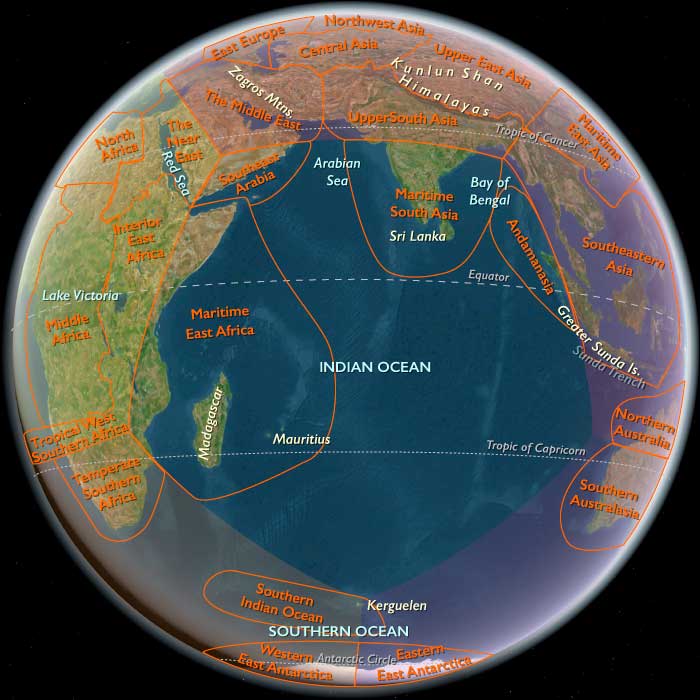
The subregion of Maritime East Africa includes Somalia, eastern Ethiopia, eastern Kenya, eastern Tanzania and its islands, northern Mozambique, the Comoros, Madagascar, Mauritius, and Seychelles. Anchors included the Swahili port cities (Mombasa, Zanzibar, Kilwa, Sofala, Mogadishu), the offshore islands of Zanzibar, Pemba, and the Comoros, the highlands and rice terraces of Madagascar, and the outlying islands of Mauritius and Seychelles.During this period, Portuguese coastal dominance receded and Omani Arabs asserted control, reshaping trade and political authority across the Indian Ocean rim.
Climate & Environmental Shifts
The waning Little Ice Age produced cycles of drought and flood. Pastoral Horn communities faced grazing crises; coastal farmers diversified subsistence with cassava, maize, and bananas. Madagascar experienced alternating famine and abundance: drought struck southern regions, while the highlands expanded irrigated rice. Cyclones occasionally battered the Comoros, Mauritius, and Seychelles.
Subsistence & Settlement
-
Swahili towns: Retained Islamic, mercantile character; hinterland caravans carried ivory, slaves, and gold. Cassava and maize, by now entrenched, expanded diets.
-
Zanzibar and Pemba: Grew coconuts, rice, and cloves (clove plantations expanded in the early 19th century under Omani rule). Fishing and trade supported islanders.
-
Comoros: Balanced subsistence gardens, rice paddies, fishing, and inter-island commerce; communities rebuilt repeatedly after cyclones.
-
Madagascar: Merina kingdom in the central highlands expanded under Andrianampoinimerina (r. c. 1787–1810), consolidating rice terraces, tribute systems, and iron-armed armies. The Sakalava maintained coastal cattle-based polities, raiding for slaves.
-
Mauritius and Seychelles: Colonized by the French in the 18th century; developed sugar plantations using enslaved labor.
Technology & Material Culture
Swahili towns featured coral-stone mosques, minarets, and merchant houses with carved doors. Dhows with lateen sails carried regional cargoes. Firearms, imported via Omani and European trade, armed coastal and Malagasy polities. On Madagascar, rice irrigation systems, cattle corrals, and fortified hilltop villages symbolized power. French colonists built sugar mills on Mauritius; Seychellois settlers planted coconuts and food gardens.
Movement & Interaction Corridors
-
Omani ascendancy: By the late 17th century, Oman expelled Portugal from Mombasa (1698) and gradually claimed authority over Swahili ports, consolidating Zanzibar as a capital of Indian Ocean commerce.
-
Ivory and slave caravans: Moved inland from Tanzania and Mozambique toward coastal entrepôts, feeding growing Omani and French demand.
-
Madagascar: Exported slaves and cattle to the Mascarenes and Swahili coast; imported textiles, firearms, and beads.
-
Comoros: Functioned as provisioning islands for dhows, slavers, and European ships rounding the Cape.
-
Mauritius and Seychelles: Integrated into the French colonial empire as plantation colonies, with enslaved Africans imported from Mozambique and Madagascar.
Cultural & Symbolic Expressions
Islam remained central to Swahili towns: mosques, madrasas, and Arabic-script poetry thrived. Omani authority patronized Islamic judges and scholars. On Madagascar, ancestor veneration, tomb construction, and cattle rituals anchored Merina and Sakalava legitimacy; Merina rulers combined ritual kingship with bureaucratic tribute. The Comoros developed Islamic scholarship blended with local ritual. In the Mascarenes, French Catholicism, African traditions, and creole cultures fused in plantation societies.
Environmental Adaptation & Resilience
Coastal and island farmers diversified crops—cassava, maize, bananas—buffering drought. Highland Merina expanded rice terraces to secure food supplies. Sakalava herders maintained cattle herds across shifting pastures. Island societies rebuilt after cyclones, replanting coconuts and rice paddies. Plantation colonies relied on enslaved labor for resilience, but suffered when storms or droughts disrupted supply lines.
Technology & Power Shifts (Conflict Dynamics)
Portuguese forts weakened as Oman asserted dominance; cannon and ships secured Zanzibar and Mombasa. Omani sultans organized tribute and port governance, tying the coast to Muscat. Slave and ivory raiding expanded inland, destabilizing societies in Tanzania, Mozambique, and Madagascar. The Merina kingdom grew into a centralized power, conquering neighbors with firearms and reorganizing tribute. In the Mascarenes, French planters entrenched slavery; enslaved resistance and marronage persisted.
Transition
By 1827 CE, Maritime East Africa had entered a new era. Omani Zanzibar dominated the Swahili coast, dispatching dhows across the Indian Ocean. Madagascar saw the rise of the powerful Merina kingdom, while coastal Sakalava still controlled raiding zones. The Comoros remained small but strategic. Mauritius and Seychelles functioned as French plantation colonies, later to be contested by Britain. The balance of power had shifted: Portuguese authority had receded, Omani Arabs and Malagasy monarchs had risen, and European plantation regimes had taken root—setting the stage for the 19th-century surge in slave and ivory exports.
The most powerful of Madagascar's kingdoms—the one that eventually establishes hegemony over a great portion of the island—is that developed by the Merina ethnic group.
Before the Merina emergevas the dominant political power on the island in the nineteenth century, they alternate between periods of political unity and periods in which the kingdom separates into smaller political units.
The location of the Merina in the central highlands affords them some protection from the ravages of warfare that recur among the coastal kingdoms.
The distinction, recognized both locally and internationally, between the central highlanders (the Merina) and the cotiers (inhabitants of the coastal areas) will soon exert a major impact on Madagascar's political system.
Organized like the coastal kingdoms in a hierarchy of nobles, commoners, and slaves, the Merina develop a unique political institution known as the fokonolona (village council).
Through the fokonolona, village elders and other local notables are able to enact regulations and exert a measure of local control in such matters as public works and security.
Two monarchs play key roles in establishing Merina political dominance over Madagascar.
The first, who rules under the name of Andrianampoinimerina (r. 1797-1810), seizes the throne of one of the Merina kingdoms in 1787.
By 1806 he has conquered the remaining three kingdoms and united them within the former boundaries of Imerina, the capital established at the fortified city of Antananarivo.
Radama I (r. 1810- 28), an able and forward-looking monarch, succeeds to the throne in 1810 upon the death of his father.
By adroitly playing off competing British and French interests in the island, he is able to extend Merina authority over nearly the entire island of Madagascar.
Radama I first conquers the Betsileo ethnic group in the southern part of the central highlands and subsequently overpowers the Sakalava, an ethnic group that also seeks at times to assert its hegemony over other groups.
With the help of the British, who want a strong kingdom to offset French influence, Radama I modernizes the armed forces.
In 1817 the peoples of the east coast, facing an army of thirty-five thousand soldiers, submit with little or no protest; Radama then conquers the entire southeast as far as Tolanaro.
Particularly barren or impenetrable parts of the island escape conquest, especially in the extreme south, but before his death Radama I succeeds in bringing the major and more hospitable portions of the country under Merina rule.
He is betrayed by an associate and is caught by the British forces, summarily judged, and condemned to death.
He is beheaded at Plaine Verte on April 15, 1822, and his head is displayed as a deterrent against future uprisings among the slaves.
The British administration of Mauritius, beginning in 1810 with Sir Robert Farquhar as Governor, has led to rapid social and economic changes.
It is tainted, however, by the Ratsitatane episode.
Maritime East Africa (1828–1839 CE): Abolition, Social Transformation, and Political Reaction
From 1828 to 1839 CE, Maritime East Africa—including Mauritius, Seychelles, Madagascar, and the Swahili Coast—undergoes pivotal transformations marked by the abolition of slavery, profound social restructuring, significant missionary influence, and complex political dynamics.
Mauritius: Abolition of Slavery and Economic Transition
In Mauritius, plantation owners of French origin (Franco-Mauritians) have vigorously resisted British efforts to abolish slavery. Nevertheless, under sustained British pressure, slavery is finally abolished in 1835. To appease the powerful planter class, the British government grants substantial concessions, including financial compensation totaling £2.1 million and enforced "apprenticeship" for former enslaved persons, compelling them to remain on plantations for another six years.
However, widespread desertions among the so-called apprentices create a severe labor shortage, forcing authorities to abandon the apprenticeship system in 1838, two years ahead of schedule. This abrupt shift dramatically reshapes the island's economy, leading to increased reliance on indentured laborers from India in subsequent decades.
Seychelles: Post-Abolition Migration and Cultural Integration
In the Seychelles, slavery is abolished in 1834, triggering a significant demographic and social shift. Many impoverished European settlers leave the islands, taking their former slaves with them. Subsequently, the British navy brings in large numbers of liberated Africans, rescued from slave ships intercepted along the East African coast, dramatically altering the islands’ demographic makeup.
The arrival of small groups of traders from China, Malaysia, and India adds to this diversity, with these groups primarily engaging in commerce. A pattern of extensive intermarriage among African, European, and Asian populations emerges (with the notable exception of the Indian community), creating a highly mixed society. By 1911, racial classifications become effectively meaningless due to this extensive integration and are ultimately abandoned.
Madagascar: Radical Reform and Conservative Backlash
In Madagascar, Radama I (r. 1810–1828) had significantly modernized and centralized the island’s administration, inviting Protestant missionaries from the London Missionary Society to establish schools, introduce the printing press, and devise a written form of the local language (Malagasy), using the Latin alphabet. By 1828, thousands of Merina individuals had become literate, and a select few students traveled to Britain for education. These efforts dramatically reshape the cultural landscape, fostering the development of a literate Merina elite and widespread Protestant conversion.
The accession of Queen Ranavalona I (r. 1828–1861) marks a stark shift. Reacting strongly against foreign influence, Ranavalona I's reign is characterized by isolationism, persecution of Protestant converts, and stringent control over trade. Many Europeans flee, although a privileged few, such as the French artisan Jean Laborde, continue to enjoy special favor. Laborde establishes a significant manufacturing complex at Mantasoa, near Antananarivo, producing silk, soap, guns, tools, and cement, highlighting a paradoxical embrace of limited modernization within a broadly reactionary political framework.
Swahili Coast: Omani Influence and Local Resistance
On the Swahili Coast, Omani control remains robust, notably under Sultan Sa'id bin Sultan, who asserts his authority firmly against local resistance—especially in strategically important cities like Mombasa and islands such as Zanzibar and Pemba. British naval forces temporarily intervene (1824–1826) on behalf of Oman but eventually withdraw. Continued local resistance, notably from the Mazrui dynasty, persists, reflecting sustained tension between Omani rulers and indigenous populations.
Malawi and Mozambique:
In the early nineteenth century, southern Malawi sees the establishment of missionary settlements, particularly the Scottish-founded town of Blantyre (named after the birthplace of explorer David Livingstone). These missions introduce new economic and agricultural practices, gradually transforming regional socioeconomic patterns. Meanwhile, central and northern Mozambique continue under Portuguese influence, their coastal settlements serving as pivotal hubs for trade in ivory, gold, and enslaved people, maintaining regional economic significance amid growing European imperial interests.
Legacy of the Age
The period from 1828 to 1839 CE in Maritime East Africa is marked by significant social and political transformations: the end of institutional slavery profoundly reshapes economic structures in Mauritius and Seychelles, triggering demographic and cultural shifts. Madagascar experiences dramatic swings between progressive modernization and conservative isolationism, profoundly influencing its political and social trajectory. The Swahili Coast continues its complex interplay between Omani dominance and resilient local identities, setting the stage for further colonial and imperial contests in the coming decades.
The reign of Radama I's wife and successor, Queen Ranavalona I (r. 1828-61), is essentially reactionary, reflecting her distrust of foreign influence.
Under the oligarchy that rules in her name, rivals are slain, numerous Protestant converts are persecuted and killed, and many Europeans flee the island.
The ruling elite holds all the land and monopolizes commerce, except for the handful of Europeans allowed to deal in cattle, rice, and other commodities.
Remunerations to the queen provided the French traders a supply of slaves and a monopoly in the slave trade.
Enjoying particular favor owing to his remarkable accomplishments is French artisan Jean Laborde, who establishes at Mantasoa, near Antananarivo, a manufacturing complex and agricultural research station where he manufactures commodities ranging from silk and soap to guns, tools, and cement.
Radama I's interest in modernizing Madagascar along Western lines extends to social and political matters.
He had organized a cabinet and encouraged the Protestant London Missionary Society to establish schools and churches and to introduce the printing press—a move that is to have far-reaching implications for the country.
The society will make nearly half a million converts, and its teachers have devised a written form of the local language, Malagasy, using the Latin alphabet.
By 1828 several thousand persons, primarily Merina, have become literate, and a few young persons are being sent to Britain for schooling.
Later the Merina dialect of Malagasy will become the official language.
Malagasy-language publications are established and circulated among the Merina-educated elite; by 1896 some one hundred and sixty-four thousand children, mainly Merina and Betsileo, will have attended the mission's primary schools.
Along with new ideas come some development of local manufacturing.
Much productive time is spent, however, in military campaigns to expand territory and acquire slaves for trade.
