
Sebastiano del Piombo
Italian painter
1485 CE to 1547 CE
Sebastiano del Piombo (c. 1485 – June 21, 1547), byname of Sebastiano Luciani, is an Italian Renaissance-Mannerist painter of the early 16th century famous for his combination of the colors of the Venetian school and the monumental forms of the Roman school.
World
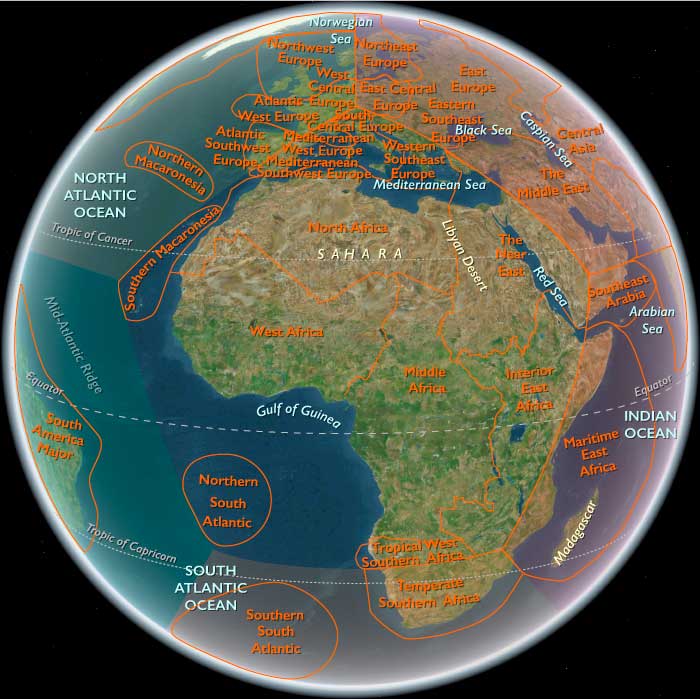
The Middle of The Earth
View →Related Events
Showing 5 events out of 5 total
Raphael produces the Portrait of Cardinal Alessandro Farnese, a portrait of the future Pope Paul III, in 1509-11.
On the four walls of the first room he decorates for Pope Julius—the Stanza della Segnatura, completed in 1511—Raphael celbrates four aspects of human, and especially papal, accomplishment: theology (“Disputation over the Sacrament” or “Disputa”), the arts (“Parnassus”), law (“Cardinal Virtues” and “Giving of the Law”), and philosophy (“School of Athens,” in which Raphael immodestly includes portraits of both himself and Michelangelo among the philosophers).
Raphael's rival and Michelangelo's associate Sebastiano del Piombo, born Sebastiano Luciani in Venice, as a student of Giovanni Bellini and Giorgione, had shared his training with Palma Vecchio and Titian, with whom he seems to have been on friendly terms until he moves to Rome in 1511.
Sebastiano Del Piombo completes his Portrait of Andrea Doria around 1526.
It is housed in the Doria Pamphilj Gallery of Rome.
Andrea Doria was born at Oneglia from the ancient Genoese family, the Doria di Oneglia branch of the old Doria, de Oria or de Auria family.
His parents were related: Ceva Doria, co-lord of Oneglia, and Caracosa Doria, of the Doria di Dolceacqua branch.
Orphaned at an early age, he became a soldier of fortune, first serving in the papal guard of Innocent VIII, when Genoa had fallen prey to the quarrels of rival families.
An extremely able soldier, he had been successively hired by King Ferdinand I and his son Alfonso II of Naples and by various Italian princes.
Fighting in Corsica in the service of Genoa in 1503, at that time under French vassalage, he had taken part in the rising of Genoa against the French, whom he compelled to evacuate the city.
He became famous from that time forward as a naval commander.
From 1503 to 1506, he had helped his uncle Domenico quell the Corsican revolt against Genoan rule.
Deciding to try his fortunes on the seas, Doria has outfitted eight galleys and patrols the Mediterranean for the past several years, fighting the Ottoman Turks and the Barbary pirates, augmenting both his reputation and his fortune.
He had scores a brilliant victory over the Turks at Pianosa in 1519.
Doria had soon become disillusioned both with French policies towards Genoa and with King Francis' intentions towards himself.
Dissatisfied with his treatment at the hands of Francis, who has been stingy about payment, he resents the king's behavior in connection with Savona, which he delayed handing back to the Genoese as he had promised.
Consequently, on the expiration of Doria's contract, he transfers his services to Holy Roman Emperor Charles V, who sees the decline of the Venetian navy as an opportunity to seek complete control over the Mediterranean.
In September 1528, Doria and his forces drive the French out of Genoa and are triumphantly received by the city.
Pope Clement VII had been kept as a prisoner in Castel Sant'Angelo for six months after the Sack of Rome in 1527.
After buying off some Imperial officers, he had escaped disguised as a peddler, taking shelter in Orvieto and then in Viterbo.
He returns to a depopulated and devastated Rome only in October 1528.
Sebastiano del Piombo, a Venetian painter who, during his years in Rome, has assimilated the Roman style as exemplified by Michelangelo, is also a distinguished portraitist: he paints Pope Clement VII in 1531.
The Pope, during his half-year imprisonment in 1527, had grown a full beard as a sign of mourning for the sack of Rome.
This is a violation of Catholic canon law, which requires priests to be clean-shaven; however, it had the precedent of the beard that Pope Julius II had worn for nine months in 1511–12 as a similar sign of mourning for the loss of the papal city of Bologna.
Unlike Julius II, however, Clement VII will keep his beard until his death in 1534.
His example in wearing a beard will be followed by his successor, Paul III, and indeed by twenty-four popes who follow him, down to Innocent XII, who dies in 1700.
Clement VII is thus the unintentional originator of a fashion that will last well over a century.