
Tekle Haymanot I
Emperor of Ethiopia
1687 CE to 1708 CE
Tekle Haymanot I ("Plant of religion," throne name Le`al Sagad, "to whom the exalted bows") is nəgusä nägäst (27 March 1706 - 30 June 1708) of Ethiopia, and a member of the Solomonic dynasty.
He is the son of Iyasu I and Empress Malakotawit.
He is often referred to as "Irgum Tekle Haymanot" or "Tekle Haymanot the Cursed"
World
The Middle of The Earth
View →Related Events
Showing 4 events out of 4 total
The most important political figure in Ethiopia during the reign of Iyoas (reigned 1755-69), son of Iyasu II, is Ras Mikael Sehul, a good example of a great noble who makes himself the power behind the throne.
Mikael's base is the province of Tigray, which by now enjoys a large measure of autonomy and from which Mikael raises up large armies with which he dominates the Gondar scene.
In 1769 he demonstrates his power by ordering the murder of two kings (Iyoas and Yohannes II) and by placing on the throne Tekla Haimanot II (son of Yohannes II), a weak ruler who does Mikael's bidding.
Mikael continues in command until the early 1770s, when a coalition of his opponents compels him to retire to Tigray, where he eventually dies of old age.
Mikael's brazen murder of two kings and his undisguised role as kingmaker in Gondar signal the beginning of what Ethiopians have long termed the Zemene Mesafmt (Era of the Princes), a time when Gondar kings are reduced to ceremonial figureheads while their military functions and real power lies with powerful nobles.
During this time, traditionally dating from 1769 to 1855, the kingdom no longer exists as a united entity capable of concerted political and military activity.
Various principalities are ruled by autonomous nobles, and warfare is constant.
The Emperors become figureheads, controlled by warlords like Ras Mikael Sehul of Tigray, Ras Wolde Selassie of Tigray, and by the Yejju Oromo dynasty, such as Ras Gugsa of Yejju, which later leads to nineteenth-century Oromo rule of Gondar, changing the language of the court from Amharic to Afaan Oromo.
Traditionally, the beginning of this period is set on the date Ras Mikael Sehul deposes Emperor Iyoas (May 7, 1769), and its end to Kassa's coronation as Emperor Tewodros II (February 11, 1855), having defeated in battle all of his rivals.
Some historians date the murder of Iyasu the Great (October 13, 1706), and the resultant decline in the prestige of the dynasty, as the beginning of this period.
Others date it to the beginning of Iyoas's reign (June 26, 1755).
During the Zemene Mesafint, various lords come to abuse their positions by making Emperors and encroach upon the succession of the dynasty, by candidates among the nobility itself: for example, on the death of Emperor Tewoflos in 1711, the chief nobles of Ethiopia fear that the cycle of vengeance that had characterized the reigns of Tewoflos and Tekle Haymanot I (1706–1708) will continue if a member of the Solomonic dynasty is picked for the throne, so they select one of their own, Yostos, to be King of Kings (nəgusä nägäst).
However, the tenure of Yostos from 1711 to 1716 is brief, and the throne comes into the hands of the Solomonic house once again.
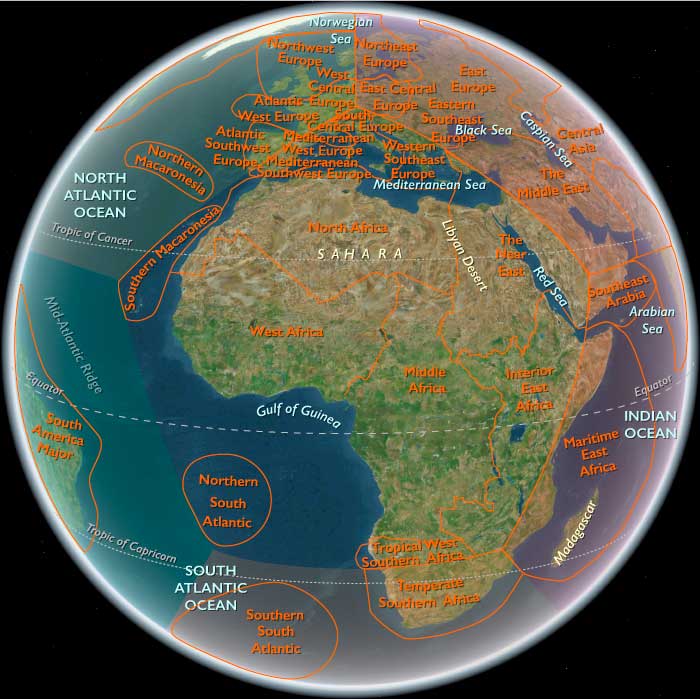
Interior East Africa (1708–1719 CE): Prelude to the Age of Princes
The era from 1708 to 1719 marked significant internal turmoil within the Ethiopian Empire, revealing the early signs of weakening central imperial authority and setting the stage for the subsequent Zemene Mesafint ("Age of Princes," roughly 1769–1855). Emperor Tewoflos, released from captivity at Mount Wehni and crowned following the assassination of his nephew Tekle Haymanot I, immediately faced severe political opposition and instability. Initially confronted by a rival claimant—the four-year-old son of Tekle Haymanot—Tewoflos moved swiftly and ruthlessly to consolidate his position. He arrested the influential Master of Horse Yohannes, who supported the child claimant, and exiled several other powerful non-royal figures on accusations of complicity in the murder of Tekle Haymanot.
Although initially feigning magnanimity, Tewoflos soon revealed his true intentions. According to the Scottish explorer James Bruce, Tewoflos accused his late nephew, Emperor Tekle Haymanot, of both regicide and patricide. This accusation permanently tarnished Tekle Haymanot's memory, earning him the epithet Irgum ("Cursed"). Despite Tewoflos’s immediate victory in securing his throne, his reign was plagued by factionalism, intrigue, and increasing assertiveness among regional nobles and provincial rulers.
The weakened central monarchy in Gondar, increasingly unable to impose authority throughout the realm, encouraged regional warlords and nobles to assert greater autonomy. This decentralization, characterized by intermittent conflict and the rise of influential local dynasties, set Ethiopia on a path towards the era known as the Zemene Mesafint. Thus, the years 1708 to 1719 served as a critical prelude, during which the seeds of prolonged political fragmentation and regional competition were decisively sown.
Tewoflos is brought out of captivity at Mount Wehni and made Emperor of Ethiopia following the murder of his nephew Tekle Haymanot I.
At first, he faces a rival in the person of the four-year-old son of his nephew, who is supported by the Master of Horse Yohannes and Empress Malakotawit.
However, Tewoflos moves quickly by having Yohannes, and several other non-royals accused of aiding in the murder of Tekle Haymanot, arrested, then sent into exile.
According to James Bruce, at first he behaved as if he would not seek vengeance on those thought responsible for the death of his brother Iyasu; but this was a deception, and once this party relaxed their guard he acted.
He accused his late nephew Emperor Tekle Haymanot of regicide and patricide, and Tekle Haymanot has been known as Irgum ("Cursed") ever since.
Empress Malakotawit was publicly hanged, while her two brothers were speared to death; Bruce states that in one afternoon a total of thirty seven persons were executed.
Tewoflos decides not long afterwards to move against all regicides, and orders that all who had taken part in the plot that led to the death of his brother Iyasu I be found and executed.