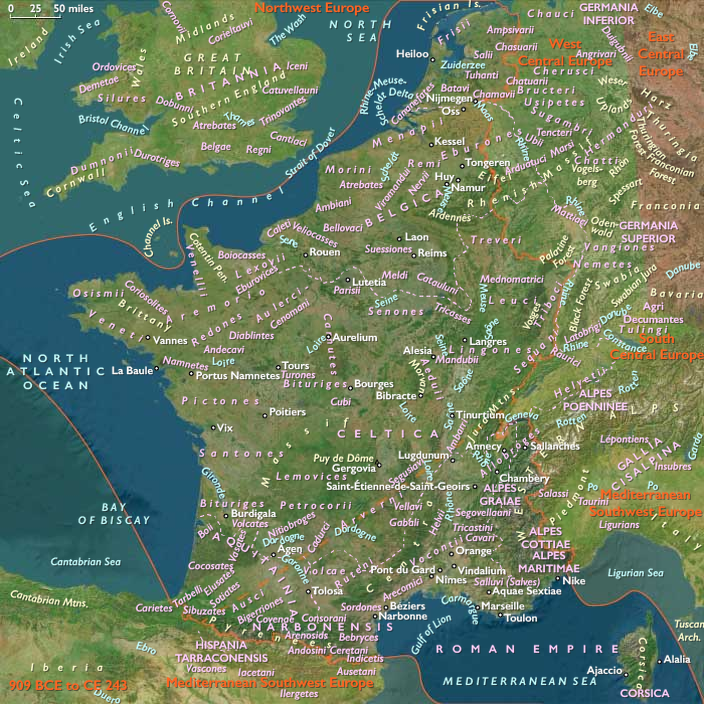
Cunobelinus, Catuvellauni overlord of southeastern England, had died prior to the Roman invasion under Aulus Plautius in 43; his sons Caratacus and Togodumnus lead the British defense, using guerilla tactics against an estimated forty thousand troops.
They lose much of the southeast after being defeated in two crucial battles on the rivers Medway and Thames.
The Roman commander then secures a crossing point of the River Thames, halts, and sends word for Claudius to join him for the final march on the Catuvellaunian capital, Camulodunum (Colchester).
Dio says that this was because the resistance became fiercer as the Britons tried to avenge Togodumnus, and Plautius needed the emperor's help to complete the conquest; however, as Claudius was no military man and in the end spent only sixteen days in Britain, it is likely the Britons were already as good as beaten.
Claudius arrives with reinforcements, including artillery and elephants, which must have made an impression on the Britons when they were displayed in the large tribal center of Camulodunum.
As Suetonius and Claudius' triumphal arch state, the British kings surrendered without further bloodshed.
An alternative reading of Dio's history of the invasion suggests that Togodumnus may actually have been acting in support of the Roman troops, against his brother Caratacus, and that he survived the battles of the River Thames, providing the later Roman administration with valued assistance.
Dr. Miles Russell of Bournemouth University has further suggested that Togodumnus and Tiberius Claudius Cogidubnus, whose original name may have been Togidubnus or Togodumnus, postulated resident of the late first century CE palace at Fishbourne may well have been one and the same.
Claudius is present in August when his legions march into Camulodunum (Colchester), the capital of the Catuvellauni, but Caratacus survives and carries on the resistance further west.