Wang Gong
warlord late in in the Chinese Tang Dynasty
Years: 860 - 899
Wang Gong (d. 899) is a warlord late in the Chinese dynasty Tang Dynasty, who controls Baoyi Circuit (headquartered in modern Sanmenxia, Henan) from 887, when he succeeds his father Wang Chongying, to his death in 899.


Related Events
Filter results
Showing 8 events out of 8 total
Yang Fugong had been instrumental in having Emperor Zhaozong made emperor, but by 889 conflicts had begun between the emperor and the chief eunuch, leading to a public argument between Yang and the chancellors Kong Wei on one occasion over Kong's accusation that Yang was disrespecting the emperor.
Nothing further had come of the dispute publicly at this point, however.
Nevertheless, at the suggestion of Kong's colleague Zhang Jun, who advocates that a strong imperial army directly under the emperor is essential for the restoration of imperial power to counteract the warlords and the eunuch-commanded Shence Armies, Emperor Zhaozong begins recruiting an imperial army that eventually numbers one hundred thousand by spring 890.
At this point, Kong and Zhang believe that it is time to test this army, to show its strengths in the struggle against Yang at court.
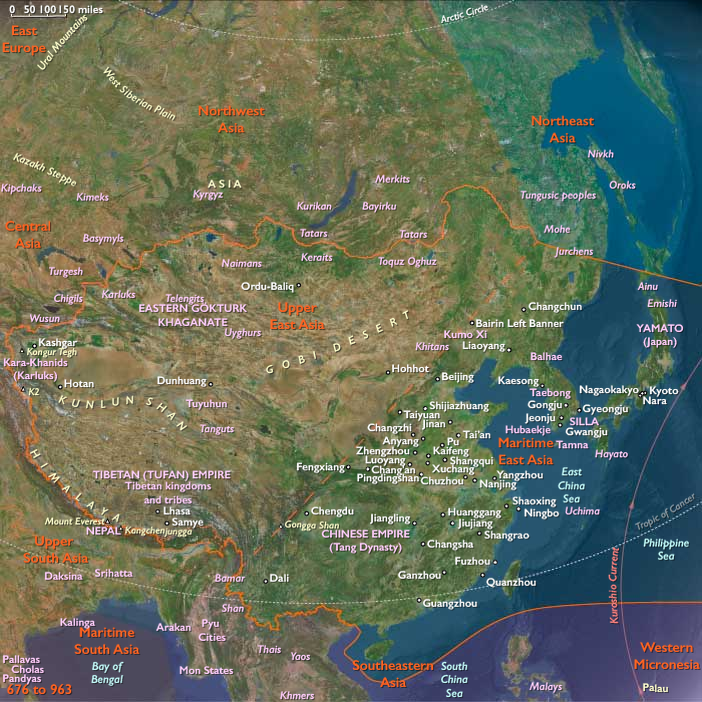
Zhang therefore advocates a campaign against the warlord Li Keyong the military governor of Hedong Circuit (headquartered in modern Taiyuan, Shanxi)—one of the most powerful warlords of the realm and archrival to the also powerful Zhu Quanzhong—as both Zhu and Li Kuangwei the military governor of Lulong are at this time also requesting an imperial campaign against the expanding Li Keyong.
Emperor Zhaozong, despite his reservations, approves the campaign, which gets under way in summer 890, with Zhu's army attacking Zhaoyi Circuit (headquartered in modern Changzhi, Shanxi), then also under Li Keyong's control, from the southeast; Li Kuangwei and Helian Duo the military governor of Datong Circuit (headquartered in modern Datong, Shanxi) attacking from the northeast; and the main imperial army, under Zhang's command and supplemented by the armies of various circuits around Chang'an, attacking from the southwest.
Zhu's army was able to seize Zhaoyi quickly, due to the assassination of Zhaoyi's military governor Li Kegong (Li Keyong's brother) by his officer An Jushou, but the imperial official sent to take over Zhaoyi, Sun Kui, is intercepted and captured by Li Keyong's adoptive son Li Cunxiao (and subsequently executed when he will not submit to Li Keyong), badly affecting the imperial army's morale.
Li Cunxiao subsequently puts Zhaoyi's capital Lu Prefecture under siege, forcing Zhu's army to withdraw.
Li Kuangwei and Helian's armies are also repelled by Li Keyong's adoptive sons Li Cunxin and Li Siyuan, leaving Zhang's imperial army to face Li Keyong himself.
By late 890, the imperial army is suffering repeated defeats at the hands of Li Keyong's Hedong army, and the supplemental troops from Jingnan (headquartered in modern Xianyang, Shaanxi) and Fengxiang (headquartered in modern Baoji, Shaanxi) Circuits abandon the imperial army and withdraw by themselves, eventually leading to a total collapse of the imperial army, with Zhang and his deputy, Han Jian the military governor of Zhenguo Circuit (headquartered in modern Weinan, Shaanxi) escaping with just a small contingent; the rest of the imperial army is effectively lost.
With Li Keyong subsequently threatening an invasion, Emperor Zhaozong is forced to restore Li Keyong to his titles and positions and exile Zhang and Kong, ending the campaign against Li Keyong in disaster.
The imperial treasury is being drained with the defeat against Li Keyong, and the campaign against Chen in a stalemate—the imperial army had put Xichuan's capital Chengdu under siege and caused a terrible famine within the city, but has not been able to capture it— and Emperor Zhaozong decides to end the Xichuan campaign as well.
He pardons Chen and recalls Wei, while ordering Gu and Wang (for whom he had created a Yongping Circuit out of parts of Xichuan territory) back to their circuits.
Wang is unwilling to accept this result, however, and he intimidates Wei into returning to Chang'an by himself, while Wang continues the siege of Chengdu.
Chen and Tian surrender to Wang in autumn 891, and Wang takes over Xichuan Circuit.
The end of the campaign against Li Keyong, which Yang Fugong had opposed, had not ended the tension between Emperor Zhaozong and Yang, but has intensifies it.
Yang had sought to retire in fall 891, and Emperor Zhaozong had approved the retirement.
Soon thereafter, amid rumors that Yang is planning a rebellion at Chang'an against the emperor, along with his adoptive nephew Yang Shouxin, Emperor Zhaozong sends the imperial guards to preemptively attack Yang Fugong's mansion, and Yang Fugong and Yang Shouxin flee to Yang Shouliang's Shannan West Circuit.
Yang Fugong thereafter starts a rebellion against the imperial government, along with Yang Shouliang, Yang Shouxin, and other adoptive sons and nephews, including Yang Shouzhong, the military governor of Jinshang Circuit (headquartered in modern Ankang, Shaanxi), Yang Shouzhen, the military governor of Longjian Circuit (headquartered in modern Mianyang, Sichuan), and Yang Shouhou, the prefect of Mian Prefecture (in modern Mianyang).
In response to the Yangs' rebellion, Li Maozhen the military governor of Fengxiang Circuit (headquartered in modern Baoji, Shaanxi), along with his allies Wang Xingyu the military governor of Jingnan Circuit (headquartered in modern Xianyang, Shaanxi) and Han Jian, as well as his brother Li Maozhuang the military governor of Tianxiong Circuit (headquartered in modern Tianshui, Gansu) and Wang Xingyu's brother Wang Xingyue the military governor of Kuangguo Circuit (headquartered in modern Weinan), submit a joint petition for Li Maozhen to be made the commander of the forces against the Yangs.
Emperor Zhaozong, while inimical to the Yangs, is hesitant to give Li Maozhen more authority and territory, and therefore initially denies the request.
However, Li Maozhen and Wang Xingyu launch an attack anyway, forcing Emperor Zhaozong into approving Li Maozhen as the commander against the Yangs.
By winter 892, Xingyuan has fallen to Li Maozhen, and the Yangs flee (and are eventually captured by Han and delivered to Chang'an to be executed).
Li Maozhen wants to add Shannan West to his territory, so he requests to be Shannan West's military governor, fully expecting that Emperor Zhaozong will allow him to retain both Fengxiang and Shannan West.
Instead, Emperor Zhaozong issues an edict making him the military governor of Shannan West and Wuding (headquartered in modern Hanzhong) Circuits, while making the chancellor Xu Yanruo the military governor of Fengxiang.
Despite the misgivings of the chancellor Du Rangneng, Emperor Zhaozong launches a campaign against Li Maozhen, with Du in charge of the logistics and Li Sizhou the Prince of Qin in command of the imperial guards, which Emperor Zhaozong has rebuilt with new recruits.
The imperial army has low morale and little battle experience, however, and when Li Sizhou sets out to engage Li Maozhen and Wang Xingyu's experienced armies, the army collapses.
Li Maozhen approaches Chang'an, demanding Du's death.
Emperor Zhaozong capitulates, ordering Du to commit suicide and allowing Li Maozhen to retain Fengxiang, Shannan West, Wuding, and Tianxiong.
It is said that after this point, Li Maozhen and Wang Xingyu, in alliance with the chancellor Cui Zhaowei, were heavily influencing imperial governance, such that the emperor would not dare to carry out any measures that they opposed.
The next point of contention in the troubled Tang dynasty comes in 895 with the death of Wang Chongying, the military governor of Huguo Circuit (headquartered in modern Yuncheng, Shanxi), which precipitates a succession struggle between his nephew Wang Ke (the adoptive son of Wang Chongying's brother and predecessor Wang Chongrong and biological son of another brother, Wang Chongjian, whom the Huguo soldiers supports, and his son Wang Gong the military governor of Baoyi Circuit (headquartered in modern Sanmenxia, Henan), who covets the more prosperous Huguo Circuit.
Li Keyong supports Wang Ke, while Li Maozhen, Wang Xingyu, and Han support Wang Gong, and all of them submit competing petitions on the behalf of the feuding cousins.
Emperor Zhaozong approves Li Keyong's petition and makes Wang Ke the military governor of Huguo.
In response, Li Maozhen, Wang Xingyu, and Han march on the capital again, killing the chancellors Wei Zhaodu (who had returned to his position as chancellor after the Xichuan campaign) and Li Xi, whom they perceive to be behind Emperor Zhaozong's decision.
The actions of Li Maozhen, Wang Xingyu, and Han, in turn, draw a strong reaction from Li Keyong, who launches his army, crosses the Yellow River, and prepares to attack the three of them.
Rumors develop that Li Maozhen and Wang Xingyu both want to seize the emperor and take him to their domains.
Emperor Zhaozong, in response, flees into the Qinling Mountains with his officials, and the people of Chang'an follow in droves.
Meanwhile, Li Keyong engages and defeats Wang's and Li Maozhen's troops, then puts Wang's capital Bin Prefecture under siege.
Wang flees and is killed by his own subordinates in flight.
Li Maozhen and Han capitulate, sending apologies and tributes to Emperor Zhaozong.
Emperor Zhaozong, who returns to Chang'an, bestows great honors on Li Keyong and his key subordinates, but hesitates when Li Keyong proposes to attack Li Maozhen, believing that if Li Keyong destroys Li Maozhen, the balance of power will be lost.
He therefore forbids Li Keyong from attacking Li Maozhen.
Li Keyong withdraws to Hedong Circuit, and, owing to his eventual defeats at the hands of Zhu Quanzhong, will not be able to return again.
Li Maozhen, who had been intimidated into an apologetic posture to the imperial court, again becomes arrogant with Li Keyong gone from the region.
He becomes suspicious of Emperor Zhaozong's attempts to rebuild the imperial guards and put them under the commands of imperial princes, including Li Sizhou, Li Jiepi the Prince of Yan, and Emperor Zhaozong's uncle Li Zi the Prince of Tong.
In summer 896, he launches an attack on Chang'an.
Emperor Zhaozong immediately seeks aid from Li Keyong, but with Li Keyong being unable to launch an army at this time and Li Maozhen's forces having defeated Li Sizhou's, Li Sizhou recommends fleeing to Hedong.
Emperor Zhaozong initially agrees and prepares to head for Fu Prefecture (in modern Yan'an, Shaanxi), preparing to cross the Yellow River to Hedong from there; he also sends Li Jiepi to Hedong to prepare for his arrival.
However, after he leaves Chang'an, Han Jian sends emissaries, then personally arrives to meet with him, to persuade him to go to Zhenguo's capital Hua Prefecture instead, promising to do all he can to uphold imperial power.
As both Emperor Zhaozong and his officials are fearful of the lengthy trek to Hedong, Emperor Zhaozong agrees and instead heads for Hua Prefecture.
Emperor Zhaozong becomes effectively under Han's control once he arrives at Hua Prefecture, however, and Han stops any real imperial attempt to engage Li Maozhen militarily.
Further, he forces Emperor Zhaozong to disband the imperial guards under the imperial princes' control, and, after Li Jiepi returns from Hedong—thus exposing the fact that Li Keyong is in no shape to launch an army to aid the emperor—slaughters eleven imperial princes.
Emperor Zhaozong makes peace with Li Maozhen in spring 898, restoring the titles that he had previously stripped from Li Maozhen.
With Zhu Quanzhong urging the emperor to move the capital to the eastern capital Luoyang, Han and Li Maozhen become apprehensive that he will launch an army to seize the emperor, and therefore repair the palaces and governmental offices at Chang'an (which Li Maozhen's army had destroyed).
In fall 898, Emperor Zhaozong returns to Chang'an, but with no army around him now other than the eunuch-controlled Shence Armies.