William of Auvergne
Bishop of Paris
Years: 1180 - 1249
William of Auvergne (1180/90-1249) is a French priest who serves as Bishop of Paris from 1228 until his death in 1249.
He is also known as Guillaume d'Auvergne, Guilielmus Alvernus, or William of Paris.




Related Events
Filter results
Showing 6 events out of 6 total
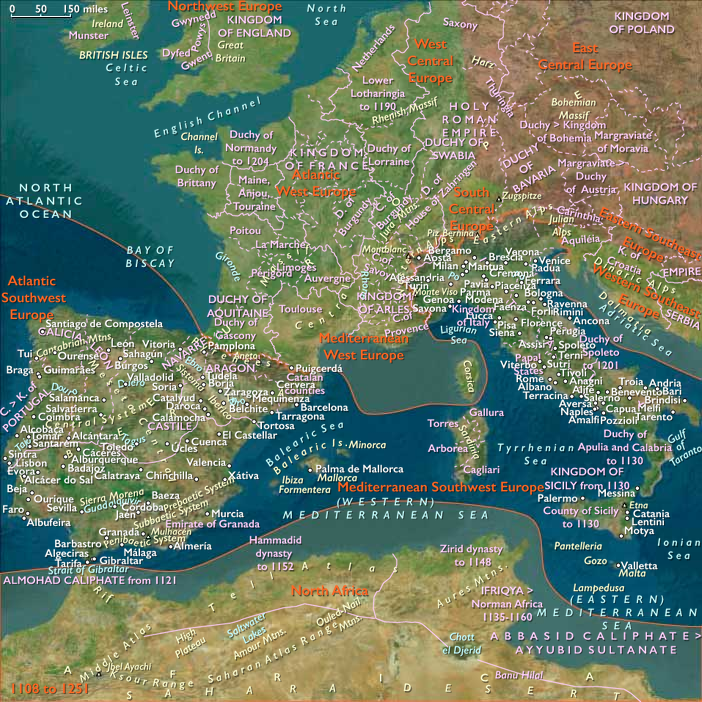
Broad Overview of High Medieval Atlantic West Europe (1108–1251 CE): Northern & Western France and the Low Countries
From 1108 to 1251, Atlantic West Europe—which includes northern and western France as well as the Low Countries (modern Netherlands, Belgium, and Luxembourg)—underwent profound transformations in political power, economic expansion, military conflicts, and cultural development.
This period saw:
- The consolidation of Capetian power in France, particularly under Philip II Augustus (r. 1180–1223) and Louis IX (r. 1226–1270).
- The decline of Plantagenet (Angevin) control in western France, culminating in the loss of Normandy, Anjou, and Poitou to the French Crown (1204–1259).
- The economic rise of the Low Countries, especially in Flanders, Brabant, and Holland, as centers of textile production and trade.
- The growing power of Burgundy, Champagne, and Lorraine, balancing between French royal authority and the Holy Roman Empire.
1. Political and Military Developments
The Capetian Expansion and the Decline of the Angevin Empire
- Philip II Augustus (r. 1180–1223) decisively defeated John of England, reclaiming Normandy, Anjou, Maine, and Poitou (1204).
- The Battle of Bouvines (1214), where Philip defeated an English-Flemish-Imperial coalition, solidified French dominance in the north.
- The Battle of Taillebourg (1242) further weakened English influence in Gascony and Poitou.
- Despite these victories, Gascony remained under English control, leading to ongoing Franco-English tensions.
The Low Countries: A Political and Economic Powerhouse
- Flanders and Brabant became crucial economic hubs, balancing alliances between France, England, and the Holy Roman Empire.
- The War of the Succession of Flanders (1185–1206) saw French intervention, culminating in Philip II’s victory over Count Baldwin IX of Flanders.
- Burgundy, Champagne, and Lorraine remained contested borderlands between France and the Empire, with frequent feudal conflicts.
- The Stedinger Crusade (1232–1234) in northwestern Germany saw the suppression of Frisian settlers resisting noble authority.
2. Economic and Urban Expansion
The Low Countries: The Rise of a Commercial Power
- Flanders, Brabant, and Holland became leading trade and textile centers, with major cities such as:
- Bruges and Ghent (Flanders) – Textile production and trade hubs.
- Brussels and Antwerp (Brabant) – Growing financial centers.
- Dordrecht and Haarlem (Holland) – Maritime and fishing economies.
- The Hanseatic League began expanding into Dutch and Flemish waters, increasing Baltic-North Sea trade links.
France: Regional Economic Growth
- Champagne Fairs (held in cities like Troyes and Provins) became key international trade markets, connecting merchants from Italy, Spain, and the Low Countries.
- Bordeaux and La Rochelle emerged as maritime trade centers, linking France to England and the Mediterranean.
- Wine production flourished in Gascony and Burgundy, fueling export economies.
3. Religious and Cultural Developments
Gothic Architecture and the High Middle Ages Cultural Boom
- Major cathedrals were constructed across the region, marking the height of French High Gothic and Rayonnant styles:
- Notre-Dame de Paris (begun 1163, completed c. 1240s)
- Reims Cathedral (begun 1211) – Coronation site of French kings.
- Amiens Cathedral (begun 1220) – Tallest of the High Gothic cathedrals.
- Sainte-Chapelle (1246–1248) – Built by Louis IX to house relics from Constantinople, showcasing the height of Rayonnant Gothic.
The Inquisition and Religious Tensions
- The Albigensian Crusade (1209–1229) led to the fall of the Cathar heresy in Languedoc, strengthening Capetian control over southern France.
- Pope Gregory IX formally established the Papal Inquisition in 1231, appointing Robert le Bougre ("Hammer of Heretics") as an inquisitor in Burgundy.
- In 1242, Christian zealots burned 24 cartloads of Talmud manuscripts in Paris, marking a period of increasing institutionalized anti-Jewish policies.
The Rise of Universities and Intellectual Thought
- The University of Paris became a leading center of Scholasticism, with thinkers like:
- Alexander of Hales, who introduced Aristotelian logic into theology.
- William of Auvergne, who worked to reconcile Augustine with Aristotle.
- The University of Orléans emerged around 1230, as a center of legal studies, focusing on Roman and canon law.
- Johannes de Sacrobosco’s Tractatus de Sphaera (c. 1230) became the leading astronomical text of the era.
4. The Strengthening of Monarchical Authority
France: The Rise of a Centralized State
- Philip II Augustus expanded royal justice, limiting noble autonomy.
- Louis IX (Saint Louis) sent enquêteurs (royal commissioners) in 1247 to investigate local governance, ensuring administrative accountability.
- The French monarchy increased control over taxation and trade, strengthening its financial power.
Burgundy, Champagne, and Lorraine: Balancing Between France and the Empire
- Burgundy remained a semi-independent duchy, balancing feudal allegiances between France and the Holy Roman Empire.
- The War of the Succession of Champagne (1216–1222) highlighted tensions between French royal influence and regional autonomy.
- In Lorraine, Theobald I’s rebellion against Frederick II (1218) led to a brief imperial occupation and restructuring of local power.
The Low Countries: Increasing Autonomy
- The Counts of Flanders and Holland navigated a delicate balance between England and France, using their economic power to resist complete subjugation.
- Haarlem (1245) and Delft (1246) received city rights, reflecting the increasing urban autonomy and self-governance of Dutch cities.
Conclusion: The Transformation of Atlantic West Europe by 1251
By 1251, northern and western France and the Low Countries had undergone profound transformations:
- Capetian France had become the dominant power, solidifying control over Normandy, Anjou, and Poitou while increasing royal administration.
- England had lost most of its continental holdings, retaining only Gascony, leading to a shift in its focus toward maritime power and internal governance.
- The Low Countries had risen as economic centers, with cities like Bruges, Ghent, and Antwerp becoming major trading hubs.
- Burgundy, Champagne, and Lorraine remained contested border regions, balancing imperial and French influences.
- Religious, architectural, and intellectual advancements flourished, positioning the region at the heart of medieval European culture and governance.
These changes set the stage for the Late Middle Ages, shaping the Hundred Years’ War, the continued growth of urban economies, and the increasing centralization of power in France and the Low Countries.
Atlantic West Europe (1216–1227): Consolidating Royal Power, Economic Vitality, and Intellectual Progress
Between 1216 and 1227, Atlantic West Europe—including the Low Countries, Brittany, Normandy, Aquitaine, Burgundy, central France, Alsace, and Franche-Comté—experienced a period of political stabilization following significant territorial realignments, alongside sustained economic growth, dynamic urban expansion, and substantial cultural and intellectual advancements.
Political and Military Developments
-
France: Strengthening Capetian Authority
- Under Philip II Augustus (r. 1180–1223) and subsequently Louis VIII (r. 1223–1226), the French crown consolidated power in territories newly acquired from the Angevin Empire, notably Normandy and Anjou.
- Louis VIII reinforced royal control through decisive campaigns in Poitou and further weakened Angevin influence in southwestern France.
-
England and Aquitaine: Shifting Loyalties
- With the decline of Angevin power after King John's death in 1216, Aquitaine became increasingly isolated, facing internal dissent and external pressure from the Capetian monarchy.
- Henry III's accession as a child (1216–1272) left English possessions on the continent vulnerable, weakening Angevin claims.
-
Brittany: Regional Autonomy under French Influence
- The Breton duchy remained nominally independent but increasingly fell under Capetian influence due to dynastic connections and strategic pressures from neighboring French territories.
-
Burgundy and the Low Countries: Political Stability
- Burgundy, under Duke Odo III (r. 1192–1218) and his successor Hugh IV (r. 1218–1272), maintained autonomy, adeptly navigating the complex political landscape dominated by the Capetian kings and Holy Roman Empire.
- In Flanders, Countess Joan (1205–1244) maintained economic prosperity while carefully balancing French and imperial interests.
Economic and Social Developments
-
Urbanization and Commercial Expansion
- Major urban centers, including Bruges, Ghent, Rouen, and Paris, continued to flourish as economic hubs, benefiting from robust trade networks and the continued importance of the Champagne fairs.
- Increased specialization in textiles, wool, and luxury goods supported urban economic vitality, boosting regional prosperity.
-
Agricultural Innovation and Population Growth
- Ongoing agricultural advancements, including crop rotation improvements and enhanced farming techniques, drove rural productivity and sustained population increases, further supporting urban development.
Cultural and Intellectual Developments
-
Gothic Architecture’s Ascendancy
- Gothic architectural styles became widespread, notably with continued construction at cathedrals like Chartres and Reims. These structures embodied both religious devotion and urban prestige.
-
Expansion of Scholasticism
- The University of Paris gained international prominence, attracting notable scholars like William of Auvergne and Robert Grosseteste, who contributed significantly to theology and early scientific inquiry.
-
Courtly Literature and Romance
- The popularity of Arthurian legends and chivalric literature continued to rise, particularly with the works of poets like Chrétien de Troyes, enhancing cultural connections between regions.
Religious Developments
-
Albigensian Crusade (1209–1229)
- The continuation of the Albigensian Crusade in southern France intensified religious fervor throughout the region, impacting political allegiances and reinforcing the authority of the Catholic Church in combating perceived heresy.
-
Monastic Growth and Reform
- Cistercian and other monastic orders continued to expand their spiritual and economic influence, founding monasteries that enhanced both regional productivity and cultural life.
Legacy and Significance
The period 1216–1227 was characterized by a marked consolidation of Capetian power, reshaping Atlantic West Europe's political landscape after the Angevin Empire’s decline. The sustained economic growth, coupled with dynamic cultural and intellectual developments, reinforced the region’s significance and set enduring foundations for its influence throughout the High Middle Ages.
William of Auvergne and Magisterium Divinale (c. 1223): A Bridge Between Augustinian and Aristotelian Thought
Around 1223, William of Auvergne (also known as William of Paris), a teacher at the University of Paris, wrote Magisterium Divinale (The Divine Teaching), a collection of philosophical and theological treatises. His work marked an early synthesis of Augustinian theology with Aristotelian and Arabic philosophy, positioning him as one of the first Western scholars to integrate these traditions into Christian thought.
William’s Intellectual Approach
-
Augustinian Foundations
- William remained firmly within the tradition of Saint Augustine, emphasizing the primacy of divine illumination, free will, and the soul’s yearning for God.
-
Use of Aristotelian and Arabic Thought
- Unlike many of his predecessors, William incorporated elements of Aristotelian philosophy, which had recently been reintroduced to the Latin West through Arabic translations and commentaries.
- He was influenced by Avicenna (Ibn Sina) and Al-Farabi, though he rejected Neoplatonic emanationism, which suggested that creation proceeded as a necessary overflow from God, rather than through divine will.
-
The Soul as the "Form" of the Body
- William accepted Aristotle’s definition of the soul as the form of the body, which would later become orthodox Christian doctrine through Thomas Aquinas.
- However, he rejected any aspect of Aristotle’s psychology that contradicted Christian teaching, ensuring that the soul remained a distinct, immaterial entity that could survive bodily death.
William’s Role in Early Scholasticism
-
A Forerunner to Aquinas
- William’s effort to balance faith and reason foreshadowed the later synthesis achieved by Thomas Aquinas.
- While William remained more Augustinian in tone, he paved the way for a more systematic Christian engagement with Aristotle.
-
Defense Against Non-Christian Philosophies
- William engaged in apologetics against Islamic and Jewish philosophy, refuting ideas from Averroes (Ibn Rushd) and Maimonides that he saw as inconsistent with Christian doctrine.
Legacy
- His writings helped establish the University of Paris as a center of Aristotelian-Christian synthesis, influencing later scholars.
- He became Bishop of Paris in 1228, where he continued to defend orthodox theology against heterodox ideas, particularly against rationalist interpretations of Aristotle.
- His works were an early example of scholasticism’s engagement with non-Christian sources, shaping the philosophical discourse of the 13th century.
William of Auvergne’s Magisterium Divinale (c. 1223) was a milestone in medieval thought, bridging Augustinian theology with Aristotelian philosophy while firmly defending the compatibility of reason and Christian doctrine.
Atlantic West Europe (1228–1239): Consolidation of Capetian Authority, Urban Expansion, and Cultural Flourishing
Between 1228 and 1239, Atlantic West Europe—including the Low Countries, Brittany, Normandy, Aquitaine, Burgundy, central France, Alsace, and Franche-Comté—experienced continued political stabilization, robust economic activity, expanding urbanization, and notable intellectual and cultural growth, amid ongoing religious transformation.
Political and Military Developments
-
France: Strengthening Royal Power
- Louis IX (Saint Louis, r. 1226–1270), though initially ruling under the regency of Blanche of Castile until 1234, significantly strengthened the centralized authority of the Capetian monarchy, suppressing noble revolts and furthering administrative reforms.
- The 1229 Treaty of Paris ended the Albigensian Crusade, effectively incorporating Languedoc into Capetian France, thus securing southern boundaries and enhancing royal prestige.
-
Brittany and Normandy: Integration and Autonomy
- Brittany retained nominal autonomy under Duke Peter Mauclerc (r. 1213–1237) but increasingly aligned with Capetian interests through marital and political alliances.
- Normandy, now firmly under French control, prospered economically while adjusting to centralizing royal governance.
-
Aquitaine: Continued Fragmentation
- Aquitaine remained a region of competing interests, with localized conflicts persisting as English Plantagenet authority weakened, enhancing French leverage.
-
Burgundy and the Low Countries: Stability and Economic Growth
- Burgundy under Hugh IV (r. 1218–1272) consolidated internal stability, skillfully balancing imperial and royal influences.
- In Flanders, Countess Joan (r. 1205–1244) sustained regional prosperity, balancing relations with France, England, and the Holy Roman Empire.
Economic and Social Developments
-
Urbanization and Trade Expansion
- Urban centers such as Paris, Bruges, Ghent, and Rouen continued rapid growth, supported by flourishing commerce in textiles, luxury goods, and agricultural produce.
- The Champagne fairs remained central, integrating trade networks across Europe, and fostering economic prosperity throughout the region.
-
Agricultural Innovation and Population Growth
- Continued agricultural advancements supported ongoing demographic growth, driving urban expansion and commercial activity, resulting in the region’s sustained prosperity.
Cultural and Intellectual Developments
-
Flourishing Gothic Architecture
- Gothic architecture reached new heights, exemplified by significant progress in constructing iconic cathedrals such as Amiens, Reims, and Beauvais, reflecting both civic pride and religious devotion.
-
Rise of Scholastic Philosophy
- The University of Paris solidified its reputation as Europe's preeminent intellectual center, hosting influential scholars such as Robert Grosseteste and William of Auvergne, fostering advancements in theology, philosophy, and science.
-
Courtly Literature and Cultural Patronage
- Courtly literature, particularly Arthurian romances and troubadour poetry, thrived, enriching cultural life in noble courts from Aquitaine to Champagne.
Religious Developments
-
Aftermath of the Albigensian Crusade
- The suppression of Catharism through the Albigensian Crusade solidified Catholic dominance, increasing the authority of the Church and supporting royal claims to legitimacy.
-
Monastic Influence and Expansion
- The Cistercian order and mendicant orders, especially the Franciscans and Dominicans, expanded significantly, enhancing religious education, preaching, and social influence across urban and rural communities.
Legacy and Significance
The period 1228–1239 marked an era of deepening Capetian consolidation, dynamic urban growth, and vibrant cultural expression. The integration of southern territories, flourishing economic networks, and continued intellectual leadership positioned Atlantic West Europe as a leading center of medieval European power, culture, and prosperity
William of Auvergne: The Scholastic Theologian and Bishop of Paris (c. 1180–1228 CE)
William of Auvergne, a Scholastic philosopher and theologian, was born in Aurillac, with scholars estimating his birthdate between 1180 and 1190. He studied at the University of Paris, where he earned his Master’s degree in Theology and became a professor first in the faculty of arts and then in theology in 1220.
As a theologian, William played a pivotal role in introducing and reconciling Aristotelian philosophy with Christian doctrine, attempting to bridge the gap between Aristotle and the teachings of Augustine of Hippo.
William’s Aristotelian Synthesis and Theological Contributions
-
At this time, Aristotle’s writings were newly circulating in Western Europe, primarily through Arabic translations and commentaries by Islamic philosophers such as Avicenna (Ibn Sina) and Averroes (Ibn Rushd).
-
William sought to "rescue Aristotle from the Arabians," rejecting interpretations he deemed incompatible with Christianity, including:
- The eternality of the world, which contradicted the Christian belief in creation ex nihilo (creation from nothing).
- The doctrines of the Cathars, a heretical dualist movement that rejected material creation.
-
His major work, Magisterium Divinale (translated as Teaching on God in the Mode of Wisdom), systematically explored divine wisdom, theology, and virtue.
-
He is one of the earliest theologians to attempt a synthesis of Augustine’s theology with Aristotelian philosophy, a precursor to later Scholastic thinkers like Albertus Magnus and Thomas Aquinas.
William’s Ecclesiastical Career and Election as Bishop of Paris (1228)
- Since 1223, William had served as a canon at Notre-Dame Cathedral in Paris.
- Upon the death of Bishop Bartholomaeus on October 20, 1227, the canons elected a cleric named Nicolas as his successor.
- Dissatisfied with this choice, William traveled to Rome to seek papal intervention.
- Pope Gregory IX was so impressed with William that he personally appointed him Bishop of Paris in 1228.
Significance of William of Auvergne
- As Bishop of Paris, he had a profound influence on the development of Scholastic theology, preparing the groundwork for later figures like Thomas Aquinas.
- His intellectual synthesis of Aristotle and Augustine contributed to the increasing incorporation of Greek philosophy into Christian theology.
- His role in refuting Catharism and challenging Arabic Aristotelianism demonstrated his commitment to defending orthodox doctrine.
William of Auvergne’s appointment as Bishop of Paris in 1228 marked the culmination of his influence in both theology and the Church, securing his legacy as a bridge between Aristotelian philosophy and Christian Scholasticism.
Atlantic West Europe (1240–1251): Capetian Consolidation, Rising Urban Economies, and Intellectual Dynamism
From 1240 to 1251, Atlantic West Europe—including the Low Countries, Brittany, Normandy, Aquitaine, Burgundy, central France, Alsace, and Franche-Comté—experienced further consolidation of royal authority, continued economic vitality, deepening urban growth, and influential intellectual and cultural developments, laying the foundations for the transition from the High Middle Ages into the Late Medieval period.
Political and Military Developments
-
France: Strengthening Capetian Centralization
- Louis IX (Saint Louis, r. 1226–1270) continued consolidating royal authority, establishing a more effective justice system, enforcing peace among nobles, and initiating far-reaching administrative reforms.
- Louis IX participated in the Seventh Crusade (1248–1254), temporarily shifting royal attention overseas, though domestic administration remained stable due to robust governance systems established during his reign.
-
Brittany and Normandy: Stable Autonomy and Integration
- Brittany, under Duke John I (r. 1237–1286), maintained relative autonomy while strengthening its diplomatic ties with the French crown, reinforcing regional stability.
- Normandy continued its integration into royal France, enhancing economic prosperity and benefiting from centralized administration.
-
Aquitaine: Shifts in Angevin Influence
- Continued rivalry between the Capetian kings and English Plantagenet authority intensified regional instability. However, French influence steadily increased, laying groundwork for future conflicts.
-
Burgundy and the Low Countries: Political Stability and Economic Expansion
- Under Hugh IV of Burgundy (r. 1218–1272), the duchy experienced continued stability, managing complex relationships with France and the Empire.
- In Flanders, Countess Joan of Constantinople (r. 1205–1244) and subsequently her successors sustained economic prosperity through textiles, trade, and diplomacy.
Economic and Social Developments
-
Expansion of Trade and Commerce
- Cities such as Bruges, Ghent, Rouen, and Paris continued rapid economic expansion driven by textile manufacturing, luxury trades, and long-distance commerce, maintaining strong connections with Mediterranean and North Sea trade networks.
- The Champagne fairs remained significant, solidifying Atlantic West Europe's central role in international trade.
-
Urbanization and Guild Development
- Urban populations expanded considerably, leading to increased prominence of guilds that regulated production, trade practices, and worker welfare, shaping urban governance and social structures.
Cultural and Intellectual Developments
-
Advancement of Gothic Architecture
- Gothic architecture continued its vibrant evolution, with significant progress in monumental cathedrals such as Amiens and Chartres, showcasing innovative techniques in vaulting, sculpture, and stained glass.
-
Scholasticism and Intellectual Growth
- The University of Paris remained a foremost intellectual center, nurturing figures such as Thomas Aquinas, who studied and taught in Paris from 1245, significantly influencing medieval philosophy and theology.
-
Literary and Cultural Flourishing
- Continued patronage of courtly literature, poetry, and troubadour traditions enriched the region's cultural life, reflecting courtly ideals, religious devotion, and chivalric values.
Religious Developments
-
Influence of Crusading Ideals
- Louis IX's Seventh Crusade (1248–1254), despite limited military success, reinforced crusading ideals, shaping popular religious sentiment and royal legitimacy.
-
Expansion of Mendicant Orders
- Franciscans and Dominicans expanded significantly, playing crucial roles in education, preaching, and combating heresy, enhancing their social and spiritual influence.
Legacy and Significance
The years 1240–1251 marked a period of increased political consolidation under Capetian leadership, vibrant economic growth, dynamic urbanization, and significant intellectual and cultural advancement. This era solidified Atlantic West Europe’s position as a critical hub in medieval Europe, preparing the region for the transitions and challenges of the Late Middle Ages.