William VIII
duke of Gascony (1052–1086), then duke of Aquitaine and count of Poitiers
Years: 1025 - 1086
William VIII (c. 1025 – 25 September 1086), born Guy-Geoffrey (Gui-Geoffroi), is duke of Gascony (1052–1086), then duke of Aquitaine and count of Poitiers (as William VI) between 1058 and 1086, succeeding his brother William VII (Pierre-Guillaume).


Related Events
Filter results
Showing 9 events out of 9 total
Atlantic West Europe (1048–1059): Ducal Dominance, Royal Challenges, and Ecclesiastical Reforms
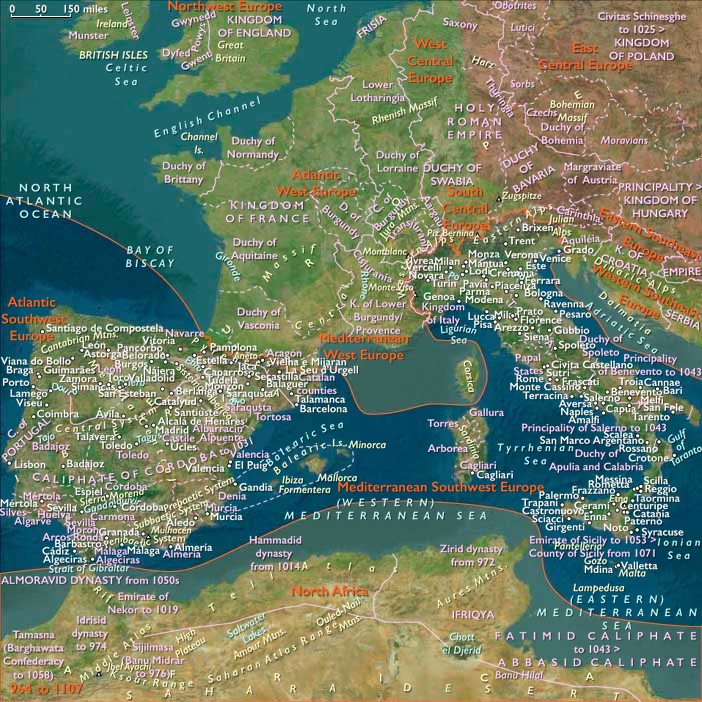
The era 1048–1059 in Atlantic West Europe—including the Low Countries, Normandy, Brittany, Aquitaine, the Duchy of Burgundy, the Franche-Comté (County of Burgundy), Alsace, and central France—was marked by ducal consolidation, royal efforts to reassert authority, continued ecclesiastical reform, and intensified regional rivalries.
Political and Military Developments
-
France: Henry I’s Struggle for Centralization
- King Henry I (r. 1031–1060) faced ongoing resistance from powerful regional nobles, notably William of Normandy and Geoffrey Martel of Anjou. The king sought alliances and employed diplomacy to maintain Capetian authority, though direct royal control remained limited outside the royal demesne around Paris.
-
Normandy: Strengthening Ducal Power under William
- Duke William II of Normandy (r. 1035–1087) firmly consolidated his authority following the decisive victory at the Battle of Val-ès-Dunes (1047), stabilizing Normandy through strategic castle-building and securing noble loyalty. His authority grew increasingly independent from royal oversight.
-
Aquitaine: Expansion under William VII and Guy-Geoffrey
- Duke William VII (r. 1039–1058) expanded control over Aquitaine and Poitou, notably clashing with rebellious vassals. Upon his death, Guy-Geoffrey (William VIII, r. 1058–1086) succeeded, pursuing aggressive territorial expansion and maintaining relative regional independence.
-
Brittany: Ducal Consolidation
- Conan II (r. 1040–1066) navigated diplomatic tensions between Normandy and Anjou, preserving Breton independence through careful political maneuvering, though pressures from neighboring principalities intensified.
-
Burgundy: Stability and Regional Independence
- Duke Robert I of Burgundy (r. 1032–1076) enjoyed relative autonomy, reinforcing ducal authority and carefully balancing ties with the French crown.
- The County of Burgundy (Franche-Comté) under Count Renaud I (r. 1026–1057), followed by William I the Great (r. 1057–1087), increasingly gravitated toward imperial influence, deepening the distinction from its French counterpart.
-
Alsace and the Low Countries
- Alsace maintained economic and political stability as a crucial conduit between France and the Holy Roman Empire.
- The Low Countries—especially Flanders—continued flourishing under Count Baldwin V (r. 1035–1067), whose astute governance enhanced trade, urban growth, and regional influence.
Economic and Social Developments
-
Urban Growth and Trade Networks
- The Flemish cities of Bruges, Ghent, and Ypres grew as vital textile-producing and trade hubs, connecting Atlantic West Europe with broader European markets.
- Increasing trade along the Rhine and Saône rivers boosted economic prosperity in Alsace and Burgundy.
-
Feudal Dynamics and Social Structures
- Noble power remained considerable, limiting direct royal control, with regional lords securing extensive autonomy in return for nominal allegiance to the crown.
Religious and Cultural Developments
-
Cluniac Reform and Monastic Expansion
- The powerful monastic network centered on Cluny continued to expand rapidly, promoting ecclesiastical reform and independence from secular influence, significantly shaping regional religious life.
- Reform-minded bishops and abbots gained prominence, influencing local and regional politics.
-
Architectural and Cultural Advancements
- Construction of Romanesque churches and monasteries proliferated, especially in Burgundy, Alsace, and Aquitaine, reflecting increased wealth and religious devotion.
Legacy and Long-term Significance
Between 1048 and 1059, key developments included:
- The consolidation of ducal power in Normandy under William II, establishing conditions that would later enable the Norman conquest of England (1066).
- Continued challenges to Capetian royal authority, exemplifying the decentralized feudal nature of French political life.
- Strengthening of regional identities, particularly in Burgundy, Brittany, and Aquitaine.
- Ongoing ecclesiastical reform that influenced future religious and political landscapes.
This era deepened regional autonomy, solidified powerful ducal states, and underscored the complex relationship between secular authority and ecclesiastical influence, setting important precedents for subsequent decades.
The Short but Turbulent Rule of William VII of Aquitaine (1039–1058)
William VII (Pierre-Guillaume) of Aquitaine, the third son of Duke William V and Agnes of Burgundy, ruled as Duke of Aquitaine and Count of Poitou from 1039 until his death in 1058. His reign was marked by dynastic struggles, territorial disputes, and ongoing conflicts with Geoffrey Martel of Anjou. Despite his military ambitions, he failed to secure control over Gascony and died during a siege at Saumur.
Family and Dynastic Background
- William VII was the half-brother of Odo of Gascony, whom he defeated and killed in battle at Mauzé to claim his Aquitanian inheritance.
- His sister, Agnes of Poitou, had married Emperor Henry III, making him a brother-in-law to the late Holy Roman Emperor.
- His mother, Agnes of Burgundy, had remarried Geoffrey Martel, Count of Anjou, creating tensions over territorial claims in western France.
Struggles Over Gascony and Conflict with Geoffrey Martel
- Though William VII had claimed Aquitaine, he failed to occupy Gascony, which had come under Aquitanian rule through the marriage of William V to Prisca (Brisce) of Gascony, the sister of Duke Sancho VI Guilhem of Gascony.
- His younger brother, Guy-Geoffroy, became Duke of Gascony in 1052, holding the duchy separately from Aquitaine during William VII’s rule.
- At the same time, Geoffrey Martel of Anjou refused to return lands seized from Aquitaine during his predecessors’ reigns, leading William VII to embark on a military campaign to reclaim his lost patrimony.
The Siege of Saumur and Death (1058)
- In 1058, William VII led a campaign against Geoffrey Martel, laying siege to Saumur, a strategic Angevin stronghold.
- While besieging Geoffrey Martel, he contracted dysentery, a common disease in medieval siege warfare due to unsanitary camp conditions.
- He died in the autumn of 1058, leaving his duchy to his younger brother, Guy-Geoffroy, who succeeded him as William VIII of Aquitaine.
Legacy and Impact
- William VII’s reign was dominated by internal conflicts, preventing him from consolidating full control over Gascony.
- His failure to reclaim lost lands from Anjou meant that his successor, William VIII, inherited a weakened position against Angevin expansion.
- The division of Gascony and Aquitaine during his rule set a precedent for continued fragmentation and power struggles within southwestern France.
Though militarily ambitious, William VII died before fully securing his patrimony, leaving his successor, William VIII, to continue the struggles against Anjou and Gascony in the late 11th century.
Atlantic West Europe (1060–1071): Norman Conquest, Capetian Consolidation, and Ecclesiastical Influence
The era 1060–1071 in Atlantic West Europe—including the Low Countries, Normandy, Brittany, Aquitaine, the Duchy of Burgundy, the Franche-Comté (County of Burgundy), Alsace, and central France—was marked by significant territorial conquests, especially the Norman conquest of England, the Capetian dynasty’s attempts at internal stabilization, and the continuing influence of ecclesiastical reform movements.
Political and Military Developments
-
Normandy: William’s Conquest of England
- William II of Normandy (William the Conqueror, r. 1035–1087) decisively conquered England at the Battle of Hastings (1066), profoundly reshaping political alliances and dramatically expanding Norman influence beyond continental Europe. Normandy thus became a powerful cross-Channel duchy with vast resources.
-
France: Transition and Stabilization under Philip I
- King Henry I died in 1060, succeeded by his son, Philip I (r. 1060–1108). The young king’s minority initially saw his mother, Anne of Kyiv, and the powerful Count Baldwin V of Flanders acting as regents. Philip’s reign marked cautious royal consolidation, maintaining peace internally while acknowledging regional autonomy.
-
Aquitaine: Strengthening Ducal Authority
- William VIII of Aquitaine (Guy-Geoffrey, r. 1058–1086) actively defended and expanded Aquitanian interests, solidifying control over local nobility and enhancing regional stability.
-
Brittany: Navigating Between Powers
- Conan II (r. 1040–1066) and subsequently Hawise of Brittany and her husband, Hoël II (r. 1066–1084), navigated the delicate political balance between powerful neighbors Normandy and Anjou, preserving Breton autonomy amidst shifting alliances.
-
Burgundy: Stable Ducal Rule
- Robert I of Burgundy (r. 1032–1076) maintained stable governance, enhancing ducal authority, building internal cohesion, and remaining relatively independent from royal intervention.
-
County of Burgundy (Franche-Comté) and Alsace
- William I the Great (r. 1057–1087) in the Franche-Comté deepened ties with the Holy Roman Empire, reinforcing its separate identity from the Duchy of Burgundy.
- Alsace maintained its strategic position as an economic bridge, prospering under imperial protection.
-
Flanders and the Low Countries
- Count Baldwin V (r. 1035–1067) continued to fortify Flanders as a commercial powerhouse. His death in 1067 led to Baldwin VI’s short reign (r. 1067–1070), followed by succession disputes briefly destabilizing the region.
Economic and Social Developments
-
Urban and Commercial Expansion
- Flemish textile cities (Bruges, Ghent, Ypres) thrived as prominent commercial hubs, linking Atlantic trade with the wider European economy.
- Normandy and Aquitaine benefited economically from increased trade with newly conquered English territories.
-
Feudal Consolidation
- Feudal relationships crystallized further, with powerful regional lords consolidating their territories, enhancing local autonomy yet limiting centralized royal authority.
Religious and Cultural Developments
-
Ecclesiastical Reform Movement
- Cluniac monasteries continued expanding their influence, championing ecclesiastical reform and spiritual renewal, reshaping religious life across the region.
- Gregorian Reform ideals, advocating Church independence from secular authority, gained momentum, particularly affecting relationships between secular rulers and religious institutions.
-
Norman Cultural Influence
- Following William’s conquest, cultural and ecclesiastical exchanges intensified between Normandy, England, and continental Europe, significantly influencing architecture, governance, and language.
Legacy and Long-term Significance
The period 1060–1071 was transformative:
- The Norman conquest of England significantly redefined Normandy’s geopolitical influence, positioning it among the most influential powers of Western Europe.
- Philip I’s accession marked a period of cautious royal strengthening, though decentralized governance remained dominant.
- Continued ecclesiastical reform efforts, particularly from Cluny and the Gregorian movement, influenced political dynamics and church-state relationships.
This era laid critical groundwork for future conflicts and alliances, setting the stage for centralization efforts, cross-channel politics, and deepened cultural and economic ties across Atlantic West Europe.
The first attempt by Ramiro I of Aragon to take Graus, the northernmost Muslim outpost in the valley of the Cinca, had taken place in 1055, probably in response to the defeat of García Sánchez III of Navarre at Atapuerca the year before (1054), which had placed Ferdinand I of León and Castile in a commanding position against Ramiro's western border and the Muslim Taifa of Zaragoza to his south.
His first expedition against Graus had failed, and in 1059 Ferdinand had succeeded in extorting parias (tribute) from Zaragoza.
Ramiro marches on Graus again in the spring of 1063, but this time the Zaragozans have with them three hundred Castilian knights under the infante Sancho the Strong and (possibly) his general Rodrigo Díaz de Vivar, better known as El Cid.
The presence of the Cid at the battle is based on a single source, the generally reliable Historia Roderici, which alleges that he was the alférez of Sancho at the time.
Considering the rarity of the Cid's name in the documents of the early 1060s, this is unlikely.
The circumstances of the actual battle are obscure.
Reinhart Dozy argued that Ramiro survived four months after the battle and that neither the Cid nor Sancho took any part in it.
The Fragmentum historicum ex cartulario Alaonis records only that occisus est a mauris in bello apud Gradus (he [Ramiro] was killed by the Moors in war near Graus), with no mention of the Castilians.
The aforementioned Chronica naierensis contains an account generally, though not universally, regarded as a legend: that Sancho Garcés, an illegitimate son of García Sánchez III of Navarre, eloped with the daughter of García's wife, Stephanie (probably by an earlier marriage), who was the fiancée of the Castilian infante Sancho, and that he sought refuge at the court first of Zaragoza, then later of Aragon.
Sancho, to avenge the disruption of his marriage plans, marched against Ramiro and Zaragoza, and Ramiro died in the encounter near "the place called Graus" (loco qui Gradus dicitur) in 1064 or 1070.
According to the Arabic historian al-Turtūshī, Ramiro (misidentified as "Ibn Rudmīr", the son of Ramiro) was assassinated by a Muslim soldier who spoke the Christians' language and infiltrated the Aragonese camp.
Pope Alexander II had first preached the Reconquista in 1063 as a "Christian emergency."
It was also preached in Burgundy, probably with the permission of participation of Hugh of Cluny, where the abbot's brother, Thomas de Chalon, leads the army.
Certainly zeal for the crusade had spread elsewhere in France, for Amatus of Montecassino notes that the "grand chivalry of the French and Burgundians and other peoples" (grant chevalerie de Francoiz et de Borguegnons et d'autre gent) is present at the siege of Barbastro.
Thus, a large army, primarily of Frenchmen and Burgundians, along with a papal contingent, mostly of Italo-Normans, and local Spanish armies, Catalan and Aragonese, is present at the siege when it begins in 1064.
The leader of the papal contingent was a Norman by the name of William of Montreuil.
The leader of the Spaniards is Sancho Ramírez, King of Aragon, whose realm is greatly threatened by the Moors to the south.
The largest component, the Aquitainian, is led by the Duke Guy Geoffrey, aka William VIII.
During William VIII's rule over Aquitaine, the alliance with the southern kingdoms of modern Spain is a political priority, as shown by the marriage of all his daughters to Iberian kings.Though the makeup of this grand army has been subject to much dispute, that it contained a large force of Frankish knights is generally agreed upon.
This expedition is the first campaign organized by the papacy against a Muslim city, and the precursor of the later Crusades movement.
Historian Reinhart Dozy first began a study of the War in the mid-nineteenth century based on the scarce primary sources, mainly Amatus and Ibn Hayyan.
Dozy first suggested the participation of a papal element based on Ibn Hayyan's reference to the "cavalry of Rome."
Subsequent historiography has stressed the Cluniac element in the War, primarily the result of Ferdinand I of León's recent attempts to introduce the Cluniac reform to Spain and inspired by the death of Ramiro I of Aragon following the failed Siege of Graus.
This interpretation has been criticized in more recent decades, especially the papal connection and Italian involvement.
It has been suggested that Alexander was preoccupied with the Antipope Cadalus at the time and did not preach a plenary indulgence for warriors of the Reconquista until the 1073 campaign of Ebles II of Roucy.
It has also been theorized that it was not William of Montreuil, but Guy Geoffrey, who was the "Roman" leader implied by Ibn Hayyan.
The duke of Aquitaine leads the army through the Pyrenees at Somport, joining the Catalan army at Girona early in 1064.
The entire army then marches past Graus, which had resisted assault twice before, and moves against Barbastro, at this time part of the taifa of Lleida ruled by al-Muzaffar.
The city is besieged for forty days until it surrenders, according to both Muslim and Christian sources.
Terms are given by the Christians to spare the lives of the Muslims and respect their properties, but the pact is quickly broken.
Another source tells us that the garrison offered to surrender their property and families in exchange for letting them leave the town, and so it was agreed with the besiegers.
However, the Crusaders didn't honor the treaty and killed the soldiers as they came out.
Crusader soldiers plunder and sack the city without mercy.
Thousands of Muslims, i.e.
residents and what little garrison remains, are massacred (reportedly fifty thousand) and the victors divide an enormous amount of booty.
Not only that, the plight of the women seems to have been especially tough as a consequence of the siege and victory of the crusaders.
During the siege, an indefinite but large number had died of thirst related diseases and the surviving females are subjected to degrading treatment after victory, converting them into servant and sex slaves, or sometimes even exposing them to the torture of their husbands.
The Kitab al-Rawd al-Mitar records the capture of a good many Saracen girls and Saracen treasures.
Armengol III of Urgel is given the lordship of the city.
The Moors, in a counterattack in 1065, easily retake Barbastro and undo all the crusaders' work, massacring the small garrison.
Ermengol III dies on April 17, 1065, while defending the city from Moorish reprisals.
Thibaut, the Burgundian leader, dies also, possibly of wounds received on campaign, while returning to France after the loss of the city.
The Decline of Geoffrey III of Anjou: Military Failures and Excommunication (1062–1065)
By the mid-1060s, Geoffrey III of Anjou had proven incapable of defending his territory, suffering multiple territorial losses and political failures. His weak leadership led to the gradual erosion of Angevin power, culminating in his excommunication in 1065.
Failure to Defend Saintonge (1062)
- Geoffrey had granted Saintonge to his younger brother, Fulk IV ("le Réchin"), as an appanage.
- When Count Guy-Geoffroy of Poitou (William VIII of Aquitaine) attacked Saintonge in 1062, Geoffrey failed to intervene, leading to its loss.
- This betrayal alienated Fulk, further weakening Angevin internal unity.
The Loss of Maine (1063)
- In 1063, the County of Maine fell to Duke William of Normandy, further diminishing Angevin influence in northern France.
- Geoffrey, despite being the nominal overlord of Maine, failed to contest William’s conquest, reinforcing the perception that he was weak and ineffective.
Failure to Support His Vassals (1064)
- In 1064, Geoffrey abandoned Rainaldus of Château-Gontier, a loyal vassal, who had been captured by the Bretons.
- His failure to act led to growing discontent among the Angevin nobility, who increasingly saw him as an unreliable ruler.
Excommunication by Archbishop Barthelemy (1065)
- In 1065, Geoffrey attempted to interfere in the election of the Bishop of Le Mans, seeking to force his own candidate on the Church.
- This act angered Archbishop Barthelemy, who responded by excommunicating Geoffrey.
- Geoffrey’s conflict with the Church further isolated him politically, reinforcing his declining authority in Anjou.
Consequences and the Rise of Fulk IV ("le Réchin")
- By 1065, Geoffrey had lost key territories, failed his vassals, and been excommunicated, making his rule increasingly unsustainable.
- His brother, Fulk IV ("le Réchin"), began plotting against him, leading to Geoffrey’s eventual overthrow in 1068.
- The decline of Geoffrey III marked the beginning of internal strife in Anjou, weakening it as a regional power.
Legacy
- Geoffrey III’s military and political failures led to the gradual collapse of Angevin authority.
- His alienation of key vassals, failure to protect his lands, and opposition to the Church made him one of the weakest counts in Angevin history.
- His excommunication in 1065 was a final humiliation, demonstrating his waning power.
Geoffrey III’s mismanagement of Anjou paved the way for his downfall and the rise of his more capable brother, Fulk IV, who would take control of the county in 1068.
Atlantic West Europe (1072–1083): Consolidating Norman Power, Capetian Stabilization, and Cluniac Influence
The era 1072–1083 in Atlantic West Europe—including the Low Countries, Normandy, Brittany, Aquitaine, the Duchy of Burgundy, the County of Burgundy (Franche-Comté), Alsace, and central France—was marked by further consolidation of Norman power across the English Channel, gradual stabilization under the Capetian monarchy, continued feudal struggles, and sustained ecclesiastical reform centered around Cluniac ideals.
Political and Military Developments
-
Normandy and England: Norman Consolidation
- William the Conqueror (r. 1035–1087) spent much of this era solidifying his rule in England, suppressing revolts (notably the Revolt of the Earls in 1075), building fortifications, and restructuring governance through the imposition of Norman feudalism.
- Normandy benefited from increased resources flowing from England, enhancing its continental power.
-
France: Slow Capetian Consolidation
- King Philip I (r. 1060–1108) continued the cautious strengthening of royal authority, albeit within narrow limits. His reign remained marked by the careful balancing of powerful regional lords such as the Dukes of Normandy, Aquitaine, and Burgundy.
-
Aquitaine: Strong Ducal Rule
- William VIII of Aquitaine (r. 1058–1086) maintained strong rule, keeping local nobility in check and safeguarding Aquitaine’s independence from Capetian encroachment.
-
Brittany: Maintaining Independence
- Hoël II of Brittany (r. 1066–1084), with Duchess Hawise, sought to preserve Breton autonomy amid Norman and Angevin pressure, successfully maintaining internal stability.
-
Duchy of Burgundy: Strength and Autonomy
- Robert I (r. 1032–1076) followed by his grandson Hugh I (r. 1076–1079) and subsequently Eudes I (r. 1079–1103), managed the duchy effectively, ensuring its continued autonomy from Capetian control and maintaining internal cohesion.
-
County of Burgundy (Franche-Comté) and Alsace
- William I the Great (r. 1057–1087) consolidated his hold on Franche-Comté, enhancing its alignment with the Holy Roman Empire, further separating it politically and culturally from the Duchy of Burgundy.
- Alsace continued to prosper economically, positioned between the German Empire and France, fostering significant trade and cultural exchanges.
-
Flanders and the Low Countries
- Robert I the Frisian (r. 1071–1093) emerged victorious from succession struggles, stabilizing the region. Flanders' commercial dominance in textile trade continued to expand, enhancing its regional influence.
Economic and Social Developments
-
Increased Trade and Urbanization
- The textile industry in Flemish cities (Bruges, Ypres, Ghent) grew significantly, fueling urbanization and broader economic integration across northern Europe.
- Norman-controlled England and Normandy saw increasing economic and cultural exchanges, boosting Normandy's prosperity.
-
Feudal Structures and Territorial Control
- Feudal bonds solidified further, especially in England and Normandy, where Norman elites held cross-channel landholdings, reshaping the social and political landscape.
Religious and Cultural Developments
-
Cluniac and Gregorian Reforms
- The Cluniac reform movement, emphasizing monastic purity and church autonomy, expanded throughout France, Burgundy, and Aquitaine, influencing secular governance.
- Gregorian reforms continued to challenge secular intervention in ecclesiastical matters, laying groundwork for future conflicts like the Investiture Controversy.
-
Cultural Transmission
- Norman rule in England fostered cultural exchange, spreading continental architectural styles (Romanesque) and administrative practices.
Legacy and Long-term Significance
The era 1072–1083 solidified transformative processes begun earlier in the century:
- William the Conqueror's stable control of England permanently altered Norman fortunes, creating a powerful cross-channel dominion.
- Capetian royal authority remained cautious yet steady, emphasizing diplomacy over direct confrontation with powerful dukes.
- Cluniac and Gregorian reforms continued to shape religious institutions, influencing church-state relations significantly.
These developments would shape subsequent political alignments, economic growth patterns, and cultural dynamics throughout Atlantic West Europe for decades to come.
The Reign and Marriages of William VIII, Duke of Aquitaine (r. 1058–1086)
William VIII, Duke of Aquitaine (r. 1058–1086), was a key figure in 11th-century France, known for his marriages, diplomatic alliances with Iberian kingdoms, and struggles to secure the legitimacy of his heirs. His reign focused on maintaining and expanding Aquitaine’s influence, particularly through marital diplomacy with the kingdoms of Spain.
Marital History and Legitimacy Struggles
- William VIII married three times and had at least five children, but securing legitimate heirs was a challenge.
- His second marriage to Matoeda ended in divorce in May 1068, likely due to infertility.
- His third wife, Hildegarde of Burgundy (daughter of Robert I, Duke of Burgundy), was his cousin.
- The marriage produced a son, but due to canonical restrictions on consanguinity, William VIII had to travel to Rome in the early 1070s to persuade the pope to recognize his children from this union as legitimate.
Political Alliances Through Marriage with Iberian Kingdoms
- William VIII prioritized diplomacy with Iberian rulers, forming alliances through the marriages of his daughters:
- Agnes (d. 1078), daughter by his second wife Matoeda, was married to Alfonso VI of Castile, strengthening ties with the leading Christian power in Spain.
- Agnes (d. 1097), daughter by his third wife Hildegarde, was married to Peter I of Aragon, reinforcing Aquitaine’s influence in the Pyrenees region.
Death and Succession (1086)
- William VIII died on September 25, 1086, at Chizé, a stronghold in western Aquitaine.
- His son by Hildegarde of Burgundy, William IX, succeeded him as Duke of Aquitaine.
Legacy
- William VIII’s reign strengthened Aquitaine’s political influence through marriage diplomacy and alliances with Iberian rulers.
- His efforts to secure the legitimacy of his heirs ensured that his lineage continued through William IX, who would become one of the most famous dukes of Aquitaine.
- The duchy remained a powerful and independent force in medieval France, setting the stage for future conflicts and alliances with both Capetian France and the Plantagenets.
William VIII’s diplomatic marriages and struggles for legitimacy shaped the course of Aquitanian and Iberian politics, demonstrating the importance of dynastic alliances in medieval Europe.