
The plate could not be loaded.
East Europe Collapse Brief Don Corridors, Neanderthal Retreat, and Early Modern-Human Expansion Brief ‹ Northeastern Eurasia Don Corridors, Neanderthal Retreat, and Early Modern-Human Expansion Explore events
Late Pleistocene I
Don Corridors, Neanderthal Retreat, and Early Modern-Human Expansion
East Europe · Northeastern Eurasia · The Great Crossroads
Read the brief
Geographic and Environmental Context
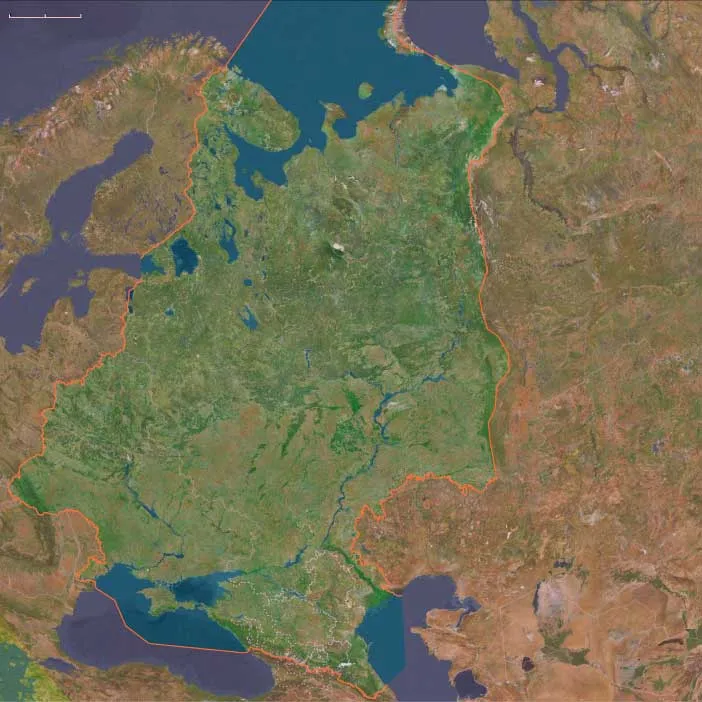
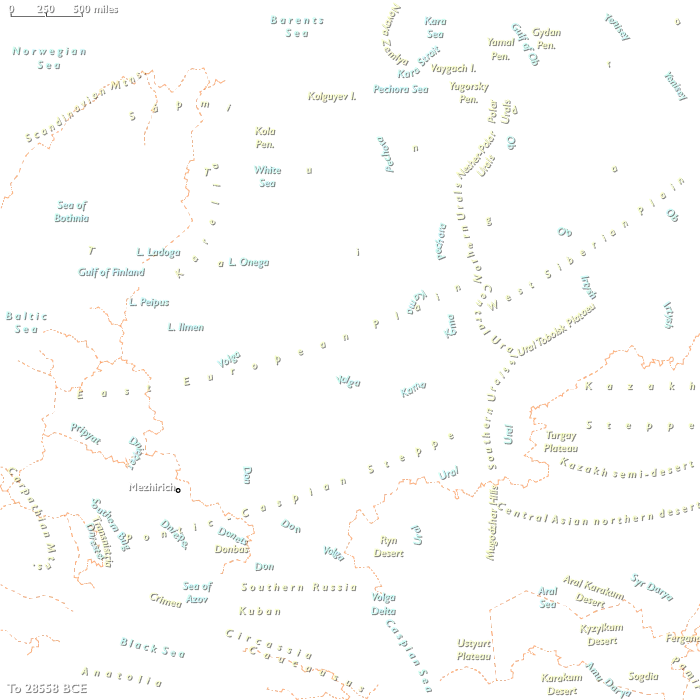
East Europe includes Belarus, Ukraine, and European Russia west of the Urals.
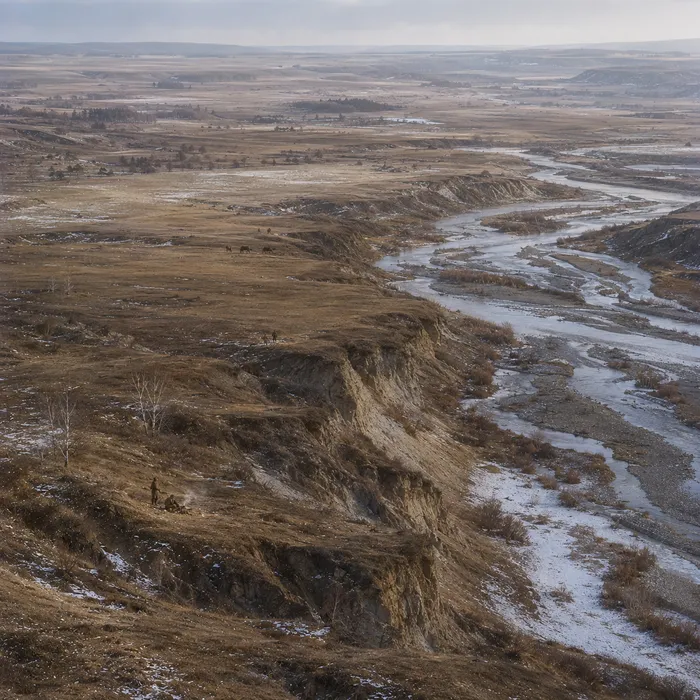
The Don, Dnieper, Oka, Volga headwaters, and Black Sea drainage basins crossed broad plains of loess, river terraces, floodplains, grassland, shrubland, and sparse woodland.
The region formed one of the great continental interiors of Late Pleistocene Europe, linking the Black Sea steppe with Central Europe, the Urals, and the approaches to western Siberia.
Its broad open landscapes were repeatedly reorganized by climate, while major river systems provided comparatively persistent ecological and movement corridors.
Climate and Environmental Shifts
Marine Isotope Stage 3 brought repeated and often abrupt changes in temperature, moisture, vegetation, permafrost, and river conditions.
During colder and windier phases, open steppe and tundra-like grassland expanded, tree cover contracted, and loess accumulated across broad plains. Frost processes intensified, while exposed landscapes became increasingly continental.
Milder interstadials allowed shrubland and sparse woodland to spread through river valleys and sheltered districts. Riparian vegetation became richer, wetlands expanded locally, and some animal populations shifted northward or eastward.
The East European Plain therefore did not move through one steady progression toward maximum glaciation. Its defining environmental rhythm was repeated alternation among cold open grasslands, riverine refugia, sparse woodland, and periglacial terrain.
Human Presence
The interval encompassed a profound transition from late Neanderthal occupation to expanding populations of Homo sapiens.
Neanderthal populations persisted in parts of eastern Europe during the earlier portion of MIS 3, while modern humans expanded across the region during the following millennia.
Modern humans were established on the East European Plain by more than 40,000 years ago. Sites in the Kostenki–Borshchevo complex preserve some of the earliest dense records of Upper Paleolithic occupation in eastern Europe, including repeated settlement, blade technologies, ornaments, and evidence of long-distance connections.
Human populations nevertheless changed through time rather than forming one continuous cultural tradition. The region experienced demographic replacement, dispersal, local contraction, and renewed occupation within a climatically unstable landscape.
Subsistence and Settlement
Mobile groups hunted horse, reindeer, bison, mammoth, and other large herbivores across open plains and river corridors.
Prey choice varied with climate and locality. Fish, birds, smaller mammals, and plant foods supplemented large-game procurement according to season and environmental setting.
River terraces, loess promontories, sheltered valleys, and other elevated locations were repeatedly used for occupation. Some places attracted recurrent settlement because they combined access to water, grazing animals, stone resources, and broad visibility across open country.
Settlement remained highly mobile rather than permanently fixed. Population density rose and fell as climatic phases altered prey distributions, winter severity, and the productivity of different sectors of the plain.
Technology and Material Culture
Middle Paleolithic technologies gave way unevenly to Initial and Upper Paleolithic blade traditions.
The transition was not instantaneous. Different technological systems overlapped through time and space as populations changed.
Later MIS 3 contexts preserve increasingly elaborate bone and ivory working, blade production, personal ornaments, pigments, and other organic technologies.
Stone procurement and tool production were adapted to broad mobility across open landscapes, while organic materials derived from large mammals supplied projectile components, clothing, shelter, and other equipment.
Systematic microblade traditions were not characteristic of the entire interval and should not be projected backward across the whole East European Plain.
Movement and Connectivity
The Don, Dnieper, Oka, and Volga-linked systems created long-distance corridors across the East European Plain.
These river networks connected the Black Sea steppe with Central Europe, the Urals, and Siberian approaches. Open loess plains and grassland belts created additional terrestrial routes where climate and prey distributions permitted.
Movement involved people, grazing animals, stone raw materials, technologies, and social information.
River valleys also functioned as refugia during severe climatic episodes, concentrating water, vegetation, fuel, and game within otherwise exposed landscapes.
Connectivity therefore depended on both environmental openness and climatic opportunity. Routes could expand during favorable phases and fragment when cold, aridity, or ecological deterioration intensified.
Cultural and Symbolic Expressions
Personal ornamentation and worked ivory became prominent in some modern-human communities.
Pigments, shaped bone and ivory, beads, pendants, and other symbolic objects appear in selected contexts, demonstrating increasingly visible systems of personal identity and social display.
Mortuary practices and portable symbolic objects also occur in particular later MIS 3 settings, but they should not be generalized across the whole East European Plain.
The surviving record indicates substantial cultural diversity rather than one homogeneous Upper Paleolithic symbolic tradition.
Environmental Adaptation and Resilience
Human communities repeatedly adjusted to severe continental climatic variability through mobility, clothing, shelter, fire, flexible prey choice, and long-distance social networks.
River valleys provided dependable water and vegetation, while open plains offered access to large grazing herds. Loess promontories and sheltered terrain supplied recurrent occupation places within otherwise exposed country.
During severe stadials, some territories became less habitable and populations contracted toward more favorable corridors. Milder intervals allowed renewed expansion across the plains.
Resilience therefore depended on the ability to shift settlement and subsistence across a large interconnected landscape rather than on continuous occupation of every district.
Transition
By 28,558 BCE, Homo sapiens was firmly established across major parts of East Europe, while Neanderthals had disappeared as distinct populations.
The Don, Dnieper, Oka, and Volga-linked systems remained central to human movement, and open steppe–tundra environments continued to support large grazing mammals and mobile hunting communities.
Colder conditions were increasingly reorganizing vegetation, river systems, and settlement opportunities, but the region remained an active human corridor rather than a depopulated northern margin.
At the close of Late Pleistocene I, East Europe was a changing human landscape of loess plains, cold grasslands, river refugia, long-distance connections, and demographic turnover—firmly incorporated into the expanding modern-human world of northern Eurasia.