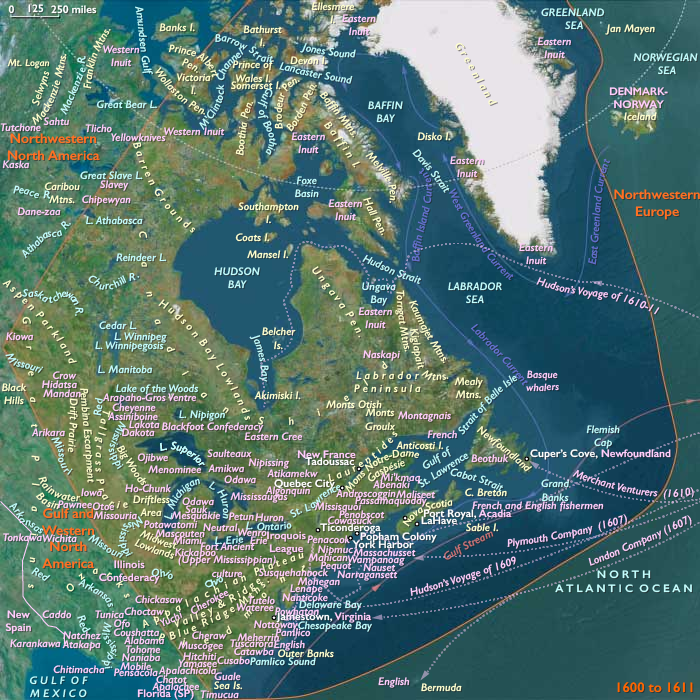
A company of settlers arrives to Jamestown…
October 1608 CE
A company of settlers arrives to Jamestown on October 1, 1608, aboard the English Mary and Margaret with the Second Supply.
The journey had taken roughly three months.
Included in the Second Supply are the first two women to come to the Jamestown Colony, Margaret Forrest and Anne Burras.
Thomas Forrest, Esq. (born May 1572 in Morborne, Huntingdonshire, England) is believed to have brought his son Peter (born 1601 in Morborne of Thomas's first marriage to Elizabeth Dancastle), and his second wife, referred to as Mistress Forrest (recently identified from her grave-site as Ann Margaret Fox (or Foxe), who has brought her maid, Anne Burras.
Thomas and Margaret had married on August 16, 1605, in St. Giles in the Fields, London, England.
While identified as Mistress Forrest's maid, it is possible that Anne Burras has accompanied the couple as a nanny to Peter (who is not Margaret's son), who would have been age six on arrival in the new colony.
The abridged compendium of American Genealogy - First Families of America states that Mistress Forrest was said to have been the first gentlewoman in Virginia.
Also included on the Second Supply are the first non-English settlers.
The company has recruited these as skilled craftsmen and industry specialists: soap-ash, glass, lumber milling (wainscot, clapboard, and ‘deal’—planks, especially soft wood planks) and naval stores (pitch, turpentine, and tar).
Among these additional settlers are eight "Dutch-men" (consisting of unnamed craftsmen and three who are probably the wood-mill-men—Adam, Franz and Samuel) "Dutch-men" (probably meaning German or German-speakers) and Polish craftsmen, who had been hired by the Virginia Company of London's leaders to help develop manufacture profitable export products.
There has been debate about the nationality of the specific craftsmen, and both the Germans and Poles claim the glassmaker for one of their own, but the evidence is insufficient.
Ethnicity is further complicated by the fact that the German minority in Royal Prussia lives under Polish control during this period.
William Volday/Wilhelm Waldi, a Swiss German mineral prospector, is also among those who arrivein 1608.
His mission is to seek a silver reservoir that is believed to be within the proximity of Jamestown.
Some of the settlers are artisans who will build a glass furnace which is to become the first factory in America.
Additional craftsmen are to produce soap, pitch, and wood building supplies.
Among all of these are the first made-in-America products to be exported to Europe.
However, despite all these efforts, profits from exports will prove insufficient to meet the expenses and expectations of the investors back in England, and no silver or gold will be discovered, as earlier hoped.
People
Groups
Commodities
Subjects
Regions
Northern North America
View →Subregions