
A fire breaks out in the new…
1137 CE
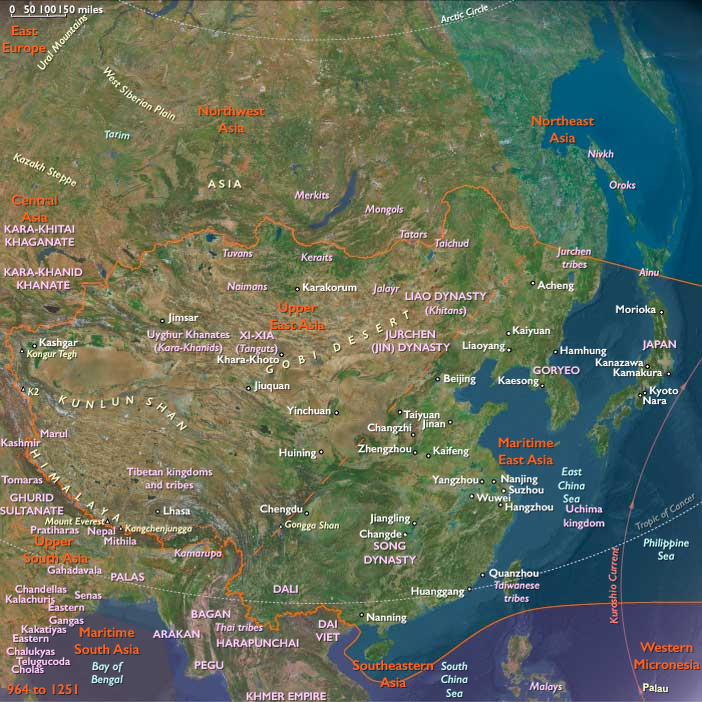
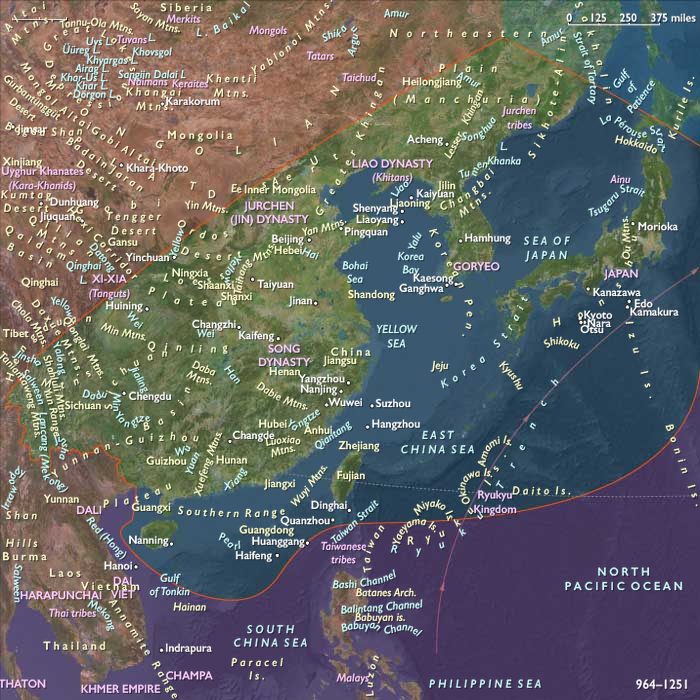
A fire breaks out in the new Song capital of Hangzhou; the government suspends the requirement of rent payments, alms of one hundred and eight thousand, eight hundred and forty kilograms (one hundred and twenty tons) of rice are distributed to the poor, and items such as bamboo, planks, and rush-matting are exempt from government taxation.
Commodities
Subjects
Regions
East Asia
View →Subregions
Maritime East Asia
View →Related Events
Showing 10 events out of 17 total
East Central Europe (1240–1251 CE): Mongol Invasion and Aftermath, Rebuilding under Béla IV, Polish Fragmentation after Legnica, Bohemian Stability, and Austria’s Babenberg Decline
Between 1240 and 1251 CE, East Central Europe—including modern-day Poland, Czechia, Slovakia, Hungary, and eastern regions of Germany and Austria east of 10°E and north of the defined southeastern boundary—experienced unprecedented turmoil, upheaval, and profound transformation due to the devastating Mongol invasion (1241–1242). The invasion dramatically reshaped regional power dynamics, political structures, and demographic landscapes. Hungary and Poland bore the brunt of Mongol destruction but subsequently entered phases of rebuilding and political realignment. Bohemia remained relatively stable under Wenceslaus I Přemysl, while Austria faced significant instability and dynastic decline following the end of the Babenberg dynasty. These developments had profound, lasting effects on regional governance, settlement patterns, and cultural identities.
Political and Military Developments
Devastating Mongol Invasion (1241–1242)
-
In 1241, Batu Khan’s Mongol armies swept across East Central Europe, causing catastrophic destruction. Major battles included the decisive defeats at Legnica (Poland) and Mohi (Hungary) in 1241, leading to mass casualties, widespread destruction, and significant territorial devastation.
-
Poland’s fragmented duchies suffered severely, notably in Silesia, where Duke Henry II the Pious fell at Legnica. Hungarian forces under King Béla IV (r. 1235–1270) were decisively defeated at Mohi, resulting in temporary royal exile and massive demographic losses.
Hungarian Reconstruction under Béla IV
-
Following the Mongol withdrawal in 1242, Béla IV initiated extensive reconstruction, fortification programs, and administrative reforms to rebuild Hungary’s political stability and security. He fostered new fortified towns and encouraged immigration and settlement to replenish population losses.
-
Béla IV’s recovery efforts fundamentally reshaped Hungary’s political structures, significantly increasing urban fortification and royal administrative reforms.
Polish Fragmentation Intensifies after Legnica
-
After the Battle of Legnica (1241) and the death of Henry II the Pious, Poland’s political fragmentation intensified. Silesia splintered further among Henry’s heirs, exacerbating regional rivalry and undermining previous unity efforts.
-
Silesian duchies, Greater Poland, Masovia, and Lesser Poland operated independently, deepening political decentralization and reducing unified governance.
Continued Stability in Bohemia under Wenceslaus I
-
Bohemia, under King Wenceslaus I (r. 1230–1253), managed to avoid direct Mongol devastation. Wenceslaus capitalized on this stability, continuing territorial consolidation, strengthening administrative governance, and maintaining regional political influence within the Holy Roman Empire.
Austrian Babenberg Dynasty Ends
-
In 1246, the Babenberg dynasty ended abruptly with the death of Duke Frederick II the Quarrelsome in battle. Austria plunged into dynastic uncertainty and instability, triggering a prolonged succession crisis that would reshape the duchy’s future within Central Europe.
Imperial Influence and Regional Instability
-
Emperor Frederick II’s (r. 1212–1250) declining authority in his final years contributed to regional instability, affecting political alliances and complicating dynastic succession disputes, notably in Austria and neighboring regions.
Economic and Technological Developments
Devastation and Economic Disruption from Mongol Invasions
-
The Mongol invasions caused severe economic disruption, widespread destruction of trade networks, agricultural devastation, and depopulation, especially in Hungary and Poland. Recovery efforts gradually restored commerce, though long-term impacts remained significant.
Reconstruction, Settlement, and Technological Advances
-
Post-invasion recovery saw significant rebuilding, settlement initiatives, and urban fortifications. Agricultural productivity and technological innovations—including improved fortification methods—played crucial roles in regional reconstruction.
Cultural and Artistic Developments
Hungarian Cultural Resilience and Reconstruction
-
Despite severe destruction, Béla IV strongly supported cultural restoration. Ecclesiastical architecture, manuscript illumination, and scholarly institutions gradually revived, reflecting Hungary’s resilient cultural identity and intellectual traditions.
Polish Cultural Continuity amid Fragmentation
-
Poland maintained significant cultural resilience, with monasteries and ecclesiastical institutions preserving cultural continuity, scholarship, and artistic traditions despite intensified fragmentation and political decentralization.
Bohemian Cultural Flourishing under Wenceslaus I
-
Bohemia, unaffected directly by the Mongol invasion, continued cultural and artistic development under Wenceslaus I. Prague’s significance as a center of manuscript production, ecclesiastical architecture, and scholarly activity notably increased.
Settlement and Urban Development
Hungarian Reconstruction and Urban Fortification under Béla IV
-
Béla IV initiated extensive rebuilding and urban fortification programs. New and existing towns, including Buda, Esztergom, and Visegrád, were substantially fortified, transforming Hungary’s urban landscape to better resist future invasions.
Continued Bohemian Urban Stability and Expansion
-
Bohemia’s urban centers, particularly Prague, remained stable, prospering commercially and culturally. Fortifications were reinforced strategically, and urban infrastructure continued developing, further enhancing regional prominence.
Austrian Instability and Urban Uncertainty
-
Following the Babenberg dynasty’s end (1246), Austrian urban growth temporarily slowed due to political uncertainty and dynastic instability. However, key centers like Vienna maintained essential administrative and economic functions, preserving continuity despite challenges.
Social and Religious Developments
Ecclesiastical Institutional Strength and Reconstruction
-
Ecclesiastical institutions played crucial roles in post-Mongol reconstruction, societal cohesion, and intellectual revival. Monasteries, bishoprics, and religious orders significantly influenced governance, education, and social recovery across East Central Europe.
Aristocratic Power, Social Transformation, and Urban Fortification
-
Aristocratic influence intensified due to the weakened royal authority from the Mongol invasion’s devastation. Nobility and local aristocrats played prominent roles in rebuilding, fortification, and regional governance, reshaping social and political structures.
Long-Term Consequences and Historical Significance
The era 1240–1251 CE was a transformative period for East Central Europe, marked by catastrophic destruction from the Mongol invasions and significant political realignments. Hungary under Béla IV undertook substantial reconstruction efforts, significantly altering its defensive strategies and urban landscapes. Poland faced deepened fragmentation following Legnica, hindering unified governance. Bohemia maintained political stability under Wenceslaus I, emerging with enhanced regional prominence. Austria’s Babenberg dynasty’s end introduced prolonged dynastic uncertainty. Collectively, these developments profoundly reshaped regional political, economic, social, and cultural structures, laying foundations for future medieval identities, governance patterns, and enduring legacies.
The Mongol Invasion of Poland from late 1240 to 1241 culminates in the Battle of Legnica, where the Mongols defeat an alliance that includes forces from fragmented Poland and members of various Christian military orders, led by Henry II the Pious, the Duke of Silesia.
The first invasion's intention is to secure the flank of the main Mongolian army attacking the Kingdom of Hungary.
The Mongols neutralize any potential help to King Bela from the Poles and the military orders (including the Teutonic knights in Prussia).
The Kingdom of Hungary, for a year after the Mongol invasion (1242), does not exist.
Poland, Bohemia and Hungary prepare for the Mongol attack while the Austrians observe from the sidelines.
Henry’s army consists of thirty thousand Polish knights, Teutonic Knights, French Knights Templar and an infantry levy including German gold miners from the town of Zlotoryja, or Goldberg.
A small settlement of gold miners had been founded on the slopes of Mount St. Nicholas (Góra św.
Mikołaja), at the shores of the Kaczawa river in the late twelfth century and early thirteenth centuries.
The village had grown rapidly and in 1211 was named Aurum and located on the Magdeburg law by Duke Henry I the Bearded as the first city in Silesia.
The local gold ore deposits are rich and the town attracts both miners and gold washers from all the nearby areas.
Hospitaller and Franciscan monasteries are founded in the town, which thus becomes one of the important cultural and religious centers of the region.
In 1241 many of the miners take part in the Battle of Legnica, where most of them die, but the mining will quickly recover.
Wenceslas of Bohemia commands an army of fifty thousand.
Boleslaw commands a sizable force of Polish and other Slavic troops; …
…a third Polish army is stationed near Chmielnik.
Mongol leader Batu has made wise use of intelligence information and strategy in his 1240-1241 invasion of Europe.
Under the brilliant strategist Subutai, the Mongols are by the winter of 1240-41 in Poland, where they attack Lublin.
The Kingdom of Hungary is in this age much like any other feudal kingdom of Europe: although the throne is still inherited by Árpád's successors, the king's authority and power has been greatly curtailed.
Rich magnates care less about the national security of the whole kingdom than about petty feudal quarrels with their fellow landlords.
The Golden Bull of 1222 issued by King Andrew II had authorized magnates to rebel against the king in some circumstances, and made him only 'primus inter pares'—first among equals.
Béla IV has tried to restore the king's former authority and power, without much success.
The Hungarians had first learned about the Mongol threat in 1229, when King Andrew had granted asylum to some fleeing Russian boyars.
Some Magyars, left behind during the main migration to the Pannonian basin, still lived on the banks of the upper Volga.
(It is believed by some that the descendants of this group are the modern-day Bashkirs, although this people now speaks a Turkic language, not Magyar.)
A Dominican friar, Julianus, had set off on an expedition in 1237 to lead them back, and had been sent back to King Béla with a letter from Batu Khan.
In this letter, Batu had called upon the Hungarian king to surrender his kingdom unconditionally to his forces or face complete destruction.
Béla had made no reply, and two more messages had later been delivered to Hungary.
The first had been sent in 1239 by the defeated Cuman tribes, who had asked for and received asylum in Hungary.
The second is sent in February 1241 by the defeated Polish princes.
King Béla IV heads a fighting force of sixty thousand to seventy thousand Hungarian and other European troops.
The Mongols invade the eastern borders of the of fragmented Kingdom of Poland in early 12410.
Baidar and Kadan ravage the southern part of Poland, first sacking Sandomierz; then, …