
The military conflict in Spain has worsened …
Years: 1810 - 1810
The military conflict in Spain has worsened by 1810.
The city of Seville has been invaded by French armies, which are already dominating most of the Iberian Peninsula.
The Junta of Seville has disestablished, and several members have fled to Cádiz, the last portion of Spain still resisting.
They have established a Council of Regency, with political tendencies closer to absolutism than the former Junta. This begins the May Revolution in Buenos Aires, as soon as the news is known.
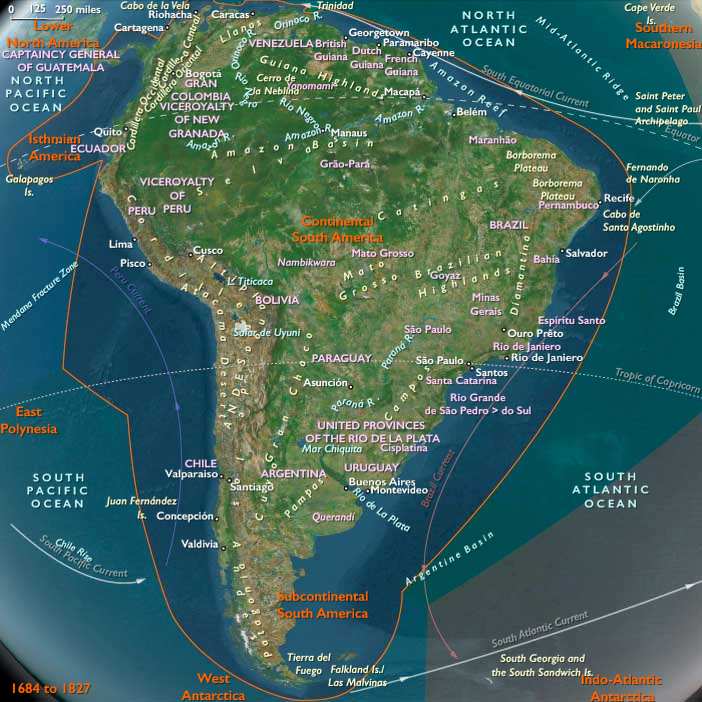
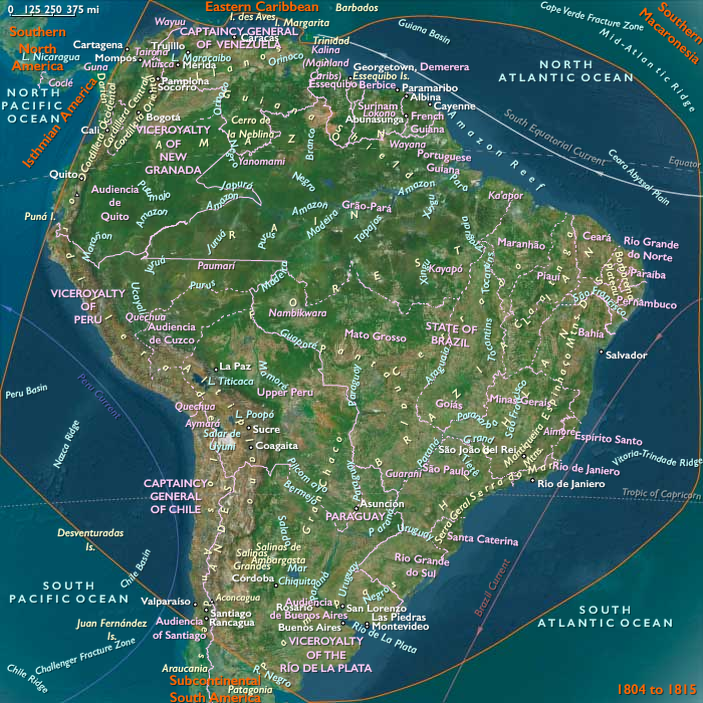
The territory of modern Argentina is part of the Spanish Viceroyalty of the Río de la Plata, with its capital city in Buenos Aires, seat of government of the Spanish viceroy.
Modern Uruguay, Paraguay and Bolivia are also part of the viceroyalty, and begin their push for autonomy during the conflict, becoming independent states afterwards.
The vast area of the territory and slow communications have led most populated areas to become isolated from each other.
The wealthiest regions of the viceroyalty are in Upper Peru, (modern-day Bolivia).
Salta and Córdoba have closer ties with Upper Peru than with Buenos Aires.
Similarly, Mendoza in the west has closer ties with the Captaincy General of Chile, although the Andes mountain range is a natural barrier.
Buenos Aires and Montevideo, who have a local rivalry, located in the La Plata Basin, have naval communications allowing them to be more in contact with European ideas and economic advances than the inland populations.
Paraguay is isolated from all other regions.
In the political structure, most authoritative positions are filled by people designated by the Spanish monarchy, most of them Spanish people from Europe, also known as peninsulares, without strong compromises for American problems or interests.
This has reated a growing rivalry between the Criollos, white people born in Latin America, and the peninsulares, Spanish people who arrived from Europe (the term "Criollo" is usually translated to English as "Creole", despite being unrelated to most other Creole peoples).
Despite the fact that all of them are considered Spanish, and that there is no legal distinction between Criollos and Peninsulares, most Criollos think that Peninsulares have undue weight in political matters.
The ideas of the American and French Revolutions, and the Age of Enlightenment, promote desires of social change among the criollos.
The full prohibition imposed by Spain to trade with other nations is also seen as damaging to the viceroyalty's economy.
The population of Buenos Aires had been highly militarized during the British invasions of the Río de la Plata, part of the Anglo-Spanish War.
Buenos Aires had been captured in 1806, then liberated by Santiago de Liniers with forces from Montevideo.[
Fearing a counter-attack, all the population of Buenos Aires capable of bearing arms had been arranged in military bodies, including slaves.
A new British attack in 1807 had captured Montevideo, but was defeated in Buenos Aires, and forced to leave the viceroyalty.
The viceroy Rafael de Sobremonte had beenb successfully deposed by the criollos during the conflict, and the Regiment of Patricians has become a highly influential force in local politics, even after the end of the British threat.
The transfer of the Portuguese Court to Brazil has generated military concern.
It is feared that the British will launch a third attack, this time allied with Portugal.
However, no military conflict takes place, as when the Peninsular War started, Britain and Portugal had become allies of Spain against France.
When the Spanish king Ferdinand VII is captured, his sister Carlota Joaquina seeks to rule in the Americas as regent, but nothing comes out of it because of the lack of support from both the Spanish Americans and the British.
Javier de Elío creates a Junta in Montevideo and Martín de Álzaga seeks to make a similar move by organizing a mutiny in Buenos Aires, but the local military forces intervene and thwart it.
Spain appoints a new viceroy, Baltasar Hidalgo de Cisneros, and Liniers hands the government to him without resistance, despite the proposals of the military to reject him.
Several citizens think that Cisneros, appointed by the disestablished Junta, does not have the right to rule anymore, and requests the convening of an open cabildo to discuss the fate of the local government.
The military gives their support to the request, forcing Cisneros to accept.
The discussion rules the removal of viceroy Cisneros and his replacement with a government junta, but the cabildo attempts to keep Cisneros in power by appointing him president of such junta.
Further demonstrations ensue, and the Junta is forced to resign immediately.
It is replaced by a new one, the Primera Junta.
Buenos Aires requests the other cities in the viceroyalty to acknowledge the new Junta and send deputies.
The precise purpose of these deputies, join the Junta or create a congress, is unclear at the time and generated political disputes later.
The Junta is initially resisted by all the main locations around Buenos Aires: Córdoba, Montevideo, Paraguay and the Upper Peru.
Santiago de Liniers comes out of his retirement in Córdoba and organizes an army to capture Buenos Aires, Montevideo had naval supremacy over the city, and Vicente Nieto organizes the actions at the Upper Peru.
Nieto proposes to José Fernando de Abascal y Sousa, viceroy of the Viceroyalty of Peru at the North, to annex the Upper Peru to it.
He thinks that the revolution can be easily contained in Buenos Aires, before launching a definitive attack.
Locations
People
Groups
Topics
- Enlightenment, Age of
- Napoleonic Wars
- Spanish American wars of independence
- Peninsular War
- Argentine War of Independence
- May Revolution
Subjects
Regions
Subregions
Related Events
Showing 10 events out of 21600 total
Years: 1810 - 1810
Locations
People
Groups
Topics
- Enlightenment, Age of
- Napoleonic Wars
- Spanish American wars of independence
- Peninsular War
- Argentine War of Independence
- May Revolution
Subjects
Regions
Subregions