A ninety-gun First Rate ship of the…
October 1637 CE
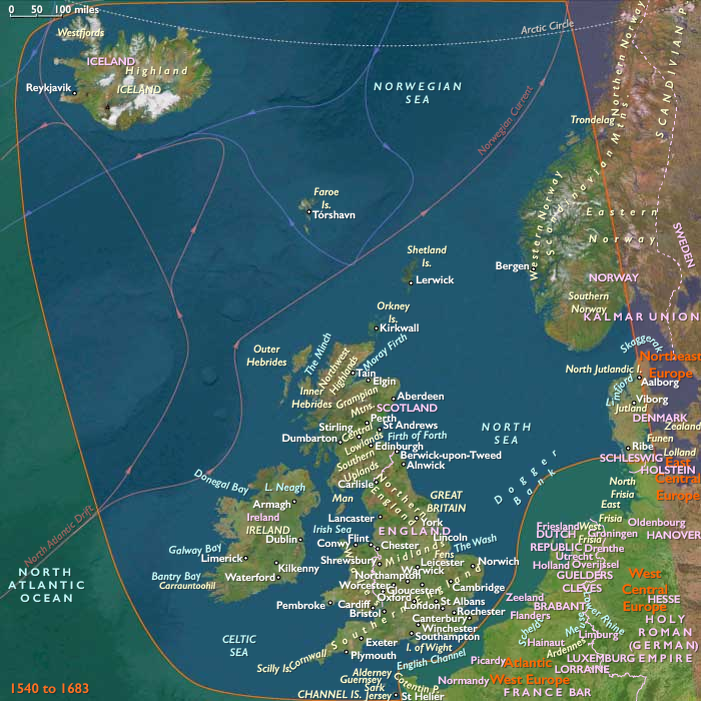
A ninety-gun First Rate ship of the line of the English Royal Navy called Sovereign of the Seas, ordered in August 1634 on personal initiative of Charles I of England, who desires a giant Great Ship to be built, is a deliberate attempt to bolster the reputation of the English crown.
The decision had provoked much opposition from the Brethren of Trinity House, who pointed out that "There is no port in the Kingdome that can harbour this shipp. The wild sea must bee her port, her anchors and cables her safety; if either fayle, the shipp must perish, the King lose his jewel, four or five hundred man must die, and perhaps some great and noble peer".
The King had overcome the objections with the help of John Pennington and from May 1635 she was built by Peter Pett (later a Commissioner of the Navy), under the guidance of his father Phineas, the king's master shipwright, and is launched on October 13, 1637, at Woolwich Dockyard.
As the second three-decked First Rate (the first three-decker being Prince Royal of 1610), she is the predecessor of Nelson's Victory, although Revenge, built in 1577 by Mathew Baker, had been the inspiration providing the innovation of a single deck devoted entirely to broadside guns.
She is the most extravagantly decorated warship in the Royal Navy, completely adorned from stern to bow with gilded carvings against a black background, made by John Christmas and Mathias Christmas after a design by Anthony van Dyck.
The money spent making her, sixty-five thousand five hundred and eighty six pounds, helps to create the financial crisis for Charles I that is to contribute to the English Civil War.
Charles had imposed a special tax, the 'Ship Money', to make possible such large naval expenditure.
The gilding alone cost six thousand six hundred and ninety-one pounds, the price of an average warship.
She carries one hundred and two bronze cannon (King Charles explicitly ordered such a high number) and is thereby at this time the most powerfully armed ship in the world.
Her name is in itself a political statement as Charles tries to revive the perceived ancient right of the English kings to be recognized as the 'lords of the seas.'
English ships demand that other ships strike their flags in salute, even in foreign ports.
The Dutch legal thinker Hugo Grotius has argued for a mare liberum, a sea free to be used by all.
As such a concept is mainly favorable to Dutch trade, John Selden and William Monson, with special permission of Charles, had in reaction published Mare Clausum ("the Closed Sea"), a book, earlier repressed by James I, trying to prove that King Edgar had already been recognized as Rex Marium, or "sovereign of the seas".
The name of the ship explicitly refers to this dispute; King Edgar is the central theme of the transom carvings.
Locations
Commodities
Subjects
Regions
North Europe
View →Subregions