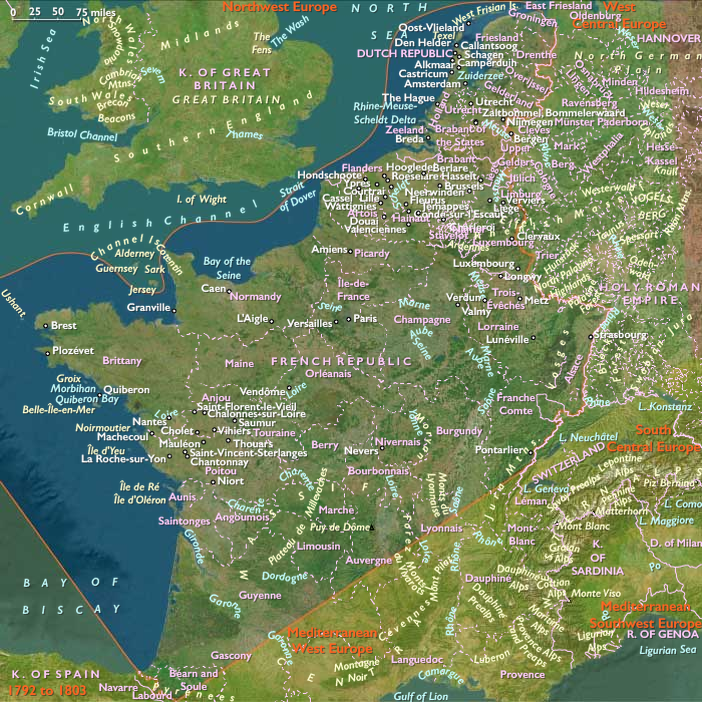
After the Southern Netherlands was annexed by…
October 1798 CE
After the Southern Netherlands was annexed by France, the French revolutionaries began to implement their policies regarding the Catholic Church.
The Civil Constitution of the Clergy requires that priests take an oath of allegiance to the state.
Priests who refuse such an oath (non-juring priests) are considered to be enemies of the state and can be removed from their positions and homes.
Additionally, in early 1798, the French Council of Five Hundred had passed a law requiring compulsory military service.
This law orders the conscription of men between the ages of twenty and twenty-five in all French territories.
General conscription like this is a relatively new product of the French Revolution, and is met with anger by the men who were forced into service.
The majority of the conflict during the Peasants' War occurs in Flanders (Lys and Scheldt départements) and Brabant (Deux-Nèthes and Dyle départements).
Referred to as the Boerenkrijg, it is referenced by some historians as a Belgian national revolt, and an indication of a desire for independence by Belgium.
In Flanders the revolt is somewhat organized, with the people seeking aid from foreign nations such as England and Prussia.
The revolution begins on October 12, 1798, with peasants taking up arms against the French in Overmere.
Locations
Topics
Subjects
Regions
West Europe
View →Subregions