At the outbreak of the conflict, Sweden…
July 1759 CE
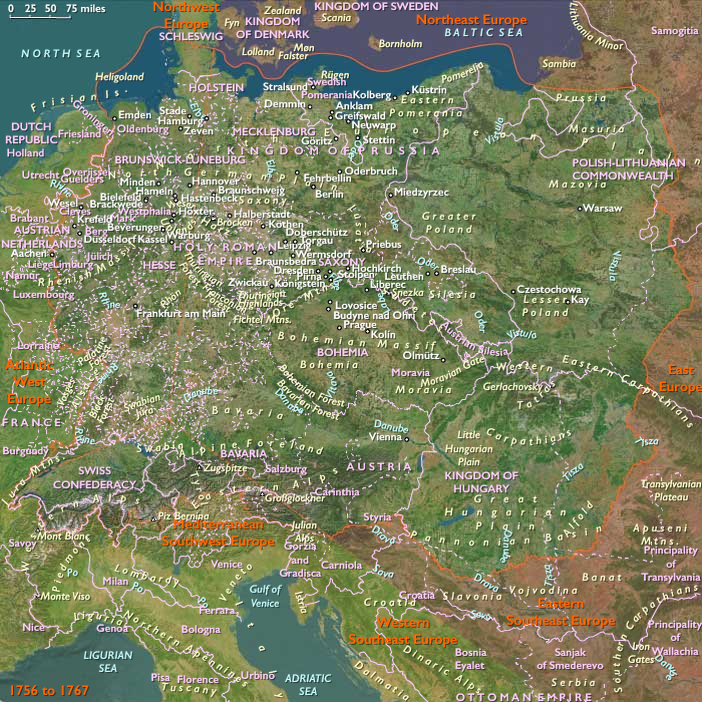
The chancellor and head of the Caps party, baron Anders Johan von Höpken, had sent an army of fourteen thousand five hundred men to Stralsund, capital of Swedish Pomerania, under field-marshal Ungern-Sternberg, with his main mission being the capture of Stettin (today in Poland), which controls the mouths of the Oder.
The Swedes had launched a first offensive but were beaten back in Stralsund by the Prussian army under marshal Lehwaldt.
Ungern-Sternberg has been replaced by count von Rosen, who had taken no risks and left himself blockaded in Stralsund.
However, a Russian offensive in west Prussia had forced Lehwaldt to leave Swedish Pomerania on June 27, 1758.
Sweden had sent reinforcements and a new commander-in-chief, count Hamilton, who profited from Prussian difficulties by going back on the offensive.
Although Prussian troops in the area have been heavily denuded to face the Russian threat, they put up a tenacious resistance to the Swedes and battles and skirmishes have come one after the other without either of the belligerents able to gain a decisive advantage over the other.
The conflict takes a naval turn when the Prussians build a fleet at Stettin, by the more or less fortunate transformation of fishing or transport boats into warships, to defy a Swedish squadron supporting their land offensive. Informed of these preparations, the Swedes decide to destroy this fleet.
People
Groups
Austria, Archduchy of
View →
Brunswick-Wolfenbüttel, Duchy of
View →
Saxony, Electorate of
View →
Holy Roman Empire
View →
Sweden, (second) Kingdom of
View →
Hesse-Kassel, Landgraviate of
View →
France, (Bourbon) Kingdom of
View →
Bavaria, Electorate of
View →
Brunswick-Lüneburg, Electorate of (Electorate of Hanover)
View →
Spain, Bourbon Kingdom of
View →
Prussia, Kingdom of
View →
Britain, Kingdom of Great
View →
Pomerania, Swedish
View →
Russian Empire
View →
Subjects
Regions
Central Europe
View →Subregions