
A very rich deposit of silver is…
1298 CE
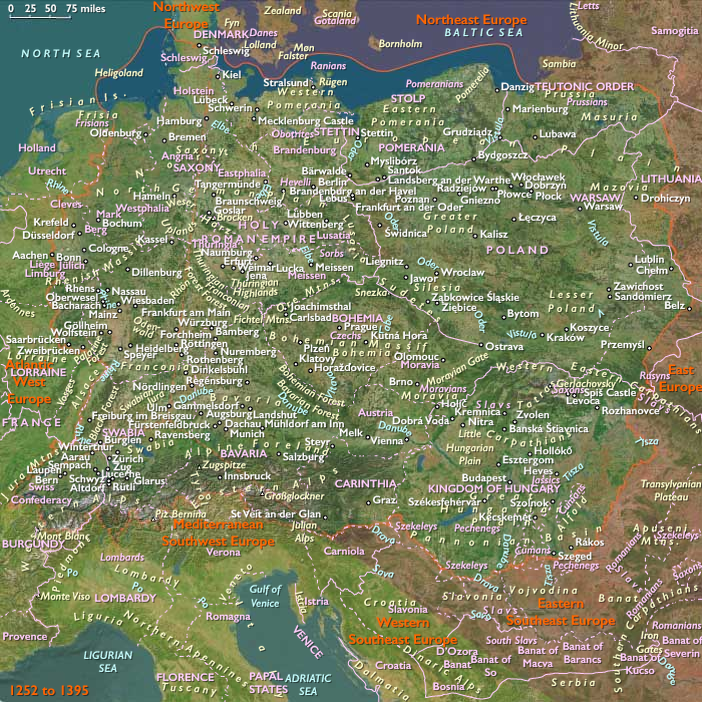
A very rich deposit of silver is discovered in 1298 in central Bohemia at Kuttenberg (Kutná Hora).
Wenceslaus takes control of the mine by making silver production a royal monopoly.
Groups
Commodities
Subjects
Regions
Central Europe
View →Subregions

East Central Europe
View →Related Events
No active filters.
Showing 10 events out of 45207 total
A civil war had broken out in 1296 in Terra Mariana between burghers of Riga and the Livonian Order.
Johannes III von Schwerin, Archbishop of Riga, had unsuccessfully attempted to mediate the dispute.
As the conflict grew, Johannes III had joined the cause of the Riga residents, but was defeated and taken prisoner.
Riga in March 1298 concludes an alliance with the pagan Grand Duchy of Lithuania, which is a subject of the Catholic crusade by the Teutonic Knights and Livonian Order.
The Lithuanians, commanded by Grand Duke Vytenis, invade Livonia and besiege Karkhus (Karksi).
The Lithuanians loot, massacre, and take many prisoners once the castle falls.
The defensive Livonian forces engage the Lithuanians on the Gauja River.
The knights seem at first to be winning the battle, but Vytenis vigorously counterattacks with reinforcements from the Archbishop and deals a decisive defeat.
Livonian Grand Master Bruno and the komtur of Fellin are killed.
According to different sources, either sixty or twenty to twenty-two noble knights were killed in the battle.
If indeed it was sixty, then the battle would be comparable to the Battle of Saule in terms of casualties.
If about twenty knights were killed, it would still be in the top ten defeats suffered in the thirteenth century by the Teutonic and Livonian crusader forces.
The Livonian Order receives reinforcements from the Teutonic Knights and defeats residents of Riga and Lithuanians near Neuermühlen on June 28.
Some four thousand Rigans and Lithuanians die at Neuermühlen, according to inflated numbers reported by Peter von Dusburg.
The knights proceed to besiege and capture Riga.
After Eric VI of Denmark threatens to invade Livonia to assist Archbishop Johannes III, a truce is reached and the conflict is mediated by Pope Boniface VII.
The conflict is not resolved, however, and the alliance between Lithuania and Riga will continue for another fifteen years.
Imperial authority, traditionally concerned with the protection of the Jews, had temporarily collapsed in the Franconia region of Germany during the civil strife between the elected King of the Romans, Count Adolf of Nassau, and his Habsburg rival Duke Albert of Austria.
Already in 1287, the death of Werner of Oberwesel in the Rhineland had been blamed on Jews and about five hundred had been killed in revenge, followed by a series of blood libels.
When, at the same time, the Jews in the Hohenlohe town of Röttingen are accused of having obtained and desecrated a consecrated host, one "Lord Rindtfleisch", whom the sources refer to either as an impoverished knight or—more probably—a butcher (the term Rindfleisch means "beef" in modern German spelling), gathers a mob around him and burns the Röttingen Jews on Sunday, April 20.
Rintfleisch declares to have received a mandate from heaven to avenge the sacrilege and exterminate the Jews.
The Colmar Dominican Rudolph refers to him in Latin as a carnifex, i.e., butcher or executioner, but it is not clear if Rudolph meant his original profession, or his behavior as a slaughterer of the Jews.
According to contemporary sources, the Lord of Röttingen, Kraft von Hohenlohe, is encumbered with debts to Jewish lenders.
After this, …
…Rintfleisch and his mob go from town to town and kill all Jews that fall under their control, destroying the Jewish communities at Rothenburg ob der Tauber, …
…Würzburg, …
…Bamberg, …
…Dinkelsbühl, …
…Nördlingen and …
…Forchheim.
The Jews in the Free Imperial City of Nuremberg seek refuge in the fortress and are assisted by the Christian citizens, but Rintfleisch overcomes the defenders and butchers the Jews on August 1.
The Nürnberger Memorbuch contains the names of thousands of murdered Jews in numerous cities, among them Mordechai ben Hillel, a pupil of Jehiel ben Asher, with his wife and children.