
…Würzburg, …
1298 CE
…Würzburg, …
Locations
Topics
Commodities
Subjects
Regions
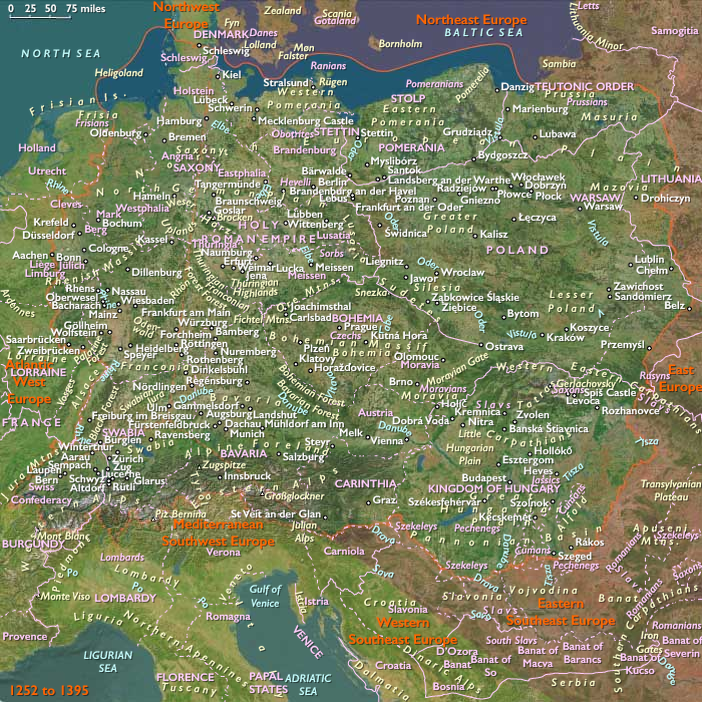
Central Europe
View →Subregions

East Central Europe
View →Related Events
Showing 10 events out of 213 total
The Prussian king, Frederick II, joined by the dukes of Bavaria and Saxony, invades the Bohemian Kingdom in 1741.
The duke of Bavaria, Charles Albert, is proclaimed king by the Czech nobility.
Although Maria-Theresa regains most of the Bohemian Kingdom and is crowned queen in Prague in 1743, all of the highly industrialized territory of Silesia except for Tesm, Opava, and Krnov is ceded to Prussia.
In attempting to make administration more rational, Maria-Theresa embarks on a policy of centralization and bureaucratization.
What remains of the Bohemian Kingdom is now merged into the Austrian provinces of the Habsburg realm.
The two separate chancelleries are abolished and replaced by a joint Austro-Bohemian chancellery.
The Czech estates are stripped of the last remnants of their political power, and their functions are assumed by imperial civil servants appointed by the queen.
The provinces of the Czech and Austrian territories are subdivided into administrative districts.
German becomes the official language.
Further reforms introduced by Maria-Theresa and Joseph II reflect such Enlightenment principles as the dissolution of feudal social structures and the curtailment of power of the Catholic Church.
Maria-Theresa nationalizes and Germanizes the education system, eliminates Jesuit control, and shifts educational emphasis from theology to the sciences.
Serfdom is modified: robota (forced labor on the lord's land) is reduced, and serfs can marry and change domiciles without the lord's consent.
Joseph II abolishes serfdom altogether.
Joseph's Edict of Toleration extends freedom of worship to Lutherans and Calvinists in 1781 .
Brandenburg in 1648 had been a small state in northern Germany.
It has been ruled by the Hohenzollern Dynasty since the late fifteenth century and consists of the core region and its capital, Berlin: eastern Pomerania; an area around Magdeburg; the former holdings of the Knights of the Teutonic Order in eastern Prussia; and some smaller holdings in western Germany.
Brandenburg becomes known as Prussia in 1701 when its ruler crowns himself King Frederick I of Prussia.
Prussia acquires the rest of Pomerania after defeating Sweden in the Great Northern War (1700-21).
Prussia's increase in size and influence may be attributed to a succession of capable leaders, all of whom enjoy long reigns.
The first is Frederick William (r. 1640-88), known as the Great Elector, who increases his family's power by granting favors to the nobility, weakening the independence of the towns, and maintaining a professional standing army.
His son Frederick I (r. 1688-1713) establishes Prussia as a kingdom.
Frederick further strengthens the army, but not nearly as much as his son Frederick William I (r. 1713- 40), who also modernizes the kingdom's bureaucracy.
Frederick II (r. 1740-86), known to posterity as Frederick the Great, continues along the same lines as his father but shows much greater imagination and ruthlessness, transforming his small kingdom into one of the great powers of Europe.
The competition culminates, fifty years later, in the Seven Years' War (1756-63).
Fought by Prussia under Frederick II (Frederick the Great, 1740-86) against Austria, Russia, and France, the conflict demonstrates the superiority of the disciplined Prussian armies.
None of the other states of the empire are strong enough by the eighteenth century to have territorial ambitions to match those of Prussia and Austria.
Some of the larger states, such as Saxony, Bavaria, and Wurttemberg, also maintain standing armies, but their smaller size compels them to seek allies, some from outside the empire.
With the exception of the free cities and ecclesiastical states, smaller states, like Austria and Prussia, are governed by a hereditary monarch who rules either with the consent or help of the nobility and with the help of an increasingly well-trained bureaucracy.
Only a few states, such as Wurttemberg, can boast of an active democracy of the kind evolving in Britain and France.
Except in a few free cities, such as Frankfurt am Main and Hamburg, which are active in international trade, Germany's commercial class is neither strong nor self-confident.
Farmers in western Germany are largely free; those in the east are often serfs.
However, whether in the east or the west, most who work the land live at the subsistence level.
Prussia and Austria are rivals but they have some important characteristics in common.
Neither state is populated by a single people, but by numerous peoples speaking different languages and belonging to different religions.
Neither state is located entirely within the empire.
Both have sizable territories to the east of the empire, and it is there that they hope mainly to expand.
Both states are governed by enlightened monarchs, who, having only to cajole the nobility with occasional concessions, see government as for the people but not by the people.
Hence, both states are governed by the most efficient methods known to the eighteenth century, and both are fairly tolerant according to the standards of the time.
Prussia accepts many Protestants expelled from other states, most notably the Huguenots who flee France after the Edict of Nantes in 1685.
Austria becomes one of the first states to allow Jews to settle where they like within its boundaries and to practice the professions of their choice.
Frederick seizes Silesia, a wealthy province that belongs to the Habsburgs and has a population of about one million inhabitants, in 1740.
Maria Theresa (r. 1740-80), the new Habsburg empress, is unable to regain possession of Silesia, which remains under Prussian control at the end of the War of the Austrian Succession (1740-48).
Frederick retains Silesia even after facing a coalition of France, Austria, and Russia during the Seven Years' War (1756-63).
Frederick expands Prussian territory still further in 1772, when, with his erstwhile enemies Russia and Austria, he takes part in the First Partition of Poland.
This last seizure is highly beneficial to Frederick because it links eastern Prussia with much of his kingdom's western holdings.
He has a great influence on Rousseau, who will leave elaborate examinations of some of them, and is a forerunner of Kant's 1795 essay on perpetual peace.
He can be seen as an early proponent of the ideas of the Enlightenment.
Saint-Pierre is one of the first to mention the possibility of a European union made by independent and autonomous states.
His work on a European community directly inspires the idea of an international order based on the principle of collective self-defense, and is important to the creation of the Concert of Europe, and later the League of Nations, whose successor is the United Nations Organization.
Frederick the Great of Prussia writes to Voltaire on the 'Projet pour render la paix perpétuelle en Europe': "The Abbe de Saint-Pierre has sent me a fine work on how to re-establish peace in Europe. The thing is very practicable. All it lacks to be successful, is the consent of all Europe and a few other such small details." ( Dosenrode, Søren (1998). Danske EUropavisioner. Århus: Systime. p. 10.)
Ideas contributed by Saint-Pierre include:
an equitable tax system, including a graduated income tax,
free public education, for women as well as men,
state improvement of transportation to further commerce,
an international court and league of states (Projet de paix perpétuelle 1713),
a constitutional monarchy, aided by a system of councils and an academy of experts (Discours sur la polysynodie 1718).
Saint-Pierre was born at the château of Saint-Pierre-Église near Cherbourg, where his father, the Marquis de Saint-Pierre, was grand bailli of Cotentin.
He was educated by the Jesuits.
The youngest of five children and unsuited to a military career owing to poor health, he became a priest.
He was introduced by family connections into the salons of Madame de la Fayette and the Marquise de Lambert in Paris.
He was elected to the Académie française in 1695, although he had previously produced no notable work; his election was an episode in the Quarrel of the Ancients and the Moderns, Saint-Pierre being a clear representative of the latter.
The same year he gained a footing at court as chaplain to Madame, the king's sister-in-law.
From 1703 to his death, he was abbot of Tiron.
Contrary to a widely believed opinion, it is not while working as a negotiator of the Treaty of Utrecht (1712–13) that he develops his project of universal peace.
Saint-Pierre worked on the idea from 1708 and publishes early versions from 1712.
In 1718, he publishes Discours sur la polysynodie, where he proposes that appointed ministers be replaced by elected councils.
As a consequence of his criticism of the policy of Louis XIV (d. 1715) he is expelled from the Académie later the same year.
East Central Europe (1732–1743 CE): War of the Polish Succession, Pragmatic Sanction Diplomacy, and Prussian Strengthening
Between 1732 and 1743 CE, East Central Europe—including modern-day Poland, Czechia, Slovakia, Hungary, and eastern Germany and Austria east of 10°E and north of the defined boundary—experienced significant geopolitical upheaval, most notably the War of the Polish Succession (1733–1738), continued diplomatic maneuvering over the Habsburg succession, further strengthening of Prussian military and bureaucratic capabilities, and steady economic and cultural growth under Enlightenment influences. This era critically shaped the region’s political dynamics, setting the stage for subsequent pivotal mid-century conflicts.
Political and Military Developments
War of the Polish Succession (1733–1738)
-
Following the death of King Augustus II the Strong in 1733, Poland-Lithuania plunged into a succession crisis. The election of Stanisław Leszczyński, supported by France, triggered the War of the Polish Succession against Augustus II’s son, Augustus III, backed by Russia and Austria.
-
The conflict, primarily a proxy struggle among major European powers, saw Poland become a battleground for foreign armies, ultimately resulting in Augustus III’s victory (confirmed by the Treaty of Vienna, 1738), further deepening Polish political instability and dependence on external powers.
Continued Pragmatic Sanction Diplomacy and European Alignments
-
Emperor Charles VI’s persistent diplomatic efforts succeeded in formally securing acceptance of the Pragmatic Sanction by major powers, notably France, through the 1738 Treaty of Vienna, guaranteeing the succession of his daughter, Maria Theresa.
-
Despite diplomatic agreements, unresolved tensions lingered, anticipating future conflicts upon Charles VI’s death in 1740.
Death of Charles VI and the Outbreak of the War of the Austrian Succession (1740)
-
Charles VI’s death in 1740 ignited the War of the Austrian Succession, as rival powers challenged Maria Theresa’s right to inherit the Habsburg dominions.
-
Frederick II (the Great) of Prussia immediately invaded Austrian Silesia (1740–1742), initiating the First Silesian War, profoundly reshaping East Central European geopolitics.
Prussian Military Expansion and Strengthening
-
Prussia, under Frederick William I (1713–1740) and his successor Frederick II (from 1740), significantly enhanced its military strength, bureaucratic efficiency, and centralized governance, transforming the kingdom into a formidable regional power capable of challenging Habsburg authority.
Economic and Technological Developments
Regional Economic Resilience Amid Conflict
-
Despite ongoing conflicts, economic conditions across East Central Europe remained relatively robust. Urban centers such as Vienna, Prague, Leipzig, and Dresden maintained prosperity through regional trade and manufacturing.
-
Agricultural productivity continued rising, bolstered by improved cultivation methods, animal husbandry, and gradual adoption of crop rotations and new crops.
Infrastructure and Industrial Development
-
Prussian investment in infrastructure, including roads and canals, boosted regional economic efficiency, laying early foundations for industrial growth.
-
Austria and Bohemia improved river navigation and infrastructure, enhancing connectivity to broader European markets.
Cultural and Artistic Developments
Enlightenment Thought and Cultural Patronage
-
Enlightenment ideas continued influencing intellectual and cultural life, with royal courts in Vienna, Dresden, and Berlin patronizing intellectual societies, artistic circles, and educational institutions.
-
Architectural and artistic production flourished, notably in the Baroque and early Rococo styles, reflecting regional wealth and cultural sophistication.
Educational and Intellectual Advancement
-
Universities and intellectual societies in Vienna, Prague, and Berlin promoted education, science, and philosophical inquiry, significantly contributing to regional cultural vitality and intellectual exchange.
Settlement and Urban Development
Urban Growth Amid Political Turmoil
-
Urbanization continued steadily, driven by economic resilience and stable demographic conditions. Key cities—including Vienna, Prague, Dresden, Leipzig, Berlin, and Warsaw—maintained robust economic and demographic growth.
-
Infrastructure enhancements and improved urban planning further strengthened urban centers’ administrative and commercial roles across East Central Europe.
Social and Religious Developments
Aristocratic Power and Social Structures
-
Aristocratic power remained deeply entrenched, particularly in Poland-Lithuania, Hungary, and Bohemia, limiting centralized governance and reinforcing noble privileges, even as state centralization advanced in Prussia and Austria.
-
Social stability persisted despite aristocratic tensions, largely supported by economic prosperity and effective bureaucratic management.
Religious Tolerance and Continued Diversity
-
Moderate religious tolerance persisted across the region, notably in Austrian territories and Prussia, fostering social cohesion among diverse religious communities, including Protestants, Catholics, and Jewish minorities.
Long-Term Consequences and Historical Significance
The period from 1732 to 1743 CE critically reshaped East Central Europe, laying foundations for mid-century conflicts. The War of the Polish Succession deepened Poland’s vulnerability and political fragmentation, amplifying foreign influence. Diplomatic agreements surrounding the Pragmatic Sanction set the stage for major conflicts upon Charles VI’s death, leading directly to the transformative War of the Austrian Succession. Prussia’s emergence as a regional military powerhouse under Frederick II dramatically shifted the balance of power, decisively influencing subsequent geopolitical alignments. Continued economic resilience, urban expansion, and Enlightenment cultural flourishing underscored the region’s growing sophistication, providing essential foundations for future political, social, and economic developments.
Atlantic West Europe (1732–1743): Economic Stability, Enlightenment Progress, and Diplomatic Realignment
Between 1732 and 1743, Atlantic West Europe—including northern France, the Low Countries (Belgium, Netherlands, Luxembourg), and regions facing the Atlantic and English Channel—experienced sustained economic recovery, strengthened diplomatic realignments, continued Enlightenment advancements, and vibrant cultural productivity. This period marked a gradual stabilization after earlier financial shocks and laid critical foundations for future political shifts and intellectual revolutions.
Political and Military Developments
Stability Under Louis XV and the Habsburgs
-
In France, Louis XV (r.1715–1774) continued his peaceful rule, stabilizing internal governance despite growing criticism of court extravagance and administrative inefficiency. His influential chief minister, Cardinal Fleury (1726–1743), managed diplomatic affairs skillfully, maintaining general European peace while avoiding costly wars.
-
The Austrian Netherlands under Maria Theresa’s rule (1740–1780) maintained internal stability and administrative efficiency. The region prospered economically and culturally, despite ongoing diplomatic tensions related to the War of the Austrian Succession (beginning in 1740).
The War of the Austrian Succession (1740–1748)
-
The death of Emperor Charles VI in 1740 triggered succession disputes across Europe, leading to the War of the Austrian Succession (1740–1748). Though this conflict primarily impacted central Europe initially, Atlantic West Europe was drawn into diplomatic realignments and military preparations.
-
France aligned against Maria Theresa's Austrian claims, allying initially with Prussia under Frederick II. Military preparations in northern France and the Low Countries intensified, though direct fighting remained limited at this stage.
Economic Developments: Stability and Growth
Continued Recovery and Prosperity
-
After the financial instability of the early 1720s, Atlantic West Europe experienced notable economic stability. French cities like Bordeaux, Nantes, and La Rochelle thrived, driven by expanding Atlantic commerce in wine, sugar, and manufactured goods.
-
Antwerp, Amsterdam, and Brussels saw renewed trade vigor, bolstered by maritime commerce, colonial products, and strong financial institutions that regained trust after earlier crises.
Industrial Innovation and Expansion
-
Textile manufacturing in Flanders and Brabant continued to expand significantly, becoming highly efficient and increasingly mechanized. These developments positioned the region as a leading center of European textile production.
-
Shipbuilding and maritime industries along the Atlantic coast, particularly in French port cities and Dutch maritime towns, flourished, fueling broader economic prosperity and maritime dominance.
Agricultural Advancements
-
Agricultural reforms and innovations continued to spread across northern France and the Low Countries, enhancing productivity and stabilizing regional economies. Improved crop rotations, drainage methods, and livestock breeding yielded higher agricultural output, reducing periodic famines.
Intellectual and Cultural Developments
Enlightenment Ideals and Intellectual Progress
-
Enlightenment thought reached new heights. In France, figures such as Voltaire published pivotal works (Letters Concerning the English Nation, 1733), critiquing French absolutism and promoting ideals of freedom, reason, and tolerance.
-
The Low Countries became prominent intellectual hubs, with Amsterdam and Leiden continuing to attract leading thinkers, philosophers, and scientists from across Europe.
The Expansion of Scientific Inquiry
-
Scientific academies, including the Académie des Sciences in Paris and societies in Amsterdam and Brussels, sponsored research in mathematics, astronomy, chemistry, and medicine, significantly advancing European scientific knowledge.
-
Eminent scientists, including French mathematician Pierre Louis Maupertuis, significantly contributed to debates about Earth's shape through geodesic expeditions, underscoring the region’s intellectual vitality.
Religious Developments and Tolerance
Gradual Religious Moderation
-
Religious toleration continued gradual expansion, particularly in the Dutch Republic, where a relatively liberal atmosphere fostered intellectual openness. Calvinist orthodoxy softened somewhat, allowing freer exchanges of ideas.
-
In France, while formal Catholic dominance remained firm, intellectual circles increasingly criticized intolerance and superstition, advocating Enlightenment ideals of religious tolerance, as illustrated by Voltaire’s critical writings.
Cultural and Artistic Flourishing
Rococo Art and Architectural Grandeur
-
Rococo style remained culturally dominant, characterized by elaborate decoration, playful themes, and delicate aesthetics. Paris, Brussels, and Antwerp notably embraced this style, influencing architecture, interior decoration, painting, and sculpture.
-
French painters like François Boucher gained significant acclaim during this period, setting aesthetic standards for European art that emphasized opulence, elegance, and courtly sophistication.
Literary and Philosophical Influence
-
French literary circles thrived, fostering intense intellectual discourse within prominent Parisian salons hosted by figures such as Madame Geoffrin and Madame du Deffand, where Enlightenment ideals circulated widely.
-
The literary scene in the Low Countries similarly flourished, especially in Amsterdam and Brussels, featuring lively publishing and distribution networks promoting both local and international works.
Social and Urban Developments
Urban Expansion and Commercial Vitality
-
Port cities such as Amsterdam, Rotterdam, Bordeaux, and Nantes experienced significant urban expansion, reflecting prosperous maritime trade and economic buoyancy.
-
Increased wealth contributed to improved urban infrastructure, including the construction of public buildings, canals, and marketplaces, facilitating commerce and enhancing quality of life.
Rise of the Merchant Class and Social Shifts
-
The merchant and bourgeois classes in Atlantic cities became increasingly influential, gaining political leverage and fostering social mobility. Urban commercial elites invested in civic improvements, education, and cultural patronage, significantly shaping urban identities.
Continued Social Critique and Debate
-
Despite economic prosperity, Enlightenment intellectuals sharply critiqued societal inequities, aristocratic privilege, and governmental corruption. Public debates fostered awareness of social injustice, laying intellectual groundwork for future revolutionary sentiments.
Legacy and Historical Significance
The period 1732–1743 solidified the resilient economic and intellectual foundations of Atlantic West Europe, contributing decisively toward its subsequent historical trajectory:
-
Politically, this era demonstrated effective governance, diplomatic pragmatism, and preparedness for emerging European conflicts.
-
Economically, sustained recovery and industrial advancements reaffirmed the region’s economic prominence, laying groundwork for future prosperity and global commercial influence.
-
Intellectually, Enlightenment thought deepened its influence, setting crucial precedents for modern European society, politics, and culture.
-
Socially and culturally, the rise of urban merchant classes, vigorous artistic production, and intellectual vibrancy shaped urban identity and future societal developments.
Ultimately, this era reinforced Atlantic West Europe's enduring position as a leading cultural, intellectual, and economic powerhouse on the European and global stages.
Many of Antoine Pesne's portraits of the Prussian royal family and their household hang today in Berlin Museums and in Charlottenburg Palace.
These include (among others) his portraits of the first two kings of Prussia, Frederich I and Frederick William I, and members of the latter's family.
In St. Agnus Church in Köthen, where J. S. Bach was music director (Kapellmeister), there is a huge portrait of the donor Gisela Agnes, Princess of Anhalt-Köthen, painted by Pesne in 1713.
The ceiling paintings in Charlottenburg, Rheinsberg, and Sanssouci Palaces are at least partially his work.
Pesne, born in Paris, had first studied art under his father and uncle, and had received a stipend for advanced training from 1704 to 1710 at the Académie Royale in Italy.
He was called to Berlin by King Frederick I of Prussia in 1710
As the director of the Berlin Academy of the Arts from 1722, Pesne has become famous through his portraiture.