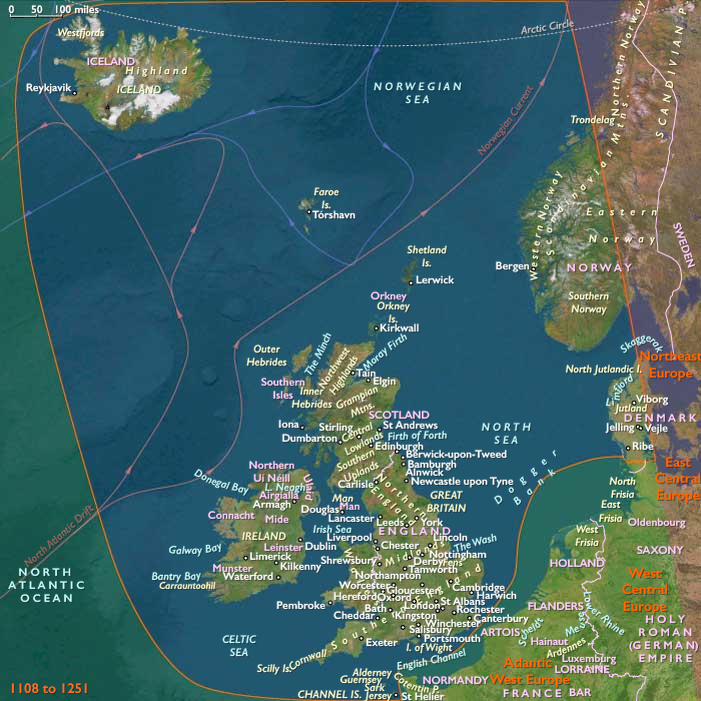
A Welsh revolt against Norman rule had…
October 1136 CE
A Welsh revolt against Norman rule had begun in south Wales, where on January 1, 1136, the Welsh win a victory over the local Norman forces at the Battle of Llwchwr between Loughor and Swansea, killing about five hundred of their opponents.
Richard Fitz Gilbert de Clare, the Norman lord of Ceredigion, had been away from his lordship in the early part of the year.
Returning to the borders of Wales in April, he ignores warnings of the danger and presses on towards Ceredigion with a small force.
He has not gone far when he is ambushed and killed by the men of Iorwerth ab Owain, grandson of Caradog ap Gruffydd (the penultimate prince of Gwent).
The news of Richard's death leads to an invasion by the forces of Gwynedd, led by Owain Gwynedd and Cadwaladr ap Gruffydd, sons of the king of Gwynedd, Gruffydd ap Cynan.
They capture a number of castles in northern Ceredigion before returning home to dispose of the plunder.
Around Michaelmas, they again invade Ceredigion and made an alliance with Gruffydd ap Rhys of Deheubarth.
The combined forces head for Cardigan.
These troops are said to include hundreds of armored horsemen, a style of warfare which the Welsh had learnt from the Normans.
After some hard fighting, the Norman forces are put to flight and pursued as far as the River Teifi.
Many of the fugitives try to cross the bridge, which breaks under the weight, with hundreds said to have drowned, clogging the river with the bodies of men and horses.
Others flee to the town of Cardigan, which however is taken and burned by the Welsh though Robert fitz Martin successfully manages to defend and hold the castle; it is the only one to remain in Norman hands at the end of the rebellion.
Ceredigion, which had been part of Deheubarth before the Normans had conquered it, is now annexed by Gwynedd as the more powerful member of the coalition.
Years later, Rhys ap Gruffydd of Deheubarth will be able to win it back.
The battle is a significant setback to Norman expansion in Wales.
Owain Gwynedd will become king of Gwynedd on the death of his father the following year, and will further expand the borders of the kingdom.
Rhys ap Gruffydd in 1137 will die in Deheubarth in uncertain circumstances, and this will enable the Normans to recover their position in the south.
Groups
Topics
Commodities
Subjects
Regions
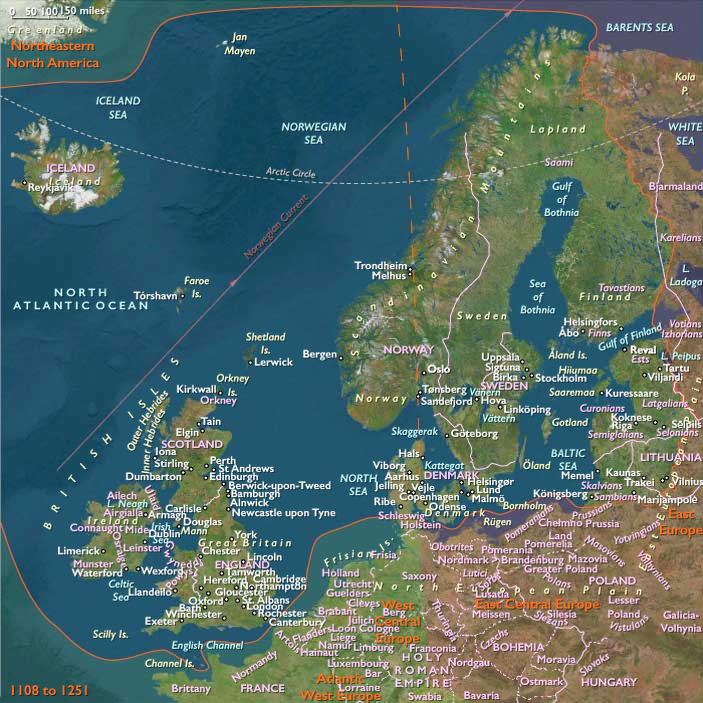
North Europe
View →Subregions