
Event
Abraham Darby, the first to cast iron…
Abraham Darby, the first to cast iron using coke fuel, is probably helped by the fact that the Shropshire 'clod coal' that he is using is relatively sulfur-free.
However, experimentation with different fuels continues for some time; for example, cargoes of coal are brought up the Severn from Bristol and Neath.
Some of the molten iron from the blast is run into pigs and sent down the Severn for use in Bristol foundries, but much of it is used to cast pots and other cast iron goods.
Darby sells eighty-one tons of iron goods this year.
The son of John Darby, a yeoman farmer and locksmith by trade, and his wife Ann Baylies, Abraham was born at Wren's Nest, Woodsetton, Staffordshire, just across the county boundary from Dudley, Worcestershire.
He was descended from nobility; his great-grandmother Jane was an illegitimate child of Edward Sutton, 5th Baron Dudley.
Abraham's great-grandmother was a sister of the whole blood to Dud Dudley, who claimed to have smelted iron using coke as a fuel.
Unfortunately, the iron that Dudley produced was not acceptable to the charcoal ironmasters.
However, this may have inspired his great-grandnephew Darby to perfect this novel method of smelting.
Darby during the early 1690s had been apprenticed in Birmingham to Jonathan Freeth, a fellow Quaker and a manufacturer of brass mills for grinding malt.
As well as the understanding of metallurgy necessary for the manufacture of products in an alloy like brass, Darby would also have picked up in Birmingham the use by brewers of coke to fuel malting ovens, preventing the sulfur content of coal contaminating the resulting beer, but also avoiding the use of the scarcer charcoal as a fuel.
The combination of these two insights is to lead to Darby's development of the coke-fueled blast furnace in 1709.
Freeth had encouraged Darby to become a highly active member in the Society of Friends, and he will remain so all his life.
When he completes his apprenticeship in 1699, he marries Mary Sergeant (1678-1718) and moves to Bristol, where he sets himself up as a malt mill maker.
There is a small community of Quakers in Bristol, and Darby had soon gained a reputation for skill and enterprise.
Darby had joined with a number of fellow Quakers in 1702 to form the Bristol Brass Company, with works at Baptist Mills in Bristol, and had brought in 'Dutchmen' to operate a brass battery work, making cooking pots and other holloware under a trip hammer.
He had also developed a method for casting pots in 'greensand' molds, previously only used for smaller castings.
This enabled pots to be mass-produced and to be thinner than those made by the traditional process of casting in loam molds.
For this purpose, he established the Cheese Lane Foundry in 1704.
Initially he cast brass pots, but by 1705 he had moved on to using iron.
A young Welsh apprentice, John Thomas, had solved the problem by using sand for the mold, with a special casting box and core.
Using this casting method, Darby could cast pots of sufficient thinness and lightness.
Darby had taken out a patent on the new casting method in 1707; his successors will sell pots over wide areas of England and Wales, and enjoy a virtual monopoly in the trade.
For this, he uses a reverberatory air furnace of a kind developed by Sir Clement Clerke, initially for smelting lead near Bristol, and applied by him or his son Talbot to iron founding at Vauxhall.
Darby had leased the Coalbrookdale Furnace furnace in September 1708, and set to work preparing to get it into blast.
His first account book, running from October 20, 1708 to 4 January 4, 1710, survives, and shows the production of 'charked' coal in January 1709 and the furnace being brought into blast on January 10.
The blast appears to have been successful, marking the first successful production of cast iron using coke fuel.
-
{# Image navigates to the detail page; the magnifying-glass chip is the only Fancybox lightbox trigger (kept a separate sibling — anchors can't nest). #}
 The North Atlantic Lands
World
-
{# Image navigates to the detail page; the magnifying-glass chip is the only Fancybox lightbox trigger (kept a separate sibling — anchors can't nest). #}
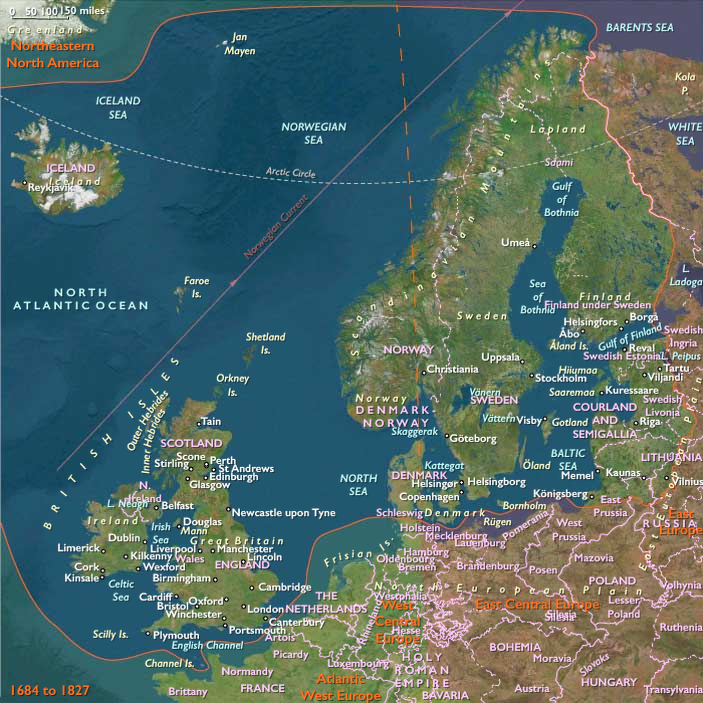 North Europe
Region
-
{# Image navigates to the detail page; the magnifying-glass chip is the only Fancybox lightbox trigger (kept a separate sibling — anchors can't nest). #}
 Northwest Europe
Subregion
