Event
Relations between Christian and Muslim powers take…
Relations between Christian and Muslim powers take the form of raids and counterraids through the first quarter of the sixteenth century in Ethiopia.
Each side seeks to claim as many slaves and as much booty as possible, but neither side attempts to bring the other firmly under its rule.
By the second decade of the sixteenth century, however, a young soldier in the Adali army, Ahmad ibn Ibrahim al Ghazi, has begun to acquire a strong following by virtue of his military successes and in time becomes the de facto leader of Adal.
Concurrently, he acquires the status of a religious leader.
Ahmad, who comes to be called Gragn (the "Lefthanded") by his Christian enemies, rallies the ethnically diverse Muslims, including many Afar and Somali, in a jihad intended to break Christian power.
In 1525 Gragn leads his first expedition against a Christian army and over the next two or three years continues to attack Ethiopian territory, burning churches, taking prisoners, and collecting booty.
At the Battle of Shimbra Kure in 1529, according to historian Taddesse Tamrat, "Imam Ahmad broke the backbone of Christian resistance against his offensives."
The emperor, Lebna Dengel (Dawit II, reigned 1508-40), is unable to organize an effective defense, and in the early 1530s Gran's armies penetrate the heartland of the Ethiopian state—northern Shewa, Amhara, and Tigray—devastating the countryside and thereafter putting much of what had been the Christian kingdom under the rule of Muslim governors.
Each side seeks to claim as many slaves and as much booty as possible, but neither side attempts to bring the other firmly under its rule.
By the second decade of the sixteenth century, however, a young soldier in the Adali army, Ahmad ibn Ibrahim al Ghazi, has begun to acquire a strong following by virtue of his military successes and in time becomes the de facto leader of Adal.
Concurrently, he acquires the status of a religious leader.
Ahmad, who comes to be called Gragn (the "Lefthanded") by his Christian enemies, rallies the ethnically diverse Muslims, including many Afar and Somali, in a jihad intended to break Christian power.
In 1525 Gragn leads his first expedition against a Christian army and over the next two or three years continues to attack Ethiopian territory, burning churches, taking prisoners, and collecting booty.
At the Battle of Shimbra Kure in 1529, according to historian Taddesse Tamrat, "Imam Ahmad broke the backbone of Christian resistance against his offensives."
The emperor, Lebna Dengel (Dawit II, reigned 1508-40), is unable to organize an effective defense, and in the early 1530s Gran's armies penetrate the heartland of the Ethiopian state—northern Shewa, Amhara, and Tigray—devastating the countryside and thereafter putting much of what had been the Christian kingdom under the rule of Muslim governors.
-
{# Image navigates to the detail page; the magnifying-glass chip is the only Fancybox lightbox trigger (kept a separate sibling — anchors can't nest). #}
 The Middle of The Earth
World
The Middle of The Earth
World
-
{# Image navigates to the detail page; the magnifying-glass chip is the only Fancybox lightbox trigger (kept a separate sibling — anchors can't nest). #}
 East Africa
Region
East Africa
Region
-
{# Image navigates to the detail page; the magnifying-glass chip is the only Fancybox lightbox trigger (kept a separate sibling — anchors can't nest). #}
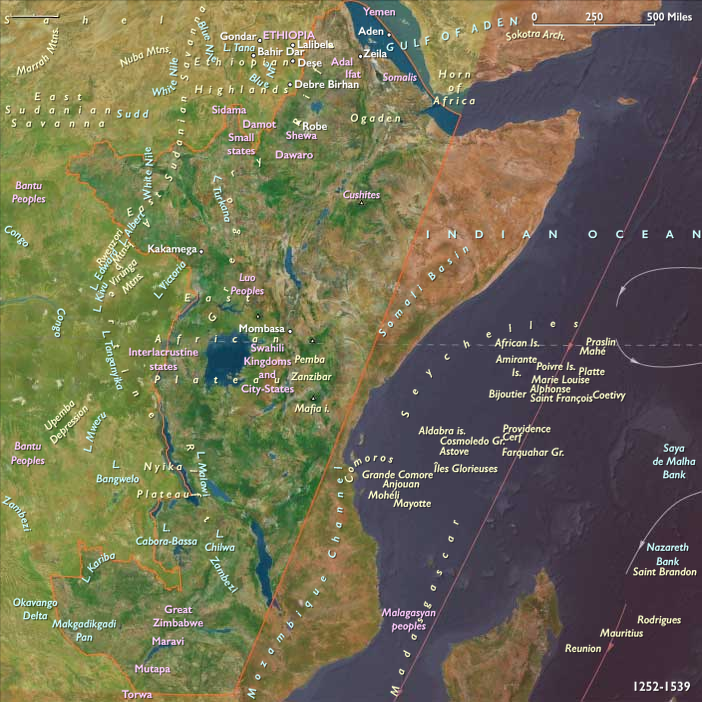 Interior East Africa
Subregion
Interior East Africa
Subregion