
A rich cultural diversity evolves in China…
1252 CE to 1395 CE
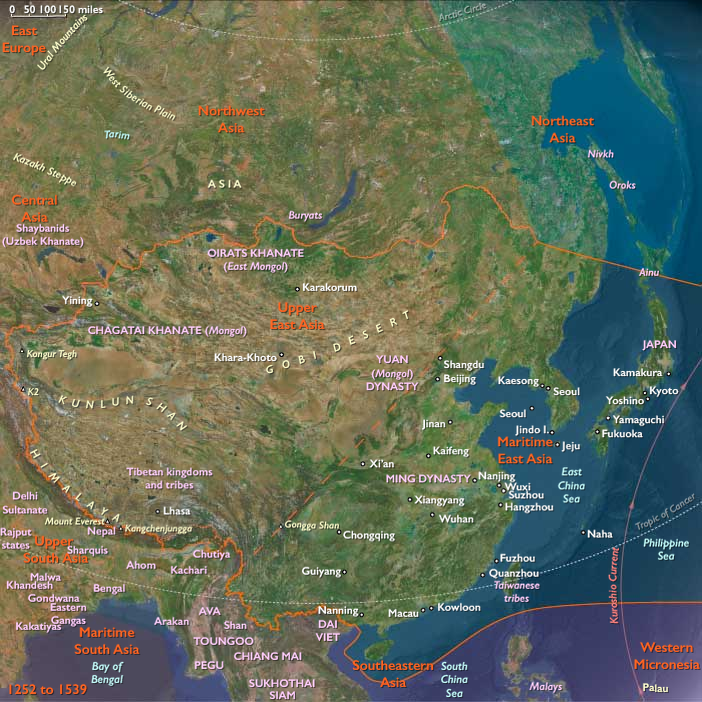
A rich cultural diversity evolves in China during the Yuan Dynasty, as it had in other periods of foreign dynastic rule.
Major achievements include the development of drama and the novel and the increased use of the written vernacular.
The Yuan is involved in a fair amount of cultural exchange because of its extensive West Asian and European contacts.
The introduction of foreign musical instruments enriches the Chinese performing arts.
The conversion to Islam of growing numbers of people in northwestern and southwestern China dates from this period.
Nestorian Christianity and Roman Catholicism also enjoy a period of toleration.
Lamaism flourished, although native Taoism endures Mongol persecutions.
Chinese governmental practices and examinations are reinstated by the Mongols in the hope of maintaining order within society.
Advances are realized in the fields of travel literature, cartography, geography, and scientific education.
Certain key Chinese innovations—such as printing techniques, porcelain playing cards, and medical literature—are introduced in Europe, while European skills, such as the production of thin glass and cloisonne, become popular in China.
People
Groups
Commodities
Subjects
Regions
East Asia
View →Subregions
