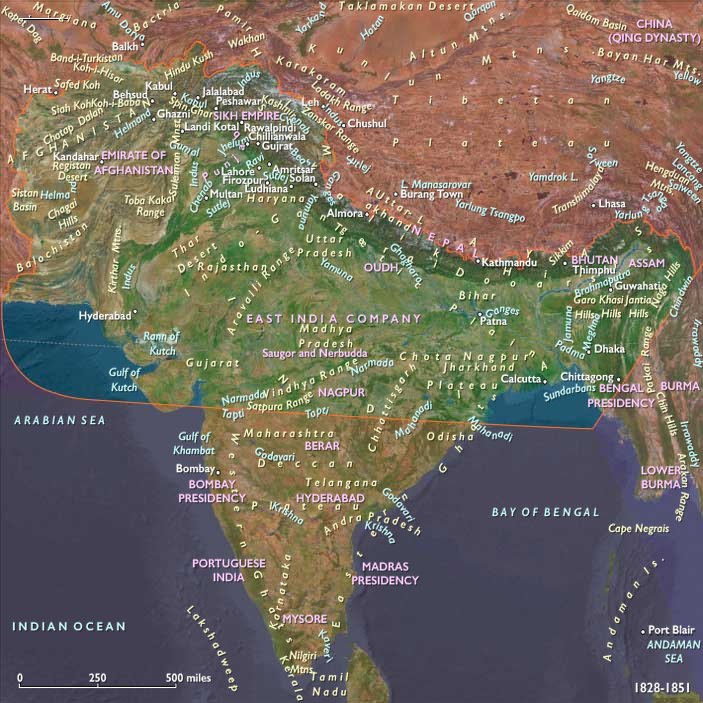
Jawahir Singh, Jind Kaur's brother, had become…
September 1845 CE
Jawahir Singh, Jind Kaur's brother, had become Vizier in December 1844, after the Vizier Hira Singh was killed attempting to flee the capital by troops under Sham Singh Attariwala.
He apparently spends his term of office in a state of terror, trying to bribe the Khalsa with promises of treasure which could not be met.
At an army parade in September 1845, he is butchered to death in the presence of Jind Kaur and Duleep Singh.
The Khalsa nevertheless does not take over the kingdom at this point.
Although Jind Kaur publicly vows revenge against her brother's killers, she remains Regent.
Lal Singh (reportedly the lover of Jind Kaur) becomes Vizier, and Tej Singh becomes commander of the army. (Sikh historians have stressed that both these men were prominent in the Dogra faction. Originally high-caste Hindus from outside the Punjab, both had converted to Sikhism in 1818.)
The primary concern of the British under Governor-General Lord Ellenborough is that the Khalsa, now without strong leadership to restrain them, is a serious threat to British territories along the border.
Their attitudes are affected by reports from the new Political Agent in the frontier districts, Major George Broadfoot, who stresses the disorder in the Punjab and recounts every tale of corrupt behavior at the court.
The Khalsa, for their part, had been asking Ranjit Singh for an opportunity to engage the British, since their expansion had reached the borders of the Punjab.
The British began preparing bridging trains and siege gun batteries, an unconcealed and seemingly aggressive British military buildup that has the effect of increasing tension within the Punjab and the Khalsa.
After mutual demands and accusations between the Sikh Darbar and the East India Company, diplomatic relations are broken.
Locations
Groups
Regions
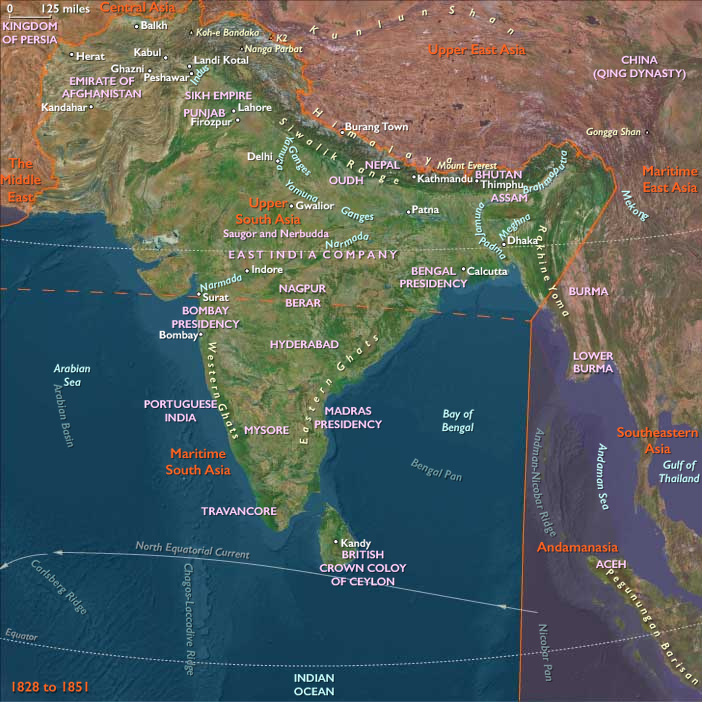
South Asia
View →Subregions