
Hamilcar, grandson of Hanno the Navigator, successfully…
310 BCE
Hamilcar, grandson of Hanno the Navigator, successfully leads the Carthaginian counterattack.
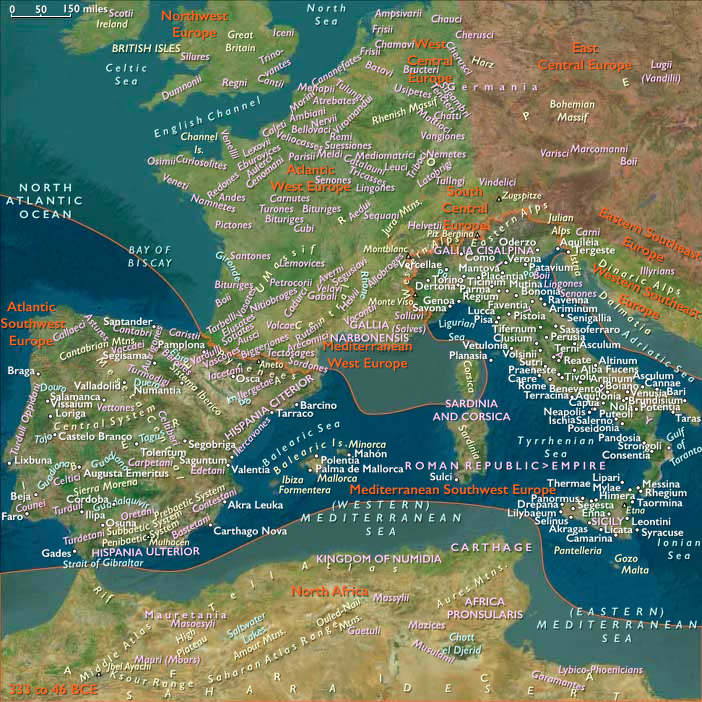
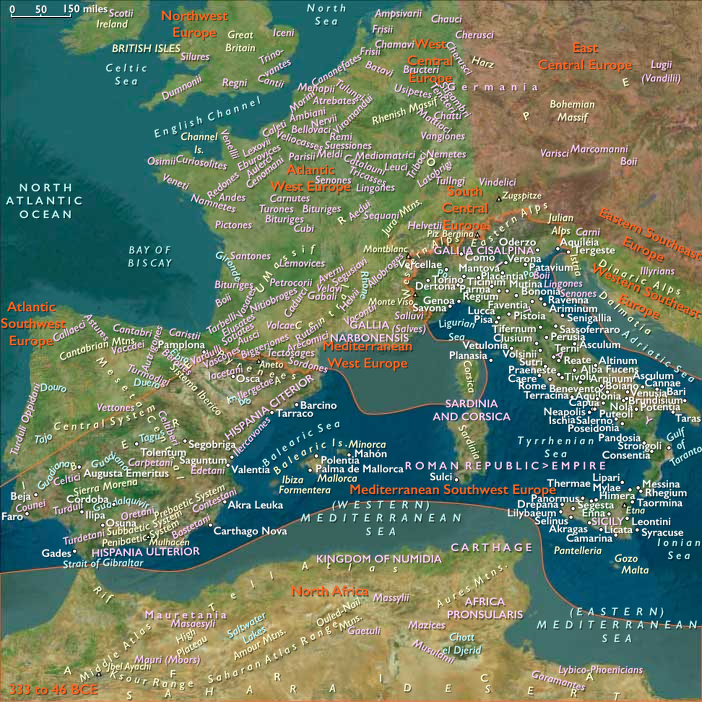
He controls almost all of Sicily by 310 BCE, and has laid siege to Syracuse itself.
Locations
Topics
Subjects
Regions
Southwest Europe
View →Subregions
Mediterranean Southwest Europe
View →Related Events
No active filters.
Showing 10 events out of 64209 total
All the other Diadochi (Alexander's successors) confirm the existing boundaries and the freedom of the Greek cities.
Antigonus, no longer regent but merely strategos (officer in charge) of the whole of Asia, is to rule in Syria and from the Hellespont to the Euphrates, leaving Lysimachus with Thrace, Cassander with Greece and Macedonia (but only until Alexander IV comes of age in 305), and …
…Ptolemy with Egypt and Cyprus.
Ptolemy suppresses the island's kingdoms and in 310 forces the last king of Salamis, Nicocreon, to commit suicide, together with all his family. (For the next two and a half centuries, Cyprus will remain a Ptolemaic possession, ruled by a strategos, or governor-general.)
Ptolemy next attacks Cilicia, sparking the second coalition war (310-301) against Antigonus.
Defenders of the Argead dynasty have begun to declare, following the treaty, that Alexander IV should now exercise full power and that a regent is no longer needed.
The response of the Macedonian regent Cassander, his ruthlessness toward Alexander's family partly dictated by political considerations, is definitive: to secure his rule, in 310 BCE or 309 BCE, he commands the Macedonian general Glaucias to secretly assassinate Alexander IV and his mother Roxana.
The orders are carried out, and they are both poisoned.
The Etruscan cities in the north, induced by the Samnites to join their second war against Rome, have revolted against Roman rule, but the Romans, after recovering from the first shock, continuously defeat both their enemies.
The war becomes a contest for the dominance of much of Italy.
Between 311 and 304, the Romans and their allies win a series of victories against both the Etruscans and the Samnites.
The Romans crush the rebellious Etruscans in 310 at the Battle of Lake Vadimo, which is the largest battle between these nations.
The Romans gain land and influence in the region; the Etruscans, who sustain heavy losses in the battle, will never again reclaim their previous glory.
The Etruscans of Volsinii appear next in 310 BCE, when, in common with the rest of the Etruscan cities, except Arretium (modern Arezzo), they take part in the siege of Sutrium (modern Sutri), a city in alliance with Rome.
This war is terminated by the defeat of the Etruscans at the First Battle of Lake Vadimo (310 BCE), a major shock to their power.
The Deutero-Malays, an Iron Age or Bronze Age people descended partly from the Chams of Cambodia and Vietnam, push the Proto-Malays inland around 300 BCE.
The first group in the peninsula to use metal tools, the Deutero-Malays are the direct ancestors of today's Malaysian Malays, and bring with them advanced farming techniques.
The Malays share a common culture and social structure but remain politically fragmented throughout the Malay archipelago.
The culture of Japan’s Yayoi people, whose comparatively large settlements are centered in southwestern and central Japan, displays a marked change in orientation from the Jomon culture it succeed circa 300 BCE.
Wet-rice cultivation and bronze technology are apparently introduced from Korea by way of Kyushu.
Yayoi ceramics , in contrast to the robust Jomon wares, are made with finer clay, are turned on a wheel, are generally more utilitarian in character, and feature more casual, occasionally elegant, decoration.
Alexander’s conquests and the subsequent partition of Alexander's empire into four major states with Macedonian dynasts has greatly facilitated communication from India to Sicily, as the Greek language spreads and becomes the lingua franca for culture, commerce, and administration throughout the Near East.
The Middle East: 309–298 BCE
Linguistic and Cultural Shifts and the Babylonian War
The Babylonian War and the Rise of Seleucus
The Babylonian War (311–309 BCE) between Diadochi kings Antigonus I Monophthalmus and Seleucus I Nicator ends in a decisive victory for Seleucus. This conflict eliminates any chance of restoring Alexander's empire, a reality confirmed at the subsequent Battle of Ipsus. The outcome solidifies Seleucus's control over the eastern satrapies, marking the emergence of the extensive Seleucid Empire.
Evolution of the Old Persian Language
During the late fourth century BCE, the Old Persian language, known through inscriptions, clay tablets, and seals, transitions significantly. Inscriptions from the reigns of Artaxerxes II and Artaxerxes III evolve into a form of "pre-Middle Persian," setting the stage for Middle Persian and eventually New Persian, the foundation of modern Persian dialects. Recent discoveries in the Persepolis Fortification Archive at the Oriental Institute reveal practical administrative texts in Old Persian, highlighting broader use beyond royal ceremonial contexts.