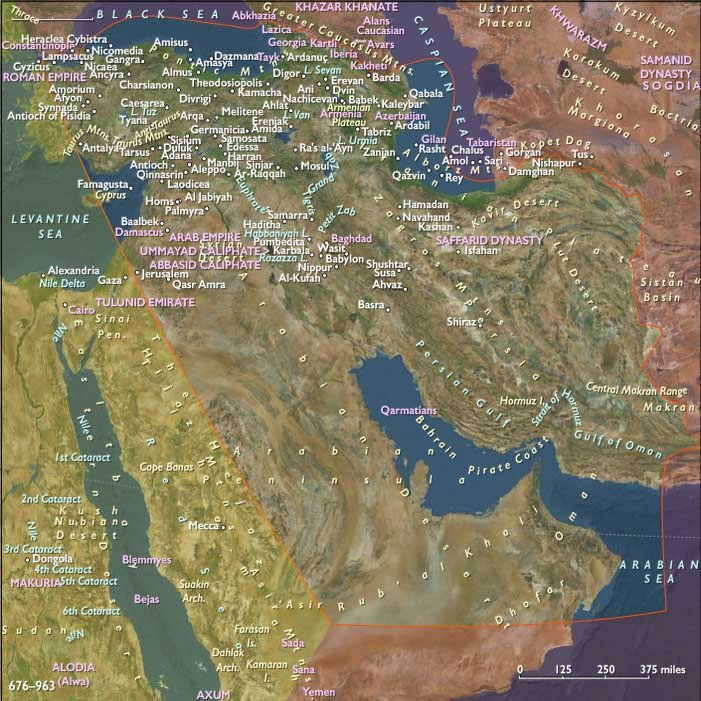
Ahmad ibn Rustah writes a geographical compendium…
892 CE to 903 CE
Ahmad ibn Rustah writes a geographical compendium known as the Book of Precious Records.
The information on his home town of Isfahan is especially extensive and valuable.
Ibn Rustah states that, while for other lands he had to depend on secondhand reports, often acquired with great difficulty and with no means of checking their veracity, for Isfahan he could use his own experience and observations or statements from others known to be reliable.
Thus we have a description of the twenty districts (rostaqs) of Isfahan containing details not found in other geographers' works.
Concerning the town itself, we learn that it was perfectly circular in shape, with a circumference of half a farsang, walls defended by a hundred towers, and four gates.
His information on the non-Islamic peoples of Europe and Inner Asia makes him a useful source for these obscure regions (he is even aware of the existence of the British Isles and of the Heptarchy of Anglo-Saxon England) and for the prehistory of the Turks and other steppe peoples.
About a certain king of the Caucasus, Ahmad ibn Rustah writes:
"He prayed on Fridays with the Muslims, on Saturdays with the Jews, and on Sundays with the Christians.
'Since each religion claims that it is the only true one and that the others are invalid', the king explained, 'I have decided to hedge my bets.'"
Locations
People
Groups
Topics
Subjects
Regions

The Near and Middle East
View →Subregions