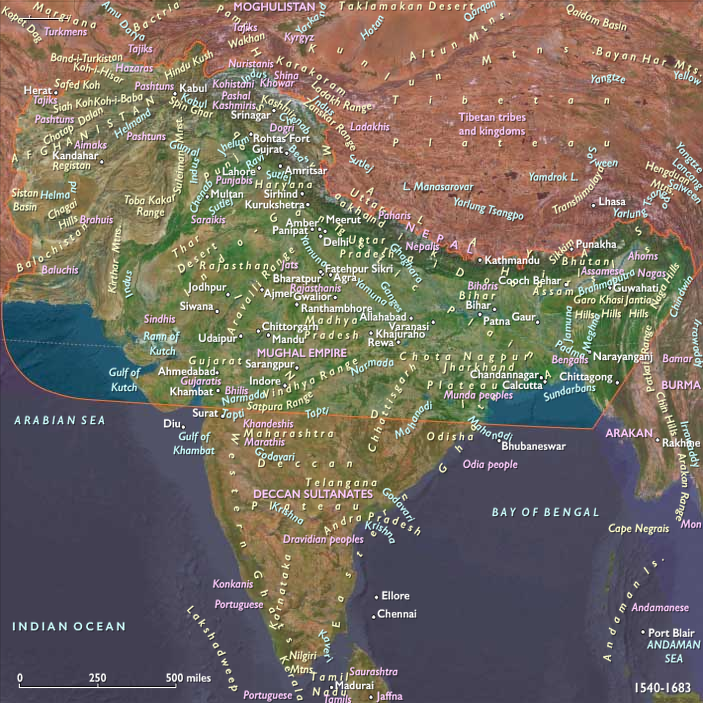
Akbar adopts two distinct but effective approaches…
1540 CE to 1683 CE
Akbar adopts two distinct but effective approaches in administering a large territory and incorporating various ethnic groups into the service of his realm.
In 1580 he obtains local revenue statistics for the previous decade in order to understand details of productivity and price fluctuation of different crops.
Aided by Todar Mai, a Rajput king, Akbar issues a revenue schedule that the peasantry can tolerate while providing maximum profit for the state.
Revenue demands, fixed according to local conventions of cultivation and quality of soil, range from one-third to one-half of the crop and are paid in cash.
Akbar relies heavily on land-holding zamindars.
They use their considerable local knowledge and influence to collect revenue and to transfer it to the treasury, keeping a portion in return for services rendered.
Within his administrative system, the warrior aristocracy (mansabdars) held ranks (mansabs) expressed in numbers of troops, and indicating pay, armed contingents, and obligations.
The warrior aristocracy is generally paid from revenues of nonhereditary and transferable jagirs (revenue villages).
Groups
Topics
Commodities
Regions
South Asia
View →Subregions