
…al-Badari, …
Years: 4365BCE - 4222BCE
…al-Badari, …
Locations
Groups
Topics
Commodoties
Subjects
Regions
Subregions
Related Events
Filter results
Showing 10 events out of 53 total
Near East (909 BCE – 819 CE) Early Iron and Antiquity — Greeks of Ionia, Levantine Tyre, Roman–Byzantine Egypt, Arabia’s Caravans
Geographic and Environmental Context
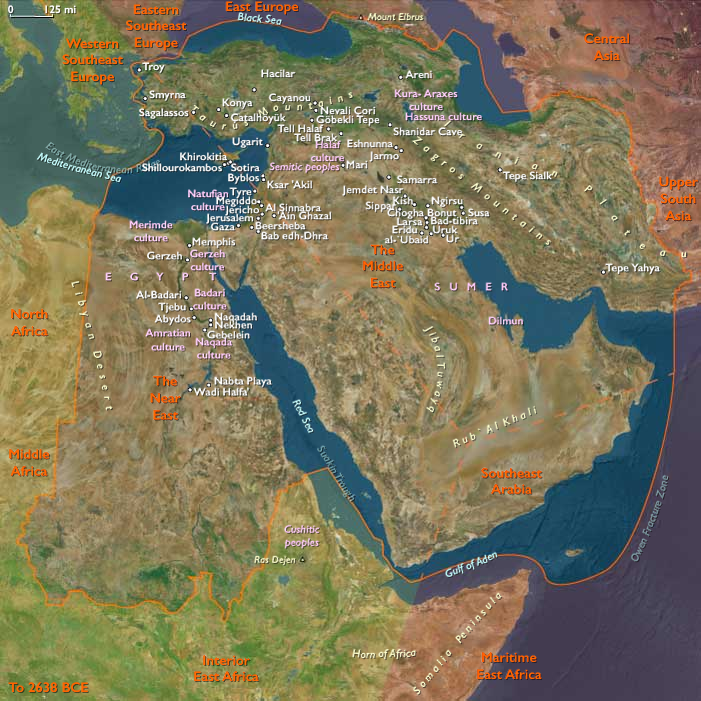
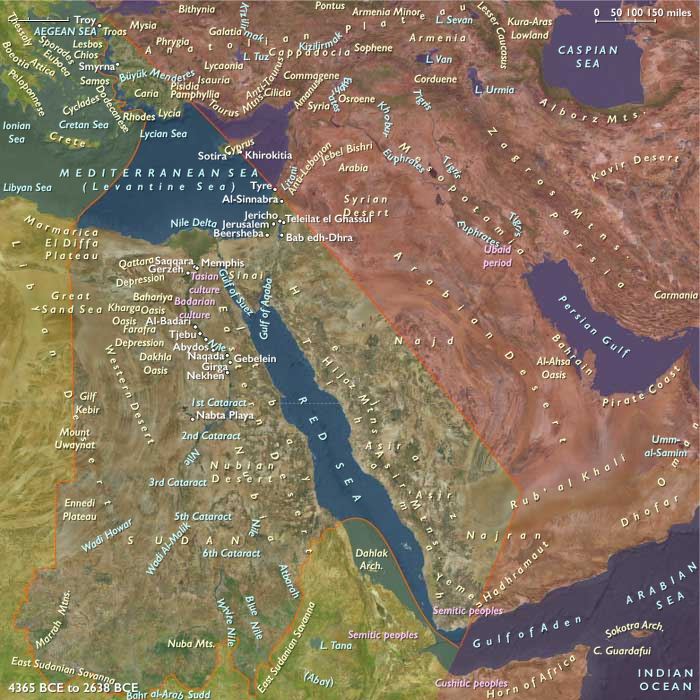
The Near East includes Egypt, Sudan, Israel, most of Jordan, western Saudi Arabia, western Yemen, southwestern Cyprus, and western Turkey (Aeolis, Ionia, Doris, Lydia, Caria, Lycia, Troas) plus Tyre (extreme SW Lebanon).-
Anchors: the Nile Valley and Delta; Sinai–Negev–Arabah; the southern Levant (with Tyre as the sole Levantine node in this subregion); Hejaz–Asir–Tihāma on the Red Sea; Yemen’s western uplands/coast; southwestern Cyprus; western Anatolian littoral (Smyrna–Ephesus–Miletus–Halicarnassus–Xanthos; Troad).
Climate & Environment
-
Nile’s late antique variability; Aegean storms seasonal; Arabian aridity persistent but terraces/cisterns mitigated.
Societies & Political Developments
-
Western Anatolia Greek city-states (Ionia–Aeolia–Doria, with Troad): Miletus, Ephesus, Smyrna, etc.
-
Tyre (sole Near-Eastern Levantine node here) dominated Phoenician seafaring.
-
Egypt (Ptolemaic → Roman → Byzantine): Nile granary and Christianizing hub.
-
Arabian west: caravan kingdoms and Hejaz–Asir oases; western Yemen incense terraces and caravan polities.
-
Southwestern Cyprus embedded in Hellenistic–Roman maritime circuits.
Economy & Trade
-
Grain–papyrus–linen from the Nile; olive–wine Aegean; incense–myrrh from Yemen; Red Sea lanes linked to Aden–Berenike nodes (outside core but connected).
-
Tyre exported craft goods and purple dye.
Technology & Material Culture
-
Iron agriculture and tools; triremes and merchant galleys; advanced terracing, cisterns; lighthouse/harbor works.
Belief & Symbolism
-
Egyptian polytheism → Christianity (Alexandria); Greek civic cults; Tyrian traditions; Arabian deities; monasticism along Nile/Desert.
Adaptation & Resilience
-
Canal maintenance buffered Nile shocks; terraces/cisterns stabilized Arabian farming; Aegean coastal redundancy protected shipping routes.
Transition
By 819 CE, the Near East was a multi-corridor world of Nile granaries, Ionia’s city-coasts, Tyre’s Phoenician legacy, and Arabian incense roads — a foundation for the medieval dynamics ahead (Ayyubids in Syria/Egypt next door, Abbasids beyond, and the Ionian–Anatolian littoral under Byzantine/Nicaean arcs).
Middle East (909 BCE – 819 CE) Early Iron and Antiquity — Urartu, Achaemenids, Parthians, Sasanian Frontiers
Geographic and Environmental Context
The Middle East includes Iraq, Iran, Syria, Armenia, Georgia, Azerbaijan, eastern Jordan, most of Turkey’s central/eastern uplands (including Cilicia), eastern Saudi Arabia, northern Oman, Qatar, Bahrain, the UAE, northeastern Cyprus, and all but the southernmost Lebanon.-
Anchors: the Tigris–Euphrates alluvium and marshes; the Zagros (Luristan, Fars), Alborz, Caucasus (Armenia–Georgia–Azerbaijan); northern Syrian plains and Cilicia; Khuzestan and Fars lowlands; the Arabian/Persian Gulf littoral (al-Ahsa–Qatar–Bahrain–UAE–northern Oman); northeastern Cyprus and the Lebanon coastal elbow (north).
Climate & Environment
-
Continental variability; oases survived by canal upkeep; Gulf fisheries stable; Caucasus snows fed headwaters.
Societies & Political Developments
-
Urartu (9th–6th c. BCE) fortified Armenian highlands;
-
Achaemenid Persia (6th–4th c. BCE) organized satrapies across Iran, Armenia, Syria uplands, Cilicia; Royal Road linked Susa–Sardis through our zone.
-
Hellenistic Seleucids, then Parthians (3rd c. BCE–3rd c. CE) and Sasanians (3rd–7th c. CE) ruled Iran–Mesopotamia; oases prospered under qanat/karez and canal regimes.
-
Transcaucasus (Armenia, Iberia/Georgia, Albania/Azerbaijan) oscillated between Iranian and Roman/Byzantine influence; northeastern Cyprus joined Hellenistic–Roman networks.
-
Arabian Gulf littoral hosted pearling/fishing and entrepôts (al-Ahsa–Qatif–Bahrain).
Economy & Trade
-
Irrigated cereals, dates, cotton, wine; transhumant pastoralism; Gulf pearls and dates.
-
Long-haul Silk Road and Royal Road flows; qanat irrigation expanded in Iran.
Technology & Material Culture
-
Iron plowshares, tools, and weapons; fortifications; qanat engineering; road stations (caravanserais earlier variants).
-
Arts: Urartian bronzes; Achaemenid stonework; Sasanian silver; Armenian and Georgian ecclesiastical arts (late).
Belief & Symbolism
-
Zoroastrianism, Armenian/Georgian Christianity, local cults; Jewish and early Christian communities in oases/ports; syncretism in frontier cities.
Adaptation & Resilience
-
Canal/qanat redundancy, pasture–oasis integration, distributed entrepôts (northeastern Cyprus, Gulf) hedged war and drought.
Transition
By 819 CE, the Middle East was a layered highland–oasis–Gulf system under Sasanian–Byzantine frontiers giving way to Islamic polities.
Near East (909 BCE – 819 CE) Early Iron and Antiquity — Greeks of Ionia, Levantine Tyre, Roman–Byzantine Egypt, Arabia’s Caravans
Geographic and Environmental Context
The Near East includes Egypt, Sudan, Israel, most of Jordan, western Saudi Arabia, western Yemen, southwestern Cyprus, and western Turkey (Aeolis, Ionia, Doris, Lydia, Caria, Lycia, Troas) plus Tyre (extreme SW Lebanon).-
Anchors: the Nile Valley and Delta; Sinai–Negev–Arabah; the southern Levant (with Tyre as the sole Levantine node in this subregion); Hejaz–Asir–Tihāma on the Red Sea; Yemen’s western uplands/coast; southwestern Cyprus; western Anatolian littoral (Smyrna–Ephesus–Miletus–Halicarnassus–Xanthos; Troad).
Climate & Environment
-
Nile’s late antique variability; Aegean storms seasonal; Arabian aridity persistent but terraces/cisterns mitigated.
Societies & Political Developments
-
Western Anatolia Greek city-states (Ionia–Aeolia–Doria, with Troad): Miletus, Ephesus, Smyrna, etc.
-
Tyre (sole Near-Eastern Levantine node here) dominated Phoenician seafaring.
-
Egypt (Ptolemaic → Roman → Byzantine): Nile granary and Christianizing hub.
-
Arabian west: caravan kingdoms and Hejaz–Asir oases; western Yemen incense terraces and caravan polities.
-
Southwestern Cyprus embedded in Hellenistic–Roman maritime circuits.
Economy & Trade
-
Grain–papyrus–linen from the Nile; olive–wine Aegean; incense–myrrh from Yemen; Red Sea lanes linked to Aden–Berenike nodes (outside core but connected).
-
Tyre exported craft goods and purple dye.
Technology & Material Culture
-
Iron agriculture and tools; triremes and merchant galleys; advanced terracing, cisterns; lighthouse/harbor works.
Belief & Symbolism
-
Egyptian polytheism → Christianity (Alexandria); Greek civic cults; Tyrian traditions; Arabian deities; monasticism along Nile/Desert.
Adaptation & Resilience
-
Canal maintenance buffered Nile shocks; terraces/cisterns stabilized Arabian farming; Aegean coastal redundancy protected shipping routes.
Transition
By 819 CE, the Near East was a multi-corridor world of Nile granaries, Ionia’s city-coasts, Tyre’s Phoenician legacy, and Arabian incense roads — a foundation for the medieval dynamics ahead (Ayyubids in Syria/Egypt next door, Abbasids beyond, and the Ionian–Anatolian littoral under Byzantine/Nicaean arcs).
North Africa (909 BCE – 819 CE) Early Iron and Antiquity — Phoenicians and Carthage, Numidian–Mauretanian Kingdoms, Rome, Garamantes, and Late Antique Transitions
Geographic and Environmental Context
North Africa includes Morocco, Algeria, Tunisia (Ifriqiya), Libya (Tripolitania–Fezzan–Cyrenaica), and Western Sahara.Anchors: the Atlas ranges (High/Middle/Anti-Atlas; Tell Atlas; Aurès), the Tell and Sahel coasts (Atlantic Morocco, Rif/Alboran, Kabylia, Ifriqiya, Syrte/Gulf of Sidra, Cyrenaica), the Saharan platforms and sand seas (Erg Chech, Grand Erg Occidental & Oriental, Tanezrouft), the oases and basins (Tafilalt, Draâ, Touat–Gourara–Tidikelt, M’zab, Wadi Igharghar, Fezzan (Wadi al-Ajyal, Ubari and Murzuq dunes)), and the trans-Saharan corridors toward Lake Chad, Niger Bend, and the Nile.
-
Coasts: Phoenician and later Punic ports (Carthage, Utica, Hippo Regius, Leptis Magna, Sabratha, Oea/Tripoli, Lixus, Mogador); Greek Cyrenaica (Cyrene).
-
Interior: Garamantes in Fezzan; Numidia (Aurès–Constantine) and Mauretania (Rif–Atlas) uplands.
Climate & Environmental Shifts
-
Mediterranean coasts temperate; interior arid but stable around engineered oases.
Societies & Political Developments
-
Phoenician colonization (from 9th–8th c. BCE) culminated in Carthage (trad. 814 BCE); Punic hegemony fostered trade and urbanism.
-
Numidian and Mauretanian kingdoms crystallized (2nd–1st c. BCE), later client to Rome; Cyrenaica Greek cities flourished in the east.
-
Rome created Africa Proconsularis, Numidia, Mauretania Caesariensis/Tingitana, Tripolitania, Cyrenaica; roads, aqueducts, ports (grain, olive oil, garum).
-
Garamantes (ca. 500 BCE–500 CE) dominated Fezzan, controlling desert trade with foggaras, walled towns, and chariot/camel trails.
-
Late Antiquity: Vandals (5th c. CE) seized coastal Africa; Byzantines reconquered (6th c.); Berberconfederacies expanded inland; Islamic polities advanced in the 7th–8th c. CE, establishing Kairouan and early dynasties; by the 8th–9th c., Idrisids rose in Morocco.
Economy & Trade
-
Coastal exports: grain, olive oil, wine, salted fish, purple dye; interior trade: salt, dates, gold, slaves, ivory; oasis produce and transshipment (Fezzan, Touat).
-
Caravan systems matured between Fezzan ↔ Niger Bend/Lake Chad and Tripolitania/Cyrenaica ↔ Nile.
Technology & Material Culture
-
Iron widespread; Roman engineering (roads, bridges, aqueducts; port moles).
-
Oasis technologies: foggaras/khettaras, cisterns, terrace gardens; wheel-made ceramics, glass.
-
Urban mosaics, Punic and Roman inscriptions; desert fortlets and tumuli fields.
Belief & Symbolism
-
Punic religion (Baal Hammon–Tanit) across ports; Greek/Roman polytheism then Christianity in cities; Judaism in port communities;
-
Amazigh (Berber) cults of springs, mountains, and ancestors persisted; Garamantian funerary landscapes extensive; Islam spread in the late centuries of this epoch.
Environmental Adaptation & Resilience
-
Coastal breadbasket + oasis waterworks + caravan redundancy ensured stability; mixed agrarian–pastoral portfolios buffered shocks.
Transition
By 819 CE, North Africa was a polycentric frontier: Punic–Roman urban legacies, Garamantian oasis know-how, and rising Islamic–Amazigh polities formed the launching pad for the 9th–14th-century Almoravid, Almohad, Marinid/Hafsid/Zayyanid transformations to come.
Central Asia (676–819 CE): Islamic Expansion, Turkic Fragmentation, and Cultural Syncretism
Between 676 and 819 CE, Central Asia—encompassing today's Kazakhstan, Kyrgyzstan, Uzbekistan, Tajikistan, and Turkmenistan—entered a dynamic era marked by the expansion of the Arab Caliphates, the fragmentation of Turkic Khaganates, and sustained Sogdian cultural and economic resilience. This period was pivotal in transitioning Central Asia into an increasingly Islamic cultural sphere, reshaping the region’s identity profoundly.
Political and Military Developments
Arab Conquests and Islamic Influence
Beginning in the early 8th century, Arab forces from the Umayyad Caliphate penetrated deep into Central Asia, capturing key cities such as Bukhara (709 CE) and Samarkand (712 CE). Despite local resistance, these conquests progressively integrated the region into the wider Islamic empire.
Turkic Khaganate Fragmentation and Decentralization
The powerful Western Turkic Khaganate fractured into smaller competing polities by the late 7th century, significantly weakening unified Turkic political control. These smaller khaganates and tribal confederations often shifted alliances between Arab, Chinese, and local powers.
Rise of the Türgesh Confederation
Emerging as a significant power in the early 8th century, the Türgesh Confederation temporarily united many Turkic tribes in western Central Asia, resisting Arab advances through a series of battles and diplomatic maneuvers, notably under the leadership of Suluk Khan (716–738 CE).
Economic Developments
Sogdian Economic Resilience
Despite political upheaval, Sogdian merchants continued to dominate Silk Road commerce. Cities like Samarkand, Bukhara, and Khujand remained critical economic hubs, facilitating trade between China, the Islamic Caliphate, and the Byzantine Empire.
Integration into the Islamic Economic Sphere
The incorporation of Central Asia into the Islamic empire fostered greater economic integration, enhancing trade networks that facilitated the circulation of goods such as silk, spices, gold, and precious metals across Eurasia, bolstering local prosperity.
Cultural and Religious Developments
Deepening Islamic Influence
Islamic religious and cultural influence significantly deepened following Arab conquests, especially among urban elites and merchant classes. Major cities saw the construction of mosques, religious schools (madrasas), and the introduction of Islamic jurisprudence.
Persistence of Religious Pluralism
Even as Islam expanded, Central Asia continued to exhibit remarkable religious diversity. Buddhism retained a significant presence, especially in areas like the Fergana Valley, while Nestorian Christian and Zoroastrian communities persisted within urban centers.
Cultural Syncretism and Artistic Innovation
This era witnessed vibrant cultural exchange and syncretism, blending Islamic, Turkic, Persian, and local Central Asian traditions. Artistic and architectural innovations included elaborate stucco decorations, vibrant mural paintings, and manuscript illumination, reflecting both Islamic and indigenous motifs.
Social and Urban Developments
Urban Transformation and Growth
Major cities underwent transformative developments reflecting Islamic architectural styles, urban planning, and public infrastructure investments. The introduction of Islamic institutions, such as mosques and marketplaces (bazaars), reshaped urban landscapes significantly.
Nomadic and Settled Integration
Interactions between nomadic Turkic tribes and sedentary populations continued to evolve, marked by deeper integration. Turkic languages and customs further integrated into settled communities, creating blended urban and rural societies rich in cultural diversity.
Long-Term Consequences and Historical Significance
The period from 676 to 819 CE decisively shaped Central Asia’s historical identity, anchoring it firmly within the Islamic world while maintaining its characteristic diversity. Politically fragmented yet economically dynamic, Central Asia emerged as a key region mediating cultural and commercial exchanges between East and West. The enduring influence of Turkic culture and the robust Sogdian economic presence underscored a historical legacy of adaptability and syncretism, preparing the ground for future empires and cultural developments.
The early Islamic polity is intensely expansionist, fueled both by fervor for the faith and by economic and social factors.
After gaining control of Arabia and the Persian Gulf region, conquering armies sweep out of the peninsula, spreading Islam.
By the end of the eighth century, Islamic armies had reached far into North Africa and eastward and northward into Asia.
Known as the Nine Oghuz, this confederation is composed of Turkic-speaking peoples who formed the basis of powerful steppe empires in Inner Asia.
In the second half of the eighth century, components of the Nine Oghuz migrate through Dzungaria into Central Asia, and Arabic sources locate them under the term Guzz in the area of the middle and lower Syr Darya in the eighth century.
Conversion to Islam occurs by means of incentives, gradual acceptance, and force of arms.
Islam spreads most rapidly in cities and along the main river valleys.
It is the prevalent religion in the entire region by the ninth century.
The Arabs first invade Mawarannahr in the middle of the seventh century through sporadic raids during their conquest of Persia.
Available sources on the Arab conquest suggest that the Sogdians and other Iranian peoples of Central Asia were unable to defend their land against the Arabs because of internal divisions and the lack of strong indigenous leadership.
The Arabs, on the other hand, are led by a brilliant general, Qutayba ibn Muslim, and they also are highly motivated by the desire to spread their new faith (the official beginning of which was in CE 622).
Because of these factors, the population of Mawarannahr is easily conquered.
The new religion brought by the Arabs spreads gradually in the region.
The native cultures, which in some respects already were being displaced by Persian influences before the Arabs arrived, will be displaced further in the ensuing centuries.
The destiny of Central Asia as an Islamic region is nevertheless firmly established by the Arab victory over the Chinese armies in 750 in a battle at the Talas River.
Central Asia retains much of its Iranian character under Arab rule, remaining an important center of culture and trade for centuries after the Arab conquest.
The language of government, literature, and commerce will be Arabic, however, until the tenth century.
Mawarannahr continuesd to be an important political player in regional affairs, as it had been under various Persian dynasties.
In fact, the Abbasid Caliphate, which will rule the Arab world for five centuries, beginning in 750, is established thanks in great part to assistance from Central Asian supporters in their struggle against the then-ruling Umayyad Caliphate.
The Middle East: 676–819 CE
Islamic Expansion, Cultural Integration, and Dynastic Transformations
Consolidation and Revolts under the Umayyads
Following the establishment of the Umayyad Caliphate (661–750) with its capital in Damascus, the region undergoes significant political and cultural transformations. Muawiyah, founder of the dynasty, cements Umayyad control through administrative reforms, military strength, and religious tolerance, particularly toward Christians. Damascus flourishes, becoming one of the great cities of the eighth century, a hub of Islamic governance, culture, and economic prosperity.
However, succession issues plague the Umayyad dynasty. The violent death of Husayn ibn Ali at the Battle of Karbala (680) creates a profound schism between Sunni and Shia Muslims, deeply influencing Islamic history. The martyrdom of Husayn solidifies Shia identity, with Karbala and the tomb of his father Ali at Najaf becoming central pilgrimage sites.
Sectarian Divisions and Ideological Movements
This era sees the rise of multiple Islamic sects, each interpreting leadership and theology distinctively. The Kharijites, initially rebels from Ali's army, promote strict doctrinal adherence and lead rebellions in Iraq and beyond, notably influencing movements such as the Azraqi Kharijites who rebel in 685. Meanwhile, the rise of the Paulicians in Armenia around 664 introduces a dualistic Christian sect influenced by Gnostic beliefs, opposing the established church and empire.
Abbasid Revolution and Cultural Renaissance
The growing dissatisfaction with Umayyad rule culminates in the Abbasid Revolution led by Abu Muslim, who captures Iraq in 747 and establishes the Abbasid Caliphate in 750 with its capital in Baghdad. The Abbasids, presenting themselves as divine-right rulers, usher in a new era of centralized administration, cultural flourishing, and intellectual expansion, significantly influenced by Persian traditions. The Abbasid caliphs, particularly under Harun ar-Rashid (786–809) and his son Al-Mamun (813–833), preside over a remarkable cultural renaissance, with Baghdad becoming a center for philosophical, scientific, and literary achievements.
Persian Influence and Cultural Integration
Under Abbasid rule, the integration of Persian administrative practices, such as the role of vizier and the bureaucratic institution of the divan, becomes foundational. Persian scholars profoundly impact Islamic sciences, literature, medicine, and philosophy, with Arabic becoming the language of administration in 696 but Persian remaining widely spoken. The Iranian populace, initially slow to adopt Islam, gradually integrates into the Islamic community by the ninth century, significantly contributing to Islamic intellectual traditions.
Regional Shifts and Continued Instability
Despite Abbasid centralization, regional unrest persists. Iraq remains restive under Umayyad and early Abbasid rule, with notable rebellions including the Alid Revolt (762–763), which emphasizes enduring sectarian divisions. Armenia, semi-autonomous under the Bagratid dynasty from 806, continues to serve as a crucial buffer state between Muslim and Byzantine spheres. In 813, Ashot I, a Bagratid prince, consolidates power in Georgia, initiating nearly a millennium of Bagratid rule there.
Religious Developments and Legal Schools
The formation of distinct Sunni legal schools—notably those founded by Malik ibn Anas, Abu Hanifa, Al-Shafi‘i, and Ahmad ibn Hanbal—begins in earnest, shaping Islamic jurisprudence. Shia communities, particularly the Twelve Imams tradition, consolidate around revered figures such as Imam Reza, whose tomb at Mashhad becomes a significant pilgrimage site.
Economic and Social Prosperity
The Abbasids promote extensive economic development, infrastructure projects, and social welfare initiatives. Caliph Al-Walid I (705–715) builds the first major hospital in Damascus, institutes quarantine practices for leprosy patients, and initiates public works including street lighting, irrigation, and welfare programs. The Persian Gulf region experiences prosperity linked to the economic success of Baghdad, revitalizing trade networks.
By 819, the Middle East stands transformed by the profound cultural synthesis of Arab, Persian, and local traditions. This dynamic fusion shapes a vibrant civilization whose influences reverberate across the Islamic world and beyond, laying a foundation for centuries of cultural, scientific, and political achievements.
Years: 4365BCE - 4222BCE
Locations
Groups
Topics
Commodoties
Subjects
Regions
Subregions