The Great Powers, alarmed by the extension…
July 1878 CE
The Great Powers, alarmed by the extension of Russian power into the Balkans, force modifications of the treaty in the Congress of Berlin, a meeting of the European Great Powers' and the Ottoman Empire's leading statesmen in Berlin in June and July.
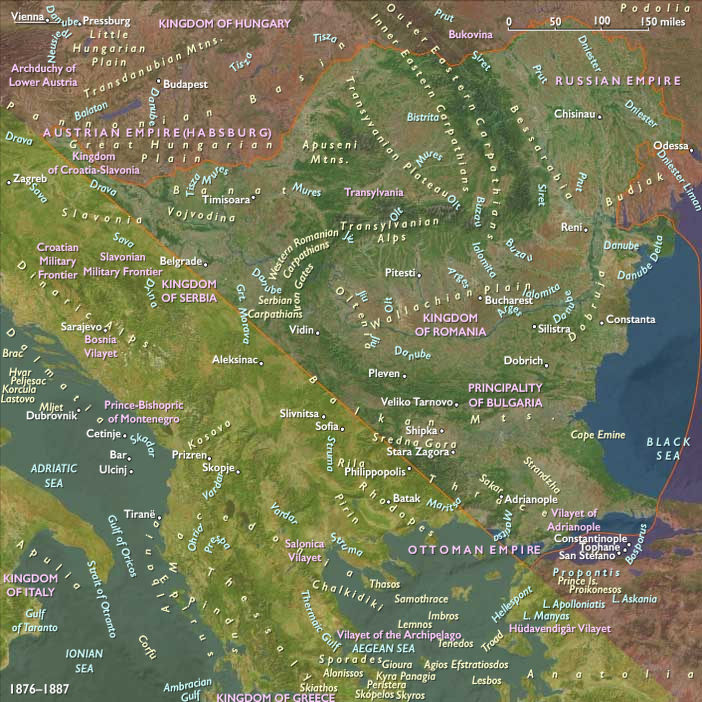
The main change here is that Bulgaria will be split, according to earlier agreements among the Great Powers that precluded the creation of a large new Slavic state: the northern and eastern parts to become principalities as before (Principality of Bulgaria and Eastern Rumelia), though with different governors; and the Macedonian region, originally part of Bulgaria under San Stefano, will return to direct Ottoman administration.
At the Congress of Berlin, Bismarck says that he is fighting for peace in Europe.
The aim of the powers is to aimed at securing both more complete protection for the provinces' Christian majority and protection of the status quo.
The centuries-long tensions among the Balkan states over their rival aspirations to the provinces of Ottoman-controlled Rumelia, namely Eastern Rumelia, Thrace and Macedonia, will subside for the next thity-four years, then erupt into the regional conflicts that shortly kindle the Great War.
A new Bulgarian state is born in 1878 despite strong dissatisfaction with the frontiers imposed by the European powers.
The new Bulgaria will be about one-third the size of that prescribed by the Treaty of San Stefano; Macedonia and Thrace, south of the Balkans, will revert to complete Ottoman control.
The province of Eastern Rumelia will remain under Turkish rule, but with a Christian governor.
Whereas the Treaty of San Stefano had called for two years of Russian occupation of Bulgaria, the Treaty of Berlin reduces the time to nine months.
Both treaties provide for an assembly of Bulgarian notables to write a constitution for their new country.
The assembly will also elect a prince who is not a member of a major European ruling house and who will recognize the authority of the Ottoman sultan.
In cases of civil disruption, the sultan retains the right to intervene with armed force.
Groups
Topics
Subjects
Regions
Southeast Europe
View →Subregions