
Albert the Bold, the younger son of…
June 1519 CE
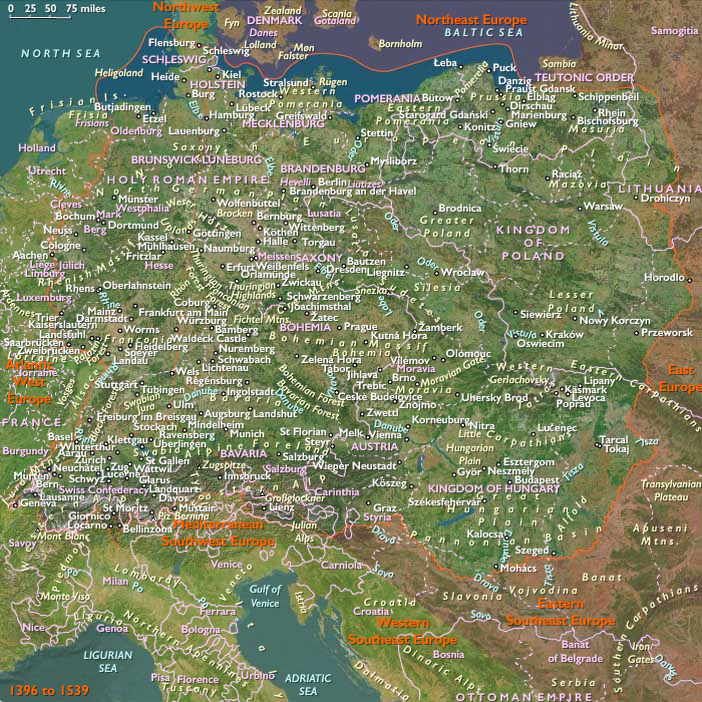
Albert the Bold, the younger son of Frederick II, Elector of Saxony, had divided the Saxon lands, including Thuringia and Meissen, with his brother Ernest in 1485.
His descendants, the Albertines, are a junior branch of the Wettin dynasty of Electors of Saxony, who rule in Northern Thuringia and Southern Meissen as Dukes of Saxony.
Albert’s son, Duke George of Saxony has from the beginning of the Reformation in 1517 directed his energies chiefly to ecclesiastical affairs.
Hardly one of the secular German princes will hold as firmly as he to the Church: he defends its rights and vigorously condemns every innovation except those countenanced by the highest ecclesiastical authorities.
At first he had not been opposed to Luther, but as time goes on and Luther's aim becomes clear to him, he turns more and more from the Reformer, and is finally, in consequence of this change of attitude, drawn into an acrimonious correspondence in which Luther, according to some without any justification, heavily criticizes the duke.
The duke is not blind to the undeniable abuses existing at this time in the Church.
In 1519, despite the opposition of the theological faculty of the university, he originates the Disputation of Leipzig, with the idea of helping forward the cause of truth, and is present at all the discussions.
The disputation between Eck and Karlstadt begins at Leipzig on June 27.
In the first four sessions, Eck maintains the thesis that free will is the active agent in the creation of good works, but he is compelled by his opponent to modify his position so as to concede that the grace of God and free will work in harmony toward the common end.
Karlstadt then proceeds to prove that good works are to be ascribed to the agency of God alone, whereupon Eck yields so far as to admit that free will is passive in the beginning of conversion, although he maintains that in course of time it enters into its rights; so that while the entirety of good works originates in God, their accomplishment is not entirely the work of God.
Despite the fact that Eck is thus virtually forced to abandon his position, he succeeds, through his good memory and his dialectic skill, in confusing the heavy-witted Karlstadt and carries off the victory.
Locations
People
Groups
Regions
Central Europe
View →Subregions
