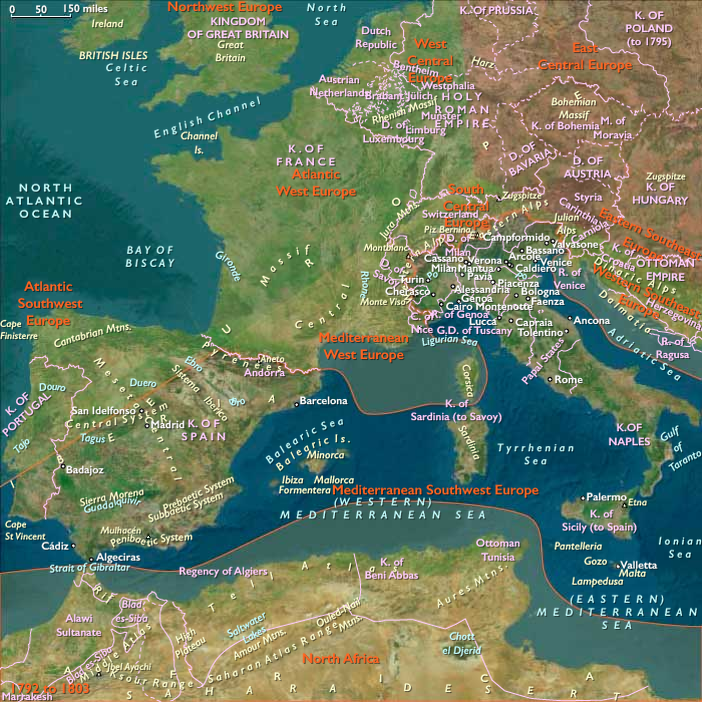
Alessandro Volta, born in Como, Italy on…
March 1800 CE
Alessandro Volta, born in Como, Italy on February 18, 1745, had in 1774 become a physics professor at the Royal School in Como.
A year later, he had improved and popularized the electrophorus, a device that produced a static charge.
His promotion of it is so extensive that he is often credited with its invention, even though a machine operating in the same principle had been described in 1762 by Swedish professor Johan Wilcke.
In the years between 1776–78, Volta had studied the chemistry of gases.
He discovered methane after reading a paper by Benjamin Franklin on "flammable air" and carefully searched for it in Italy.
In November, 1776, he found methane at Lake Maggiore, and by 1778 he had managed to isolate methane, and devised such experiments as the ignition of methane by an electric spark in a closed vessel.
Volta also studied what we now call electrical capacitance, developing separate means to study both electrical potential (V) and charge (Q), and discovering that for a given object, they are proportional.
This may be called Volta's Law of capacitance, and, likely for this work, the unit of electrical potential has been named the volt.
In 1779 he became professor of experimental physics at the University of Pavia, a chair he will occupy for almost 25 years.
In 1794, Volta had married an aristocratic lady also from Como, Teresa Peregrini, with whom he raises three sons The late Luigi Galvani had discovered something he dubbed "animal electricity" when two different metals were connected in series with the frog's leg and to one another.
Volta realizes that the frog's leg serve as both a conductor of electricity (we would now call it an electrolyte) and as a detector of electricity.
Replacing the frog's leg with brine-soaked paper, he had detected the flow of electricity by other means familiar to him from his previous studies.
In this way, he had discovered the electrochemical series, and the law that the electromotive force (emf) of a galvanic cell, consisting of a pair of metal electrodes separated by electrolyte, is the difference between their two electrode potentials (thus, two identical electrodes and a common electrolyte give zero net emf).
This may be called Volta's Law of the electrochemical series.
In 1800, as the result of a professional disagreement over the galvanic response advocated by Galvani, he invents the voltaic pile, an early electric battery, which produces a steady electric current.
Volta had determined that the most effective pair of dissimilar metals to produce electricity is zinc and silver.
Initially he experiments with individual cells in series, each cell being a wine goblet filled with brine into which the two dissimilar electrodes were dipped.
The voltaic pile replaces the goblets with cardboard soaked in brine.
In announcing his discovery of the pile, Volta pays tribute to the influences of William Nicholson, Tiberius Cavallo and Abraham Bennet.
In a letter to the Royal Society of London, Volta documents his invention of the voltaic pile, the first electrochemical battery.
Locations
People
Subjects
Regions
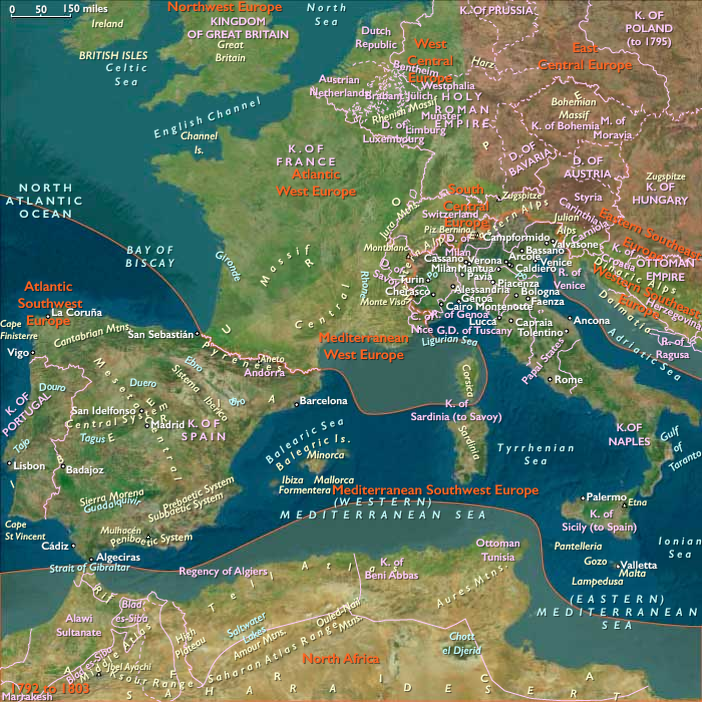
Southwest Europe
View →Subregions