
…Alghero.
1410 CE
…Alghero.
Locations
Groups
Commodities
Subjects
Regions

Southwest Europe
View →Subregions
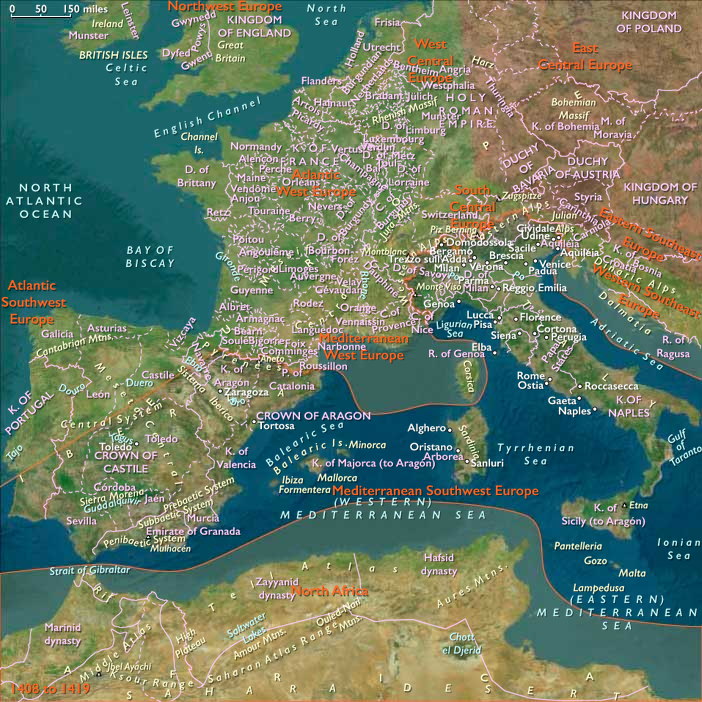
Mediterranean Southwest Europe
View →Related Events
Showing 10 events out of 106 total
The Invasion of Libya and the Shattering of the Balance in the Ottoman Empire (1911)
By the early 20th century, the Ottoman Empire had long been regarded as "the sick man of Europe," surviving largely due to the fragile balance of power maintained by the Great Powers. This precarious equilibrium was shattered in late 1911 when Italy launched an invasion of Libya, marking the beginning of the Italo-Turkish War (1911–1912).
Italy’s Motives and the Ottoman Dilemma
- Italy sought to expand its colonial empire and viewed Libya, the last remaining Ottoman territory in North Africa, as a natural target for conquest.
- The Ottomans, already weakened by internal strife and political instability, were ill-prepared to resist a European power.
- The conflict exposed Ottoman vulnerability, signaling to other nations that the empire was ripe for territorial dismemberment.
The Consequences: A Catalyst for Regional Unrest
- The war ended in 1912 with the Treaty of Ouchy, forcing the Ottomans to cede Libya to Italy.
- The invasion undermined the status quo in the Balkans, emboldening the Balkan states to launch the First Balkan War (1912–1913) against Ottoman rule.
- The rapid Ottoman decline contributed to the wider instability that would eventually lead to the outbreak of World War I in 1914.
Italy’s invasion of Libya thus served as a turning point, demonstrating that the Great Powers could no longer maintain the balance that had propped up the Ottoman Empire, setting the stage for further European conflicts.
Montenegro’s Prince Nicholas declares himself king on August 28, 1910.
Montenegro, preparing to grab Albanian-populated lands for itself, supports a 1911 uprising by the mountain tribes against the Young Turks regime that grows into a widespread revolt.
Unable to control the Albanians by force, the Ottoman government grants concessions on schools, military recruitment, and taxation and sanctions the use of the Latin script for the Albanian language.
The government refuses, however, to unite the four Albanian-inhabited vilayets.
The reduction of the Ottoman Empire in Europe is nearly completed by the two successive military conflicts known as the Balkan Wars.
In the first, the Ottomans lose almost all their European possessions, including Crete, to Bulgaria, Serbia, Greece, Montenegro, and the newly created state of Albania.
In the second, fought between Bulgaria and the remaining Balkan states (including Romania) over the division of Macedonia, the Ottomans intervene against Bulgaria and recover part of eastern Thrace, including Edirne.
The irredentism of the Megali Idea, which has remained a strong force in Greek society since independence, gains new momentum from the liberation of territory surrounding Greece and from changes in Great Power policy in the second half of the nineteenth century.
The results are conflict with the Ottoman Empire in Crete and with the Slavs in Macedonia, along with territorial gains in Thessaly and Arta.
The heightened tensions in the Balkans reach their climax in the Great War, which is sparked by the assassination of the Austrian heir-apparent by a Serb in Sarajevo, Bosnia, on June 28, 1914.
By this time, the Ottomans have lost more than four-fifths of the territory and more than two-thirds of the population of their European provinces.
The Allies begin as Britain, Belgium and France.
Turkey and Bulgaria will soon join the Central Powers, and Russia and Italy (and eventually, the US) will join the Allies.
The war will spread from Europe to Asia and Africa, making a world war of the long-anticipated Great War.
Military operations in the Great War extend from Northern Europe through Russia, the Balkans and the Middle East to Germany’s African colonies.
Germany blockades British shipping and declares unrestricted submarine warfare.
When the First World War provokes acute shortages of tungsten, molybdenum is used on a massive scale to make arms, armor plating, and other military hardware.
The war, which pits the Central Powers—mainly Germany, Austria-Hungary, and Turkey—against the Allies—mainly France, Great Britain, Russia, Italy, Japan, and, from 1917, the United States, ends with the defeat of the Central Powers, which Bulgaria had joined, and yet another reconfiguration of the Balkan polities, including the emergence of an independent Albania and the virtual creation of a Greater Serbia in the guise of the Kingdom of the Serbs, Croats and Slovenes.
Russia and Japan reach an accord over China.
During and after the First World War, the United States pursues a policy of direct intervention in Latin America, variously occupying Puerto Rico, Cuba, the Dominican Republic, Haiti, Nicaragua, Panama, and, during the Mexican Revolution, the Mexican cities of Chihuahua and Vera Cruz.
Movements in art, literature and philosophy present an aggressive, pugnacious approach to art and language.
The movement by American women to gather in ladies’ clubs leads to their finally getting the vote in the 1920s.
Tsar Ferdinand, possessed of imperialistic ambition and pressured by Russian diplomacy, on May 12, 1912 signs a secret bilateral defensive alliance with Serbia providing for Bulgarian military cooperation but leaving a large section of Macedonia as a contested zone, the fate of which is to be determined after the war.
A similar, quickly made agreement with Greece and verbal agreements with Montenegro also make no provision for the future distribution of territory.
It is the great mistake of Bulgarian diplomacy to organize a war against the Ottoman Empire without first clearly resolving the competing claims of Serbia and Greece.
The Albanians’ armed struggle of three years (1910–12) forces the Turks to agree, in effect, to grant their demands.
Albania's Balkan neighbors—Serbia, Montenegro, Greece, and Bulgaria—who have already made plans to partition the region, react with alarm at the prospect of Albanian autonomy.
In spite of their conflicting interests, the four countries conclude a series of secret bilateral treaties that have as their explicit intention the ejection of the Turks from Europe.
New state bureaucracies have been established in Greece, and the powers of the governmental branches are substantially reworked by constitutional amendment.
Social laws establish workers' rights and simplify taxes while Venizélos builds military support by expanding and reëquipping the army.
The first years of Venizélos’ power have stabilized Greece's finances and stemmed the massive social unrest that had promised major upheaval.
Venizélos, his continuing political ascendancy confirmed with a sweeping victory in elections held in 1912, on May 29 creates an alliance of the Balkan Christian peoples (Balkan League).
Ostensibly created to limit increasing Austrian power in the Balkans, the league is actually formed at the instigation of Russia in order to take Macedonia away from Turkey, which is already involved in the war instigated by Italy.
France, perceiving in the League a plan to impose Russian dominance on the Balkans, forms an alliance with Austria-Hungary, itself unwilling to see a large Serbian state emerge on its southern border, and rallies the other Powers to issue a stern warning to the Balkan states.
… and the other members of the league—Bulgaria, …
…Serbia, …