The allies Denmark, Saxony, and Russia conquer…
December 1712 CE
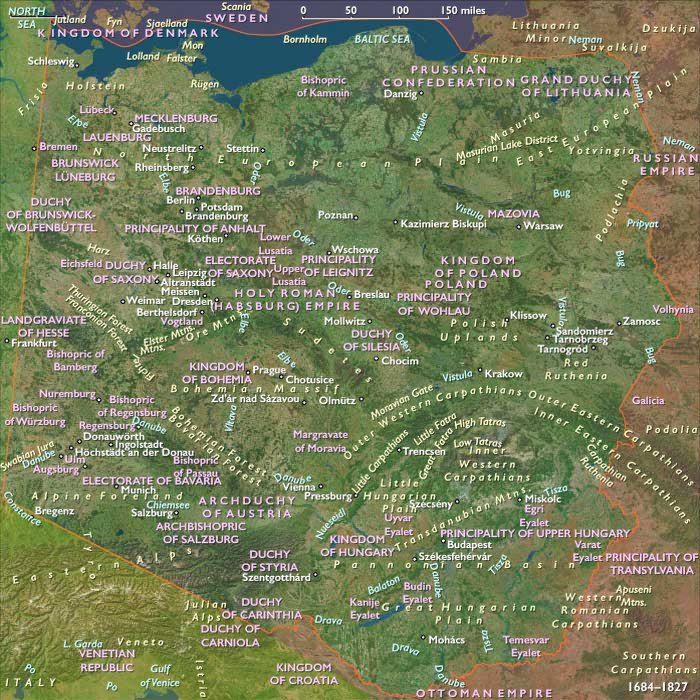
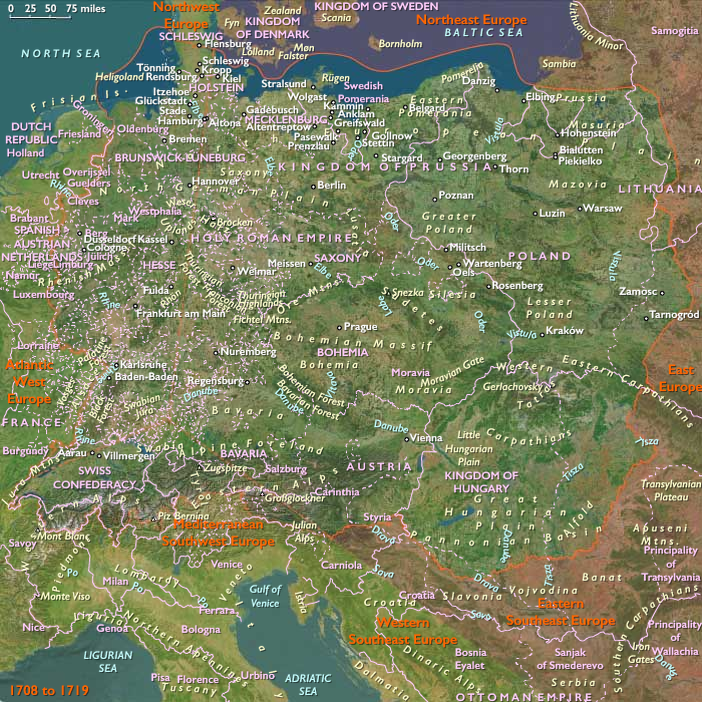
The allies Denmark, Saxony, and Russia conquer all of Sweden's dominions south of the Baltic Sea, apart from forts, during 1712.
The Danish admiral Gyldenløve patrols the Baltic with a squadron to disrupt Swedish supply lines to the Continent.
It is vital for Sweden not to lose Stralsund, as it is the gateway to campaigns in Poland.
While a Danish army moves in the region of Hamburg, a large Russian-Saxon force stands south of Stralsund.
Stenbock can hardly attack this force with a frontal assault, but hopes that by moving west towards Mecklenburg it can be encircled or scattered.
Such a movement will also prevent the joining of the two allied forces.
The Danish army under Frederick IV of Denmark is led by general Jobst von Scholten closer to the Russian-Saxon army, and on December 3, the Danish forces reach the little town of Gadebusch, southwest of Wismar.
Fortunately for Stenbock, the allied movements have been slowed due to disagreements among the allied commanders.
He marches the Swedish army on December 8, to Gross Brütz, less than ten kilometers east of Gadebusch.
The Russian infantry is now too far away to assist the Danes, but the Saxon cavalry under Jacob Heinrich von Flemming is approaching quickly.
Danish forces break camp the night of December 19 and move to a better position around the village of Wakenstädt, three kilometers south of and today incorporated by Gadebusch.
Scholten expects the Swedish attack to come from the south to avoid the marshy Radegast river.
The Danish army at four in the morning of December 9 (O.S.) is arrayed in defensive formation, with cavalry wings flanking the infantry in the center.
As hours pass, snowfall turns to rain.
The Saxon cavalry under Flemming finally arrives at Wakenstädt at mid-morning.
Swedish reconnaissance has made it clear that the only Swedish option is a frontal assault.
Stenbock judges that although the passable terrain is narrow and his men somewhat outnumbered, the thirty Swedish field guns will provide an advantage over the Danish thirteen.
The Swedish onslaught from the east begins around 11 AM.
Swedish artillery open fire on the tightly grouped Danish battalions and provide cover for the deploying cavalry and infantry.
The battle, won by the Swedes’ efficient use of artillery combined with determined flanking attacks by infantry and cavalry, gives the hard-pressed Swedish forces some well needed breathing room.
The battle winds down by dusk: Danish and Saxon forces withdraw more or less orderly to a position several kilometers west of Gadebusch to regroup.
All of the Danish artillery has been abandoned.
Groups
Regions
Central Europe
View →Subregions