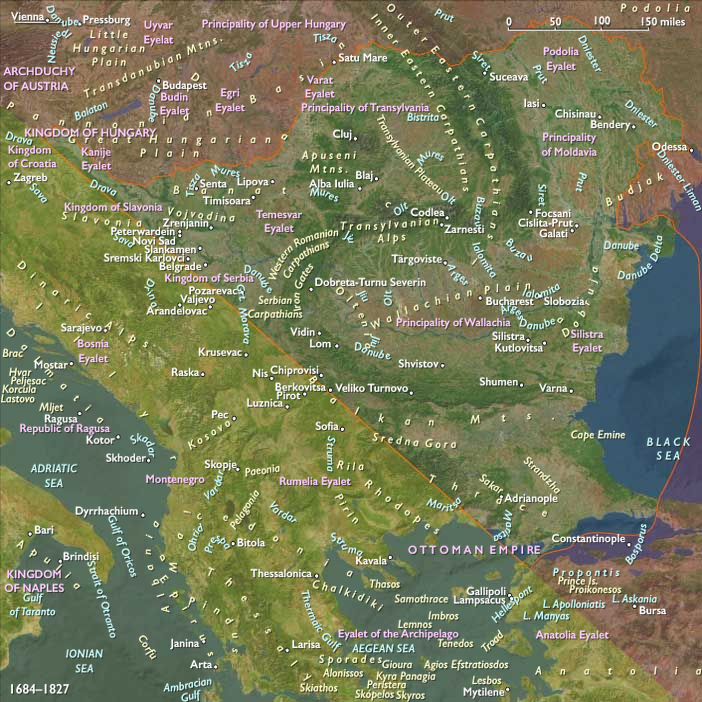
Centralized Ottoman control in agricultural Bulgaria had…
1684 CE to 1827 CE
Bulgarians increasingly welcome the progressive Western political ideas that reach them through the Danube trade and travel routes.
Already in the 1600s, Catholic missionaries in western Bulgaria had stimulated creation of literature about Bulgaria's national past.
Although the Turks suppress this Western influence after the Chiprovets uprising of 1688, the next century brings an outpouring of historical writings reminding Bulgarian readers of a glorious national heritage.
For Bulgaria the eighteenth century brings transition from static subservience within a great Asian empire toward intellectual and political modernization and reestablishment of cultural ties with Western Europe.
The monasteries of an increasingly independent Bulgarian church foster national thought and writing; Western influences alter the nature of commerce and landholding in the Balkans; and the forcible assimilation of Bulgarian culture into a cosmopolitan Asian society ends, allowing Bulgarian national consciousness to reawaken.
At the same time, social anarchy inhibits the liberation process.
These developments set the stage for a full national revival.
Father Paisi of Hilendar writes a history of the Bulgarian peoples in a mixture of Old Church Slavonic and vernacular language in 1762.
Circulated in manuscript form for nearly one hundred years, the book is a lively, readable celebration of the Bulgarian past and a call for all Bulgarians to remember their heritage and cultivate their native language.
Paisi's history inspires generations of writings on Bulgarian patriotic themes.
In part, its influence is strong because Paisi writes at a monastery on Mt. Athos, the largest spiritual center in the Balkans and an early receptacle of ideas of the European Enlightenment.
Paisi's follower Sofronii Vrachanski further develops the literature by using a much more vernacular language to advance secular ideas of the Enlightenment in translations of Greek myths and his original Life and Tribulations of the Sinner Sofronii.
Sofronii also publishes the first printed book in Bulgaria in 1806.
The Mediterranean and Asian trade routes meet in Bulgaria under the Ottoman Empire.
Fairs and regional markets eventually bring tradesmen into contact with their foreign counterparts.
After centuries of exclusion from population centers by Turkish policy, Bulgarians begin migrating back to the towns, establishing an urban ethnic presence.
By the eighteenth century, trade guilds include many workers in cloth, metal, wood, and decorative braid.
The estate holders of Macedonia also profit from growing European cotton markets.
Some Bulgarian merchants assume positions as intermediaries between Turkish and European markets, grow rich from such connections, and establish offices in the major European capitals.
As the Bulgarian cultural revival spreads from the monasteries into secular society, these newly wealthy groups promote secular art, architecture, literature, and Western ideals of individual freedom and national consciousness.
Of particular impact are the ideals of the French Revolution, introduced through commercial connections at the start of the nineteenth century.
The end of centralized Ottoman power over Bulgarian territory brings several decades of anarchy, called the kurdzhaliistvo, at the end of the eighteenth century.
As at the end of the Second Bulgarian Empire four hundred years before, local freebooters control small areas, tyrannize the population, and fight among themselves.
Political order is not reestablished in Bulgaria until 1820.
Meanwhile, large population shifts occur as Bulgarians flee the taxation and violence inflicted by this anarchic condition; the new communities they establishmove in Romania and southern Russia are important sources of cultural and political ideas in the nineteenth century.
The Bulgarian national revival takes place in the larger context of Christian resistance to Turkish occupation of Eastern and Central Europe—a cause whose momentum increases as the Ottoman Empire crumbles from within.
Groups
Topics
Commodities
Subjects
Regions
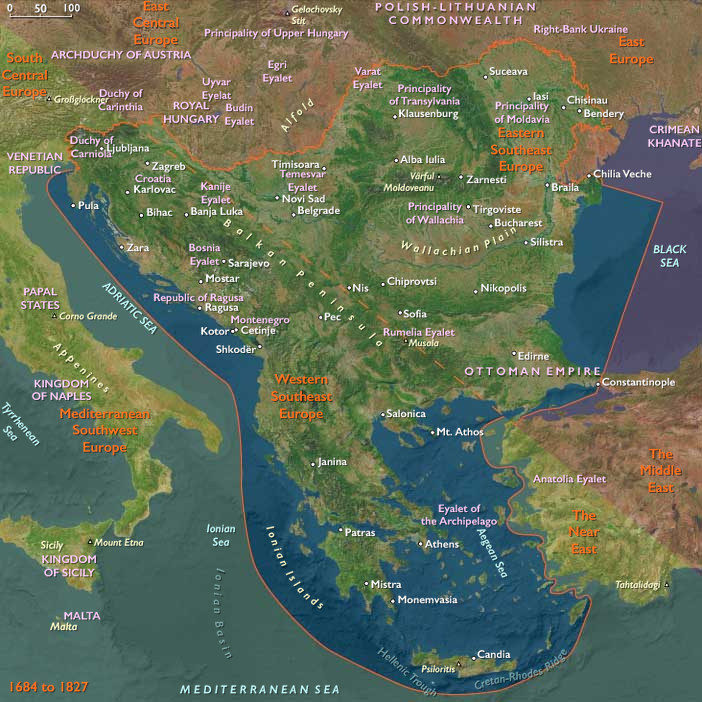
Southeast Europe
View →Subregions