Geography dictates that operations during 1812 and…
August 1812 CE
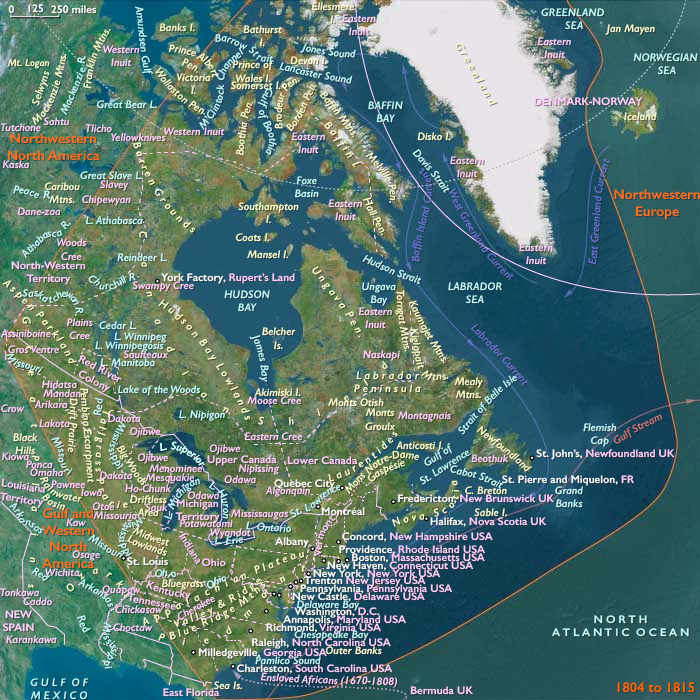
Geography dictates that operations during 1812 and 1813 take place in the west: principally around Lake Erie, near the Niagara River between Lake Erie and Lake Ontario, and near the Saint Lawrence River area and Lake Champlain.
This is the focus of the three-pronged attacks by the Americans in 1812.
Here, British military experience will prevail over inexperienced American commanders.
Although cutting the St. Lawrence River through the capture of Montreal and Quebec would have made Britain's hold in North America unsustainable, the United States begins operations first in the western frontier because of the general popularity here of a war with the British, who have sold arms to those natives opposing the settlers.
The British score an important early success when their detachment at St. Joseph Island, on Lake Huron, learned of the declaration of war before the nearby American garrison at the important trading post at Mackinac Island in Michigan.
A scratch force had landed on the island on July 17, 1812, and mounted a gun overlooking Fort Mackinac.
After the British fired one shot from their gun, the Americans, taken by surprise, had surrendered.
This early victory has encouraged the natives, and large numbers move to help the British at Amherstburg.
The island totally controls access to the Old Northwest, giving the British nominal control of this area, and, more vitally, a monopoly on the fur trade.
Locations
Groups
Topics
Commodities
Regions
Northern North America
View →Subregions