Event
Western East Antarctica (4,365–2,638 BCE): Coastal Oases,…
Western East Antarctica (4,365–2,638 BCE): Coastal Oases, Ice Frontiers, and Polar Refugia
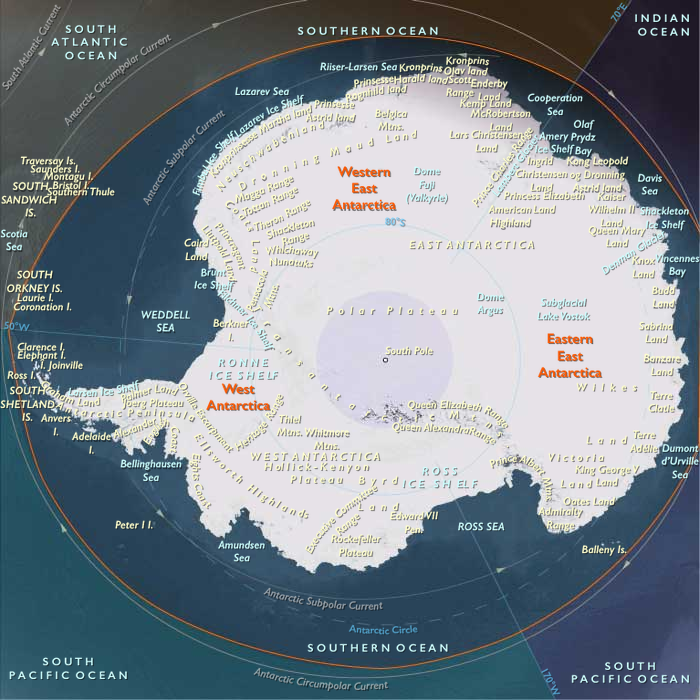
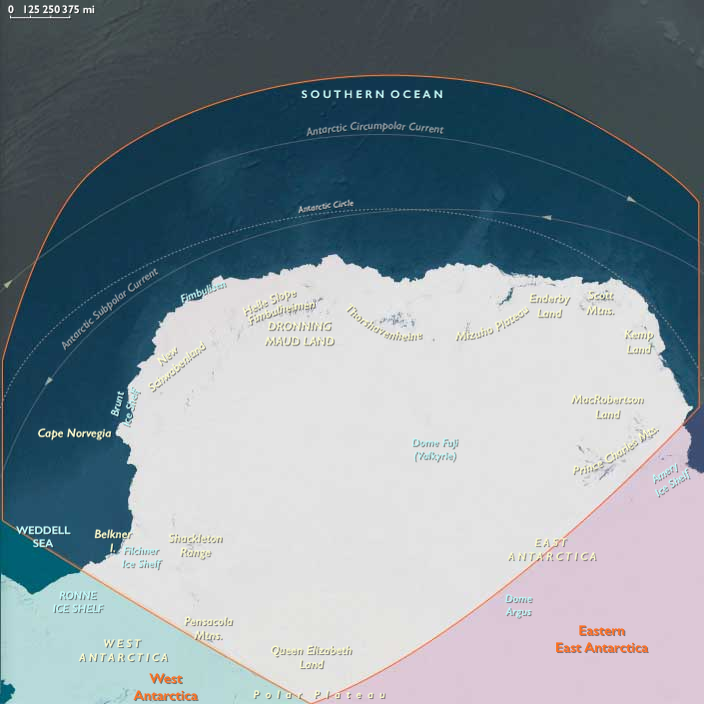
Western East Antarctica extended along the Indian Ocean-facing coast of East Antarctica through Princess Elizabeth Land, Queen Mary Land, Wilkes Land, George V Land, Adélie Land, and Oates Land, together with their offshore islands and scattered coastal oases. Among its most distinctive landscapes were the Vestfold Hills, Larsemann Hills, Bunger Oasis, Windmill Islands, Adélie Coast, Mertz Glacier region, Shackleton Ice Shelf margins, and numerous rocky headlands and nunataks along the continental edge.
At 4,365 BCE, the East Antarctic Ice Sheet still dominated almost everything inland. Beyond the narrow coastal fringe stretched an immense plateau of ice, cold, wind, and extreme aridity. Along parts of the coast, however, thousands of years of postglacial retreat had already exposed rock, raised beaches, lakes, meltwater channels, and low ice-free hills. These oases formed tiny biological refuges between the continental ice and the Southern Ocean.
The 1,728 years from 4,365 through 2,638 BCE did not bring one uniform climatic change across this long coastline. Around Prydz Bay and the Larsemann Hills, the period opened during a relatively mild phase with reduced nearshore sea ice and productive summer waters. After about 3,300 BCE, sea-ice seasons lengthened and conditions became more similar to those of later millennia. Farther east, off Adélie Land, relatively mild early-to-mid-Holocene marine conditions persisted beyond the close of this period. Meanwhile, the interior ice sheet remained far less responsive than the coast.
The Vestfold Hills
The Vestfold Hills formed one of the largest ice-free coastal districts in East Antarctica.
Rocky peninsulas, low hills, islands, fjords, saline lakes, freshwater basins, and marine inlets created a complicated boundary between land and sea. At the opening of the period, relative sea level stood considerably higher than today.
Around 4,250 BCE, shortly after the beginning of this epoch, relative sea level reached roughly nine meters above the modern level. Thereafter it fell steadily as the land continued to rebound following the removal of glacial ice. Former marine embayments were gradually separated from the sea, beginning long transformations into saline and freshwater lakes.
This falling relative shoreline continually altered coastal habitats. Marine basins became lagoons, enclosed lakes, or isolated ponds; beaches were stranded above later shorelines; and newly exposed ground became available to microbial mats, algae, lichens, and other hardy organisms.
Seasonal melting fed streams and lake margins during the short summer, while katabatic winds and prolonged winter darkness kept terrestrial productivity extremely limited.
The Larsemann Hills
The Larsemann Hills were another major coastal oasis, characterized by rocky peninsulas, islands, hundreds of lakes and ponds, and areas of exposed ground surrounded by continental ice.
The beginning of the period fell within a second Holocene climatic optimum recorded around Prydz Bay. Between about 7,400 and 5,230 years BP, spring and summer waters were comparatively open and nearshore winter sea ice was reduced. The opening centuries of this epoch therefore belonged to the later part of that relatively mild interval.
Around 3,300 BCE, conditions changed. Sea ice around Prydz Bay persisted for longer each year, and the marine environment became more like that of later Holocene centuries. On land, lakes remained seasonally active during summer but increasingly varied in salinity and water level.
Some low coastal basins were still directly connected to the sea. In parts of the Larsemann Hills, marine water continued to occupy depressions that only much later became isolated lakes, showing how slowly uplift and shoreline retreat reshaped the oasis.
Cyanobacteria and other microorganisms formed dense mats in suitable lakes and ponds, making these small aquatic systems among the most biologically productive terrestrial habitats anywhere along the coast.
The Bunger Oasis
The Bunger Oasis contained exposed hills, lakes, marine inlets, raised beaches, and glacier margins surrounded by the East Antarctic Ice Sheet and the Shackleton Ice Shelf.
The sea had entered the oasis during earlier deglaciation, leaving an intricate landscape of marine embayments and rocky islands. By the opening of this period, much of that basic geography was already established.
Relative sea level remained higher than today, and continued uplift gradually raised former beaches above the coast. Glacier margins along the southern part of the oasis were remarkably persistent: parts of the Antarctic Ice Sheet and the Apfels Glacier had reached positions close to their later limits by roughly 5,600 years BP, during the middle of this epoch.
Local ice tongues nevertheless remained capable of small advances and moraine building. The result was a coast where long-term stability coexisted with local glacier movement, shoreline emergence, and continuing lake development.
The Windmill Islands
The Windmill Islands combined rocky coastal hills, offshore islands, marine embayments, lakes, and exposed peninsulas along the Wilkes Land coast.
Postglacial retreat had already opened substantial areas before 4,365 BCE. During this period, relative sea-level change and land uplift continued to transform marine inlets into increasingly isolated basins.
Some lakes passed through complex sequences from marine embayment to brackish lagoon and eventually freshwater lake as uplift severed their connections with the sea. These transformations could take centuries or millennia rather than occurring abruptly.
The region also supported Adélie penguin colonies during parts of the mid-Holocene. Colony locations shifted as access to open water, sea ice, and suitable nesting ground changed, leaving guano-rich soils and abandoned nesting sites as records of changing coastal conditions.
Adélie Land and the George V–Oates Coast
Farther east, Adélie Land, George V Land, and Oates Land faced a different combination of glaciers, katabatic winds, coastal polynyas, offshore islands, and seasonal sea ice.
Marine evidence off Adélie Land indicates that the early and middle Holocene remained warmer than the later Holocene, with less extensive sea ice and a longer spring–summer growing season. The major transition toward colder late-Holocene conditions occurred only around 4,000 years BP, several centuries after this epoch ended.
At 2,638 BCE, therefore, this eastern part of the subregion still lay within the comparatively favorable side of its own Holocene climate sequence.
Recurring coastal polynyas created especially important biological concentrations. Where persistent winds drove sea ice away from the coast, open water allowed early seasonal phytoplankton growth and provided feeding access for penguins, seals, seabirds, and marine mammals.
Glaciers such as the Mertz Glacier remained imposing outlets of the continental ice sheet, but stretches of rock and offshore islands offered nesting terrain wherever summer conditions and sea access permitted.
Life in the Coastal Oases
Terrestrial life remained confined to tiny fractions of the landscape.
Mosses and lichens occupied favorable rock surfaces and sheltered hollows. Algae and cyanobacteria flourished in meltwater ponds, lake shallows, and damp soils during summer. Microbial mats could persist for many generations in lakes whose waters ranged from fresh to intensely saline.
These communities survived extraordinary seasonal extremes. Months of darkness and freezing temperatures alternated with brief summers in which sunlight, meltwater, and exposed ground became suddenly available.
The richest terrestrial sites were therefore not broad vegetated plains but small patches of suitable moisture and substrate separated by ice, rock, snow, and barren ground.
Penguins, Seabirds, and Seals
The most conspicuous animals lived at the boundary between land and sea.
Adélie penguins occupied suitable ice-free nesting sites where access to productive coastal water remained practical. Their colonies could persist for long periods, shift to neighboring sites, or disappear when changing sea ice made feeding routes too difficult.
Petrels and skuas nested on rocky ridges, offshore islands, and nunataks. Seals used sea ice, beaches, and sheltered coastal areas for resting and breeding.
Guano, feathers, carcasses, and other remains transferred nutrients from the ocean onto otherwise nutrient-poor ground. Around long-lived colonies, this enrichment supported distinctive soils, algae, mosses, and microbial communities.
Sea Ice and Coastal Productivity
The biological rhythm of the coast depended heavily on sea ice.
Winter ice restricted access to open water but also supported algae beneath and within the ice. In spring and summer, retreating sea ice released nutrients and light into surface waters, stimulating phytoplankton and the food webs above them.
Polynyas complicated this seasonal cycle by maintaining areas of open or thin ice even during colder months. Such recurring openings could become exceptionally productive feeding areas and strongly influence the location of penguin and seal colonies.
The importance of these systems varied greatly along the coast. The long East Antarctic margin contained many local combinations of winds, bathymetry, glaciers, islands, and sea ice rather than one uniform marine environment.
An Uninhabited Continent
No humans reached Western East Antarctica during this period.
There were no settlements, tools, fires, boats, introduced species, hunting grounds, or other cultural traces. The physical record consists instead of moraines, raised beaches, lake sediments, microbial mats, penguin remains, guano deposits, and the changing margins of glaciers and sea ice.
Legacy of the Age
By 2,638 BCE, the East Antarctic interior remained overwhelmingly dominated by ancient continental ice, but the coast preserved a much more varied history.
Relative sea level had fallen around oases such as the Vestfold and Bunger Hills, leaving raised beaches and transforming marine inlets into lakes. Prydz Bay had moved from relatively open mid-Holocene conditions toward longer sea-ice seasons, while Adélie Land still retained comparatively mild marine conditions. Coastal glaciers were locally dynamic even where larger ice-sheet margins had become relatively stable.
Scattered among these changing shorelines were the continent’s rare footholds for life: lakes thick with microbial mats, exposed rock bearing mosses and lichens, and coastal nesting grounds where penguins and seabirds carried the productivity of the Southern Ocean onto the frozen continent.

-
{# Image navigates to the detail page; the magnifying-glass chip is the only Fancybox lightbox trigger (kept a separate sibling — anchors can't nest). #}
 The African South
World
The African South
World
-
{# Image navigates to the detail page; the magnifying-glass chip is the only Fancybox lightbox trigger (kept a separate sibling — anchors can't nest). #}
 Antarctica
Region
Antarctica
Region
-
{# Image navigates to the detail page; the magnifying-glass chip is the only Fancybox lightbox trigger (kept a separate sibling — anchors can't nest). #}
 Western East Antarctica
Subregion
Western East Antarctica
Subregion