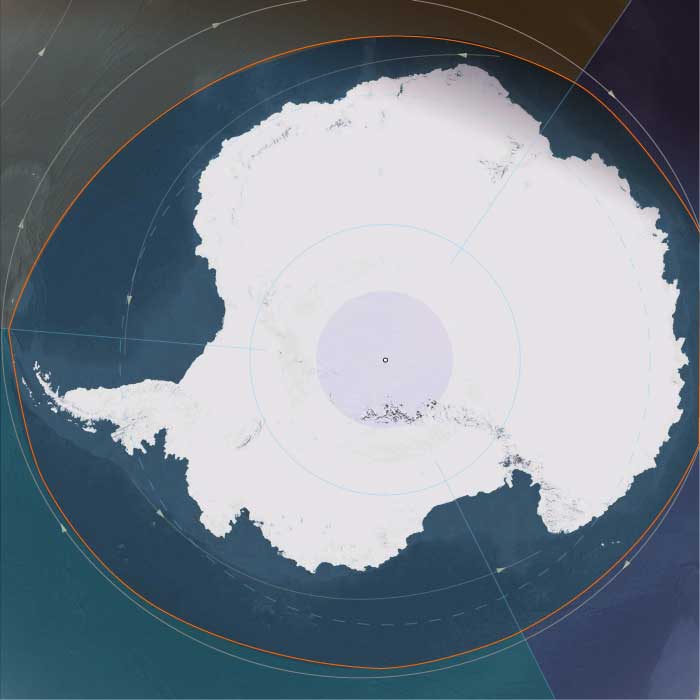
Antarctica
Related Events
Showing 10 events out of 72 total
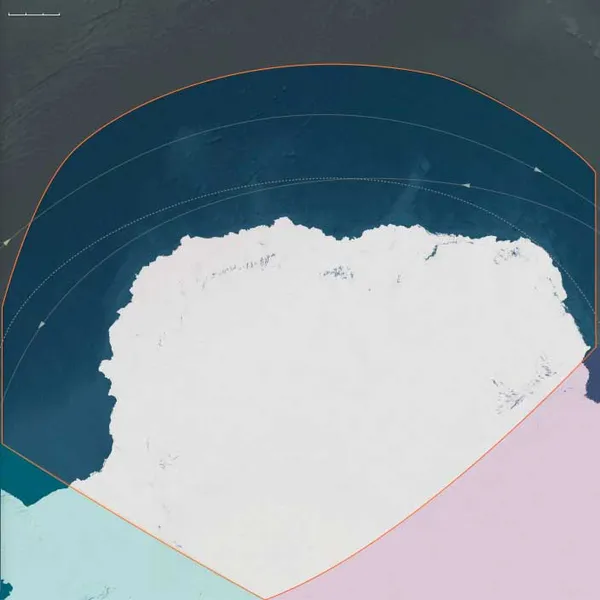
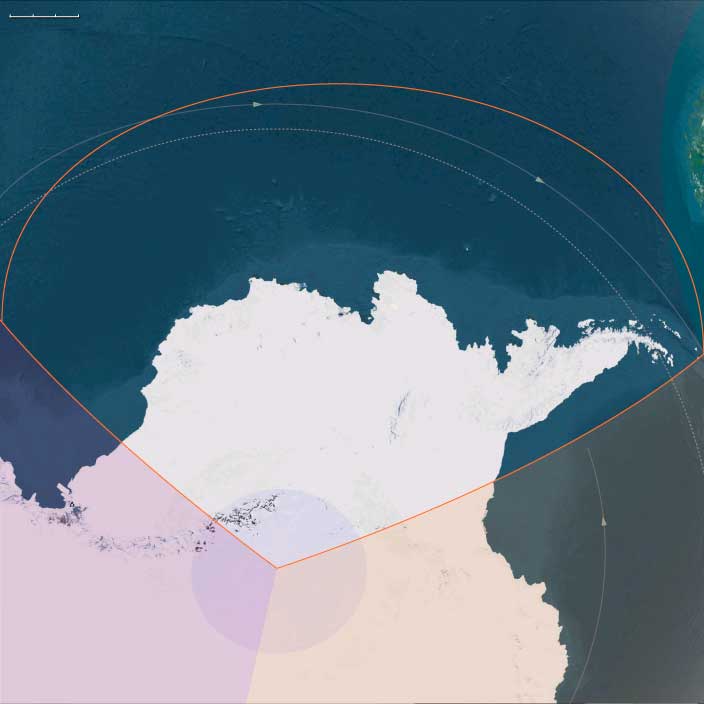
The African South, encompassing the southern subcontinent of Africa, includes the Republic of South Africa, Lesotho, Eswatini (formerly Swaziland), Botswana, southern Mozambique, nearly all of Namibia except its far north, and the western portion of East Antarctica.
This region also extends into the South Atlantic and Southern Ocean, incorporating Coronation Island (visible above the tip of the Antarctic Peninsula), South Georgia, the South Sandwich Islands, and the remote Tristan da Cunha and Gough Islands in the mid-South Atlantic.
The desolate Kerguelen Islands, marking the convergence of Southern Africa, Australasia, and Afroasia, form its easternmost point.
The northern boundary runs just south of the Namibia-Angola border, tracing the Caprivi Strip before reaching the Mababe Depression, northwest of the Okavango Basin.
The northeastern border follows Botswana’s boundary with Zimbabwe, then continues between South Africa’s Drakensberg Range and Kruger National Park, before finally separating Eswatini from Mozambique.
HistoryAtlas contains 554 entries for the African South from the Paleolithic period to 1899.
Narrow results by searching for a word or phrase or select from one or more of a dozen filters.
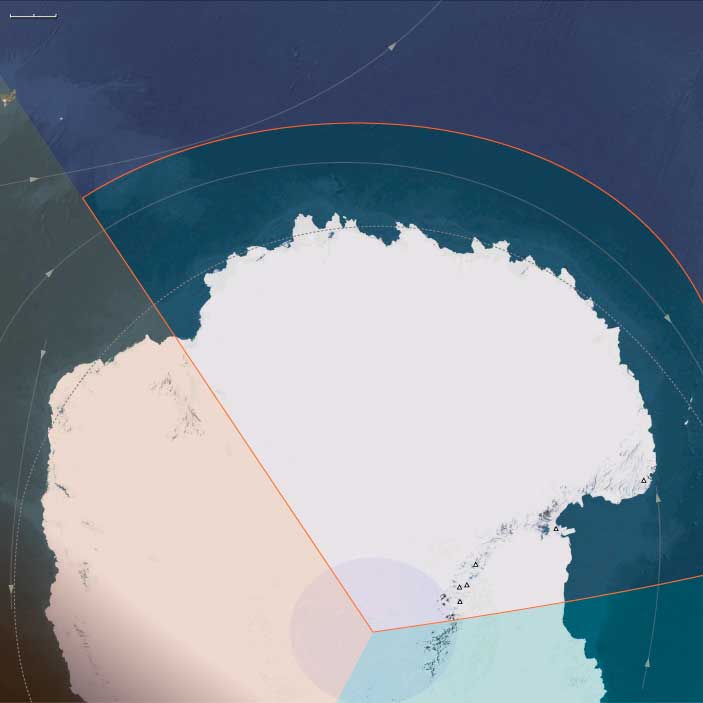
Southern Oceania encompasses Eastern East Antarctica, Tasmania, New Zealand’s South Island (including its southern coast), and Australia, extending northward to the continent’s Top End and Cape York Peninsula.
The term Australasia (French: Australasie) was coined by Charles de Brosses in Histoire des navigations aux terres australes (1756). Derived from Latin, meaning "south of Asia," the term was intended to distinguish this region from Polynesia (to the east) and the southeastern Pacific (Magellanica).
Southern Oceania’s southwestern boundary divides East Antarctica into its Western and Eastern subregions, running from the South Pole to the Kerguelen Islands. These islands, among the most remote on Earth, form part of the Kerguelen Plateau, a vast igneous geological province largely submerged beneath the southern Indian Ocean.
The French Southern and Antarctic Lands (Terres australes et antarctiques françaises)—which include Adélie Land, the Crozet Islands, the Kerguelen Islands, Amsterdam and Saint Paul Islands, and France’s Scattered Islands in the Indian Ocean—are administered as a separate district.
The southeastern boundary runs a little north of the Cook Strait, which separates New Zealand’s South Island—sometimes called the "mainland"—from the smaller yet more populous North Island (Te Ika-a-Māui).
The northern boundary divides Southern Oceania from The Far East, to which Australia’s tropical north belongs.
HistoryAtlas contains 569 entries for Southern Oceania from the Paleolithic period to 1899.
Narrow results by searching for a word or phrase or select from one or more of a dozen filters.
Antarctica (49,293–28,578 BCE): Upper Pleistocene I — The Frozen Continent and Its Oceanic Halo
Geographic and Environmental Context
During the height of the Late Pleistocene, Antarctica stood as the coldest, driest, and most isolated world on Earth—a continent sealed in ice and girdled by the Southern Ocean.
The great landmass divided naturally into three broad realms:
-
East Antarctica, the immense polar plateau rising more than 3 km above sea level, draped in ice more than 4 km thick and stretching from the Transantarctic Mountains to the Indian Ocean rim.
-
West Antarctica, a lower, fractured terrain comprising the Antarctic Peninsula, Marie Byrd Land, and the Amundsen–Ross embayments, fringed by vast floating shelves.
-
The subantarctic ring—the nearby island arcs of South Georgia, the South Orkneys, the South Sandwich Islands, Bouvet, and the Prince Edward–Marion chain—sat just beyond the continental ice but within its climatic orbit, forming Antarctica’s ecological frontier with the world’s oceans.
These divisions—polar plateau, continental rim, and subantarctic ring—behaved less like a single geography than like three interconnected systems whose unity was maintained by ice, wind, and current.
Climate and Environmental Shifts
The period between 49,000 and 28,500 BCE encompassed the build-up to the Last Glacial Maximum.
-
Temperature: Mean annual values across the plateau were 10–15 °C colder than today; coastal sectors remained below freezing even in summer.
-
Ice extent: The East Antarctic Ice Sheet thickened and spread toward the coast, while the smaller West Antarctic ice masses merged, grounding on the continental shelf. Overall, Antarctica’s ice volume reached its greatest Quaternary extent.
-
Sea level: Global levels fell ~120 m, exposing continental shelves and expanding grounded ice.
-
Atmosphere: Lower greenhouse-gas concentrations and stronger katabatic winds intensified polar deserts in the interior.
-
Ocean: Sea-ice fronts advanced far north in winter, yet polynyas—open-water oases—persisted along parts of the coast, sustaining remarkable marine productivity.
The result was a planet tipped toward cold equilibrium: Antarctica at its broadest and most luminous, radiating sunlight back into space and anchoring global climate.
Flora, Fauna, and Ecology
Antarctica itself supported only microbial, algal, and cryptogamic life confined to small ice-free niches, while its surrounding seas and subantarctic islands hosted some of Earth’s richest cold-water ecosystems.
-
Terrestrial oases: Along the Dry Valleys, the Antarctic Peninsula, and scattered nunataks, thin melt-season films supported cyanobacteria, mosses, lichens, and minute invertebrates.
-
Coastal wildlife: Adélie and early emperor-penguin lineages bred on stable sea-ice platforms; skuas and petrels nested on rocky ledges.
-
Marine systems: Krill, copepods, and under-ice algae flourished beneath seasonal pack ice, feeding whales, seals, and seabirds.
-
Subantarctic ring: Islands like South Georgia and the Prince Edward group carried tussock grass, moss, and sprawling rookeries of albatrosses, petrels, and fur seals—vital nodes in the circum-polar web.
Though barren by continental standards, Antarctica’s margins were alive with motion, its biological clock synchronized to the annual advance and retreat of ice.
Human Presence and Global Context
No humans had ever set foot on this continent or its islands.
Elsewhere, Homo sapiens spread across Africa, Eurasia, and Sahul, but Antarctica lay far beyond the technological reach of any Pleistocene mariner.
Its isolation rendered it the world’s ultimate terra incognita, absent even from myth.
Yet indirectly, it mattered: the continent’s albedo, sea-ice cycles, and carbon sequestration steered the climates within which human civilizations would one day arise.
Antarctica was already humanity’s silent climate engine.
Movement and Interaction Corridors
Though devoid of people, the region was a crossroads for wind, current, and life:
-
The Antarctic Circumpolar Current (ACC) encircled the continent, connecting the Atlantic, Indian, and Pacific Oceans into a single conveyor.
-
The westerly wind belt (“roaring forties” – “furious fifties”) drove surface circulation and upwelling that fed krill blooms.
-
Whales, seals, and seabirds migrated along these highways from every southern continent, forming a truly circum-global ecological network.
These corridors prefigured the pathways of future exploration, commerce, and science.
Symbolic and Conceptual Role
In human terms, Antarctica existed only as an absence—a mythic void beyond any known horizon.
Had Ice-Age peoples imagined it, it might have represented the under-world of ice, a place where sun and earth froze in perpetual night.
In geological reality, it was the earth’s mirror, reflecting heat and regulating balance: a physical metaphor for stasis at the edge of creation.
Environmental Adaptation and Resilience
Antarctica’s ecosystems, though sparse, showed immense stability:
-
Glacial resilience: Microbial and moss communities endured multiple glacial advances, recolonizing from refugia during brief interstadials.
-
Marine adaptation: Krill and fish species evolved antifreeze proteins, surviving under permanent cold.
-
Carbon storage: Ice-sheet expansion sequestered atmospheric CO₂, tightening Earth’s glacial grip yet ensuring reversibility when melting resumed.
In every process—wind, ice flow, nutrient recycling—the system demonstrated the capacity of life and climate to adapt through feedback and equilibrium.
Transition Toward the Glacial Maximum
By 28,578 BCE, Antarctica had reached near-peak glacial extent.
The East Antarctic plateau remained unaltered in its frozen dominion; the West Antarctic shelves thickened; and the subantarctic islands thrived as refugia for the Southern Ocean’s living abundance.
Humanity still knew nothing of this world, yet its influence touched every other: it cooled the tropics, lowered the seas, and sculpted the very margins of habitable Earth.
In the grand pattern of The Twelve Worlds, Antarctica stood as the still point of the planet’s climatic wheel—its icy heart, unseen but omnipresent, binding the glacial age together.
Antarctica (28,577 – 7,822 BCE): Upper Pleistocene II → Early Holocene — Ice, Ocean, and the Edges of Life
Geographic & Environmental Context
During the transition from the Last Glacial Maximum (LGM) to the Early Holocene, Antarctica remained a continent of deep ice and shallow change—a frozen core slowly responding to planetary warming.
Its three major regions reflected stark gradients of cold, wind, and ecological possibility:
-
Eastern East Antarctica — the vast polar plateau rising over 3,000 m, capped by ice up to 4 km thick and rimmed by the Amery, Shackleton, and Ross Sea shelves. A hyper-arid interior where snow accumulation was minimal and temperatures rarely rose above –40 °C.
-
Western East Antarctica — the coastal fringe along the Indian and Atlantic sectors and its subantarctic island arc (South Georgia, South Sandwich, South Orkney, Bouvet, Prince Edward–Marion, western Kerguelen). Cold, wet, and windy, these islands were the biological outposts of the polar world.
-
West Antarctica — including the Antarctic Peninsula, Ellsworth Mountains, Marie Byrd Land, and the great Ross and Filchner–Ronne shelves. Ice streams here flowed into subpolar embayments, while geothermal oases and ice-free headlands supported sparse but persistent life.
Together they formed a mosaic from permanent polar desert to storm-lashed tundra, all encircled by the Antarctic Circumpolar Current (ACC)—the engine linking the Southern Ocean to every other sea.
Climate & Environmental Shifts
-
Last Glacial Maximum (c. 26,500 – 19,000 BCE):
The Antarctic Ice Sheet was thicker and broader than today. Ice shelves reached the continental-shelf edge; sea ice expanded hundreds of kilometers northward each winter. Mean annual temperatures were 6–10 °C colder than modern values. -
Bølling–Allerød (c. 14,700 – 12,900 BCE):
Global warming marginally softened coastal climates. Seasonal sea ice contracted slightly in summer, exposing rocky beaches for brief biological colonization. -
Younger Dryas (c. 12,900 – 11,700 BCE):
Cooling restored extensive winter sea ice; outlet glaciers paused or advanced; westerly winds strengthened. -
Early Holocene (post-11,700 BCE):
Renewed warmth reduced ice extent along the Antarctic Peninsula and Ross–Amundsen coasts; polynyas widened; ice-free ground on subantarctic islands expanded. Interior East Antarctica remained effectively unchanged—still the planet’s coldest desert.
Flora, Fauna & Ecology
Life was confined to coastal oases, volcanic slopes, and the surrounding seas:
-
Mainland Antarctica:
• Lichens, mosses, and microbial mats in ice-free pockets near geothermal sites and rocky headlands.
• Adélie and early Emperor penguins nesting on stable fast-ice or gravel beaches.
• Weddell, leopard, and crabeater seals using tide cracks and polynyas for breeding. -
Subantarctic islands:
• Tundra vegetation—tussock grasses, mosses, and cushion plants—spread on newly deglaciated slopes.
• Immense rookeries of albatrosses, petrels, penguins, and fur or elephant seals.
• Peat initiation began in saturated hollows, creating long-term carbon sinks. -
Marine realm:
• Seasonal phytoplankton blooms at the ice edge supported vast krill swarms, anchoring the food web for whales, seals, and seabirds.
• Nutrient-rich upwelling sustained the Southern Ocean as Earth’s most productive cold-water ecosystem.
Human Presence
None.
Antarctica remained completely beyond the reach of late Pleistocene navigation and survival technology. Its existence was outside any cultural geography or mythic horizon.
Environmental Dynamics
-
Ice-flow systems transported snow from the plateau to the sea, feeding the great shelves.
-
Calving and polynyas drove marine productivity by mixing surface and deep waters.
-
Volcanism in Marie Byrd Land, the South Shetlands, and South Sandwich arc created minor geothermal refuges that harbored unique biota.
-
Subantarctic feedback loops: guano deposition, peat formation, and storm redistribution of nutrients knit ocean and land into one biogeochemical engine.
Symbolic & Conceptual Role
For every human society of this time, Antarctica did not yet exist—not as rumor, myth, or destination. It was a planetary absence, sensed only through distant weather and current systems that touched Africa, South America, and Australasia.
Eastern East Antarctica (28557 – 7822 BCE): The Polar Plateau’s Eastern Expanse
Geographic and Environmental Context
Eastern East Antarctica—stretching from the Ross Sea sector eastward past the Amery Ice Shelf toward the Australian Antarctic Territory—is dominated by the East Antarctic Ice Sheet, the largest single ice mass on Earth.
-
The interior rises over 3,000 meters above sea level, with ice thickness reaching up to 4 km.
-
Coastal margins are fringed by floating ice shelves, ice cliffs, and occasional rocky nunataks.
-
Katabatic winds sweep from the polar plateau toward the coast, scouring snow and creating vast sastrugi fields.
Climate and Environmental Shifts
-
Last Glacial Maximum (c. 26,500 – 19,000 BCE): Already the coldest region on Earth, Eastern East Antarctica experienced intensified cold, reduced snowfall, and ice sheet expansion along some coastal fringes. The interior remained a hyper-arid polar desert.
-
Bølling–Allerød (c. 14,700 – 12,900 BCE): Global warming was detectable only at the coastal periphery—slight retreat of sea ice in summer months, but the interior climate remained well below freezing year-round.
-
Younger Dryas (c. 12,900 – 11,700 BCE): No significant interior change, but seasonal sea ice extended slightly further offshore in winter.
-
Early Holocene (after c. 11,700 BCE): Some coastal ice shelves experienced minor retreat, and limited ice-free ground expanded in rare Antarctic oases and rocky headlands, briefly supporting mosses, lichens, and microbial mats.
Flora, Fauna, and Ecology
Life was almost entirely restricted to the coastal margins and offshore waters:
-
Adélie penguins and early forms of Emperor penguins bred on rocky beaches and stable fast ice.
-
Seals—Weddell, leopard, and crabeater—hauled out on ice edges for breeding and resting.
-
Seasonal phytoplankton blooms in surrounding waters supported krill, fish, and seabirds such as petrels and skuas.
-
On the few exposed rocky oases, microbial mats, mosses, and lichens persisted in summer.
Human Presence
-
During this epoch, no humans had reached Eastern East Antarctica. Extreme cold, remoteness, and pack ice barriers kept the continent far beyond the reach of late Pleistocene maritime technology.
-
The region existed entirely outside human conceptual geography and oral tradition at the time.
Environmental Dynamics
-
Ice movement flowed from the high polar plateau toward the coast, feeding ice shelves like the Amery and Shackleton.
-
Coastal polynyas—areas of open water in sea ice—were crucial wintering and feeding zones for marine mammals and birds.
-
Occasional katabatic wind storms sculpted ice surfaces and redistributed snow.
Symbolic and Conceptual Role
For human societies of this period, this land was an unknown polar void—geographically real but unimagined in any cultural mapping of the world.
Transition Toward the Holocene
By 7822 BCE, Eastern East Antarctica’s vast ice sheet remained largely unchanged in extent from the LGM, though subtle coastal retreats and seasonal productivity increases in the surrounding Southern Ocean were underway. It would remain unvisited by humans for many thousands of years.
Western East Antarctica (28557 – 7822 BCE): Icebound Shores and Subantarctic Refuges
Geographic and Environmental Context
Western East Antarctica—stretching along the Indian Ocean and Atlantic sectors of the Southern Ocean from the Transantarctic Mountains eastward—includes the coastal Antarctic mainland as well as a chain of subantarctic islands: South Georgia, the South Sandwich Islands, the South Orkney Islands (including Coronation Island), Bouvet Island, Prince Edward and Marion Islands, and the western Kerguelen Islands.
-
The mainland is dominated by the East Antarctic Ice Sheet’s steep coastal margins, calving massive icebergs into the Southern Ocean.
-
The subantarctic islands, positioned in the Furious Fifties and Screaming Sixties, are cold, wet, and windy but far more biologically productive than the Antarctic continent.
Climate and Environmental Shifts
-
Last Glacial Maximum (c. 26,500 – 19,000 BCE): The Antarctic mainland experienced intensified cold and sea ice expansion; glaciers extended beyond modern limits in some coastal sectors. The subantarctic islands were glaciated at higher elevations but retained ice-free lowlands that served as refugia for seabirds and hardy tundra vegetation.
-
Bølling–Allerød (c. 14,700 – 12,900 BCE): Slight warming shortened seasonal sea ice extent around the islands; vegetation cover expanded, and seabird populations grew. Offshore waters saw richer plankton blooms as ice-edge productivity increased.
-
Younger Dryas (c. 12,900 – 11,700 BCE): Cooling reversed some gains—winter sea ice extended further north again, and glacial tongues on islands advanced slightly.
-
Early Holocene (after c. 11,700 BCE): Renewed warming and more stable ocean circulation patterns improved biological productivity in the Southern Ocean, supporting dense colonies of penguins, seals, and seabirds on ice-free coastal slopes.
Flora, Fauna, and Ecology
-
Mainland Antarctica: Almost entirely ice-covered, with life restricted to scattered ice-free rock hosting lichens, mosses, and microbial mats.
-
Subantarctic islands: Supported tundra vegetation, tussock grasslands, and mossy bogs; teeming seabird rookeries (albatrosses, petrels, penguins) and seal haul-outs (fur seals, elephant seals).
-
The surrounding Southern Ocean hosted krill swarms, fish, and seasonal whale migrations.
Human Presence
-
During this period, no humans had reached Western East Antarctica or its subantarctic islands. Distances from inhabited continents, extreme weather, and rough seas placed them far beyond the range of late Pleistocene navigation.
-
These ecosystems evolved without human disturbance.
Environmental Dynamics
-
The Antarctic Circumpolar Current and persistent westerly winds maintained high nutrient turnover in surrounding waters, sustaining marine productivity even during colder phases.
-
Volcanic activity in the South Sandwich Islands occasionally reshaped coastlines, creating new nesting sites.
-
Iceberg calving events influenced local marine habitats, providing temporary platforms for seals and seabirds.
Symbolic and Conceptual Role
For contemporary human cultures, these lands and islands were unknown southern realms, invisible beyond the maritime horizons of the southern continents.
Transition Toward the Holocene
By 7822 BCE, Western East Antarctica’s subantarctic islands were entering a biologically rich phase under Early Holocene warmth. The mainland coast remained icebound, but seasonal productivity along the ice edge made the surrounding Southern Ocean one of the planet’s richest marine ecosystems—still untouched by humans.
West Antarctica (28557 – 7822 BCE): Ice Sheets, Shelves, and Subpolar Seas
Geographic and Environmental Context
West Antarctica consists of the Antarctic Peninsula, the Ellsworth Mountains, the Marie Byrd Land coast, and the adjoining Amundsen and Ross Sea sectors.
-
This region is largely an ice-covered landmass split into several smaller blocks by deep, ice-filled basins.
-
Extensive ice shelves fringe the coastline, with the Ross Ice Shelf and the Filchner–Ronne Ice Shelf among the most significant.
-
Offshore, the Southern Ocean’s subpolar seas—fed by nutrient-rich upwelling—were crucial for marine life.
Climate and Environmental Shifts
-
Last Glacial Maximum (c. 26,500 – 19,000 BCE): Ice sheets in West Antarctica were thicker and extended farther toward the continental shelf edge; sea ice expanded far northward in winter. The Antarctic Peninsula experienced mean annual temperatures several degrees colder than today, with tundra or ice-free ground confined to isolated coastal oases.
-
Bølling–Allerød (c. 14,700 – 12,900 BCE): Global warming caused some retreat of ice fronts along the Antarctic Peninsula and in the Amundsen and Ross Sea embayments. Summer sea-ice extent reduced, increasing marine productivity near the ice edge.
-
Younger Dryas (c. 12,900 – 11,700 BCE): Cooling slightly re-extended seasonal sea ice, though glaciers on the Antarctic Peninsula largely held their ground rather than advancing significantly.
-
Early Holocene (after c. 11,700 BCE): Continued warming triggered further ice-shelf thinning and retreat, especially in the northern Antarctic Peninsula; summer sea ice became less extensive, and open-water seasons lengthened in coastal waters.
Flora, Fauna, and Ecology
-
Terrestrial life: Limited to ice-free headlands, volcanic slopes, and nunataks. Mosses, lichens, and microbial mats survived in moist, sheltered microhabitats.
-
Marine life: Abundant along ice edges and in polynyas—Adélie and chinstrap penguins, Antarctic fur seals, and Weddell seals bred on stable ice or rocky beaches. Large numbers of petrels and skuas nested on ice-free cliffs. Krill swarms supported baleen whales, seals, and seabirds.
-
Subantarctic connections: The Antarctic Peninsula’s northern fringe had ecological links to South Georgia and other subantarctic islands via seabird and marine mammal migrations.
Human Presence
-
There was no human presence during this epoch. West Antarctica lay far beyond the capabilities of late Pleistocene seafaring and survival technology, and remained completely unknown to human societies.
Environmental Dynamics
-
Ice flow from the West Antarctic Ice Sheet fed the Ross, Filchner–Ronne, and Amundsen Sea ice shelves, calving vast tabular icebergs into the Southern Ocean.
-
Polynyas—open water within the sea ice—formed seasonally and were key feeding grounds for marine life.
-
Volcanically active areas, such as parts of Marie Byrd Land and the South Shetland Islands, created small patches of geothermal ice-free ground, which could support plant and microbial life.
Symbolic and Conceptual Role
For human cultures elsewhere, West Antarctica was an unseen polar land, absent from any geographic awareness until the modern era.
Transition Toward the Holocene
By 7822 BCE, West Antarctica’s ice sheet had begun to thin in some coastal sectors, but remained vast and continuous. Seasonal marine productivity along the ice edge increased as open-water seasons lengthened, fostering rich but completely untouched ecosystems.
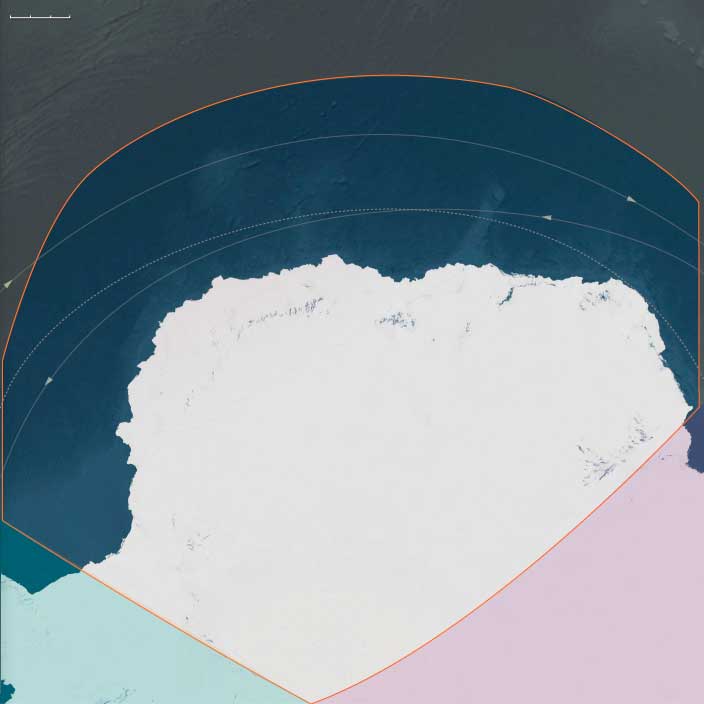
The Ends of the Earth, one twelfth of the Earth’s surface, is bordered by the South Atlantic and South Pacific Oceans and includes Subcontinental South America, the Chonos Archipelago, Chiloé Island, Tierra del Fuego, the Falkland Islands, the remote Juan Fernández Islands (notably home to the marooned sailor Alexander Selkirk from 1704 to 1709, an experience thought to have inspired Daniel Defoe’s Robinson Crusoe), the even more remote Easter Island, and West Antarctica—the portion of Antarctica that lies within the Western Hemisphere and includes the Antarctic Peninsula.
Easter Island, culturally Polynesian yet governed by Chile, is among the most isolated inhabited islands in the world, positioned in the eastern South Pacific Ocean at the northwestern edge of The Ends of the Earth, along with the equally remote Pitcairn Islands.
The southeastern and southwestern boundaries divide West Antarctica from the much larger East Antarctica.
The northeastern boundary follows the approximate courses of the Colorado and Barrancas Rivers, which flow from the Andes to the Atlantic Ocean and are traditionally recognized as the northern limit of Argentine Patagonia.
For Chilean Patagonia, most geographers and historians identify its northern boundary at the Huincul Fault in the Araucanía Region.
HistoryAtlas contains 153 entries for The Ends of the Earths from the Upper Paleolithic period to 1899.
Narrow results by searching for a word or phrase or select from one or more of a dozen filters.
A dramatic and rapid rise in global sea-levels of around fourteen meters is linked by coral off the South Pacific island of Tahiti to the collapse of massive ice sheets fourteen thousand six hundred years ago.
An Aix-Marseille University-led team, including Oxford University scientists Alex Thomas and Gideon Henderson, confirmed that a dramatic and rapid rise in global sea-levels of around fourteen meters occurred at the same time as a period of rapid climate change known as the Bølling oscillation.
The Bølling oscillation, a warm interstadial period between the Oldest Dryas and Older Dryas stadials, at the end of the last glacial period, is used to describe a period of time in relation to Pollen zone Ib—in regions where the Older Dryas is not detected in climatological evidence, the Bølling-Allerød is considered a single interstadial period.
The beginning of the Bølling is also the high-resolution date for the sharp temperature rise marking the end of the Oldest Dryas at 14,670 BP and the beginning of the so-called Humid Period in North Africa.
The region that will later become the Sahara is wet and fertile, its aquifers full.
During the Bølling warming high latitudes of the Northern hemisphere warmed as much as 15 degrees Celsius in a few tens of decades.
The team has used dating evidence from Tahitian corals to constrain the sea level rise to within a period of three hundred and fifty years, although the actual rise may well have occurred much more quickly and would have been distributed unevenly around the world's shorelines.
A leading theory is that the ocean's circulation changed so that more heat was transported into Northern latitudes.
A considerable portion of the water causing the sea-level rise at this time must have come from melting of the ice sheets in Antarctica, which sent a 'pulse' of freshwater around the globe.
However, whether the freshwater pulse helped to warm the climate or was a result of an already warming world remains unclear.
Antarctica (7,821 – 6,094 BCE): Early Holocene — Ice Retreat, Blue Shadows, and the Rebirth of Polar Life
Geographic & Environmental Context
In the Early Holocene, Antarctica was a continent in transition—from the crushing grip of the last glacial maximum toward the cold equilibrium that would define the modern world.
The East Antarctic Ice Sheet remained massive and largely stable, locked high across the polar plateau.
The West Antarctic Ice Sheet, however, was in full retreat: ice fronts pulled back across the Ross and Weddell embayments, and outlet glaciers in the Amundsen Sea sector began their long withdrawal.
Ice-free oases and mountain ridges—Bunger Hills, McMurdo Dry Valleys, Larsemann Hills, and portions of the Antarctic Peninsula—expanded modestly, exposing ancient moraines, saline lakes, and tundra-like niches.
Around the margins, the Southern Ocean encircled the continent as a restless engine—driven by the Antarctic Circumpolar Current (ACC)—linking it ecologically to the subantarctic islands of the South Atlantic and Indian Oceans.
Climate & Environmental Shifts
The Holocene thermal maximum brought slight but critical warming to the polar realm:
-
Mean annual temperatures rose by a few degrees compared to the Late Glacial period.
-
Ice-sheet thinning occurred along coasts and embayments; major ice shelves (Ross, Filchner–Ronne, Amery) receded inland from their glacial maxima but remained expansive.
-
Sea ice diminished seasonally, producing longer open-water summers; polynyas (persistent open-water zones) formed near coasts.
-
Moisture transport from mid-latitude storms increased snowfall in coastal sectors, while the interior remained hyper-arid and katabatic-wind-swept.
The Antarctic atmosphere, once dominated by glacial cold, now cycled through new seasonal pulses of thaw, meltwater, and refreeze—introducing rhythm to a continent that had long known only permanence.
Subsistence & Settlement
No human beings had yet set foot on the Antarctic continent.
Life here was purely non-human, yet in its own way as adaptive and dynamic as any civilization:
-
Coastal tundra oases supported mosses, lichens, and microbial mats, expanding in meltwater-fed basins and rock fissures.
-
Seabirds and penguins (Adélie, gentoo, chinstrap) colonized ice-free shores, while petrels, skuas, and cormorants nested along the Antarctic Peninsula.
-
Seals (Weddell, leopard, and elephant) established new haul-outs on beaches newly exposed by ice retreat.
-
Offshore ecosystems surged with life: krill, squid, fish, and plankton fed vast congregations of whales returning to the high-latitude feeding grounds each summer.
This was the rebirth of the polar food web—a return of productivity after millennia of glacial austerity.
Technology & Material Culture
In the human world elsewhere, people were perfecting pottery, domesticating animals, and building the first agricultural villages—but Antarctica remained untouched.
No hearth, no track, no artifact broke its frozen solitude; the continent’s only “technology” was that of ice, wind, and wave shaping the living crust of sea and shore.
Movement & Interaction Corridors
Biological movement replaced any human route:
-
The ACC circled Antarctica as a constant conveyor, carrying nutrients, plankton, and larvae around the planet’s southern girdle.
-
Migratory whales followed the seasonal sea-ice edge, feeding in austral summers and migrating north in winter.
-
Seabirds linked Antarctica to the subantarctic islands, bridging thousands of kilometers.
-
Oceanic fronts—the Polar and Subantarctic convergences—acted as invisible highways of life, defining productivity gradients that tied Antarctica to every southern ocean.
Cultural & Symbolic Expressions
No human culture existed here to interpret its grandeur, yet natural symbolism flourished:
-
The cyclic return of sunlight, the waxing and waning of ice, the rhythm of migration and reproduction—all wrote an ecological cosmology of recurrence and endurance.
-
Each year’s melt renewed the promise of life; each winter’s freeze sealed it again in blue ice and silence.
Antarctica, though empty of people, was alive with rituals of nature: nesting cycles, whale migrations, the return of krill swarms, the annual exchange of heat and light.
Environmental Adaptation & Resilience
Life clung to margins and adapted ingeniously to extremes:
-
Microbial and algal mats developed antifreeze proteins and pigments to withstand freeze–thaw cycles.
-
Seabirds and seals synchronized breeding to brief ice-free seasons.
-
Krill populations adapted to feed beneath thinning sea ice, ensuring continuity of the entire food chain.
-
Vegetation and soil microbes colonized wind-sheltered microhabitats, enriching them over centuries.
Antarctica’s ecosystems achieved a delicate equilibrium—resilient, self-renewing, and finely tuned to the planet’s most unforgiving climate.
Long-Term Significance
By 6,094 BCE, Antarctica had reached its Holocene form:
-
Ice sheets largely stabilized within modern bounds; ice-free oases persisted as scattered sanctuaries of life.
-
Marine productivity and migratory cycles reached full vigor, fueling the great southern food web.
-
The continent’s pristine ecosystems remained untouched, awaiting future ages when humankind would finally seek them out.
At the dawn of the Holocene, Antarctica was both a remnant of the glacial past and a promise of planetary renewal—the white mirror of Earth’s resilience, where wind, sea, and sunlight rehearsed the rhythm of life long before human memory.