
Antonio Vivarini had initially trained with Andrea …
Years: 1451 - 1451
Antonio Vivarini had initially trained with Andrea da Murano, and his works show the influence of Gentile da Fabriano.
The earliest known date of a picture of his, an altarpiece in the Accademia is 1440; the latest, in the Lateran museum, 1464, but he appears to have been alive in 1470.
He works in company his brother in law, Giovanni d'Alemagna (also known as "Joannes de Alemania", who has also been regarded as a brother (Giovanni of Murano), but no trace of this painter exists of a date later than 1447.
After 1447, Antonio painted either alone or in combination with his younger brother Bartolomeo.
Antonio had attempted naturalness in his “Madonna and Saint,” painted around 1445, using strong contours to strengthen the figures in an unsuccessful attempt to achieve plasticity.
His masterpiece, the polyptych entitled “Virgin and Child Enthroned with Saints,” executed in about 1450, displays the influence of his brother Bartolomeo, a coarser but bolder artist.
The works of Antonio are well drawn for their time, with a certain noticeable degree of softness, and with good flesh and other tints.
He is likely influenced by Andrea Mantegna, and works with him in the Ovetari Chapel in 1450-1451.
It is sometimes difficult to assign authorship for works from the Vivarini studio.
Another of Antonio’s paintings, the undated “Saint Anthony of Padua,” derives its composition owes from the example of Mantegna.
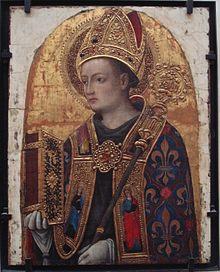
Antonio Vivarini: Saint Louis de Toulouse, probably from a polyptych, ca. 1450. The halo is inscribed in Pseudo-Kufic. (46 cm (18 in.), x 36 cm (14 in.) Louvre Museum. Photo by PHGCOM (2009)
Locations
People
Groups
Topics
Subjects
Regions
Subregions

Years: 1451 - 1451
Antonio Vivarini: Saint Louis de Toulouse, probably from a polyptych, ca. 1450. The halo is inscribed in Pseudo-Kufic. (46 cm (18 in.), x 36 cm (14 in.) Louvre Museum. Photo by PHGCOM (2009)
Locations
People
Groups
Topics
Subjects
Regions
Subregions