Arbella Stuart, fourth in line to the…
July 1610 CE
Arbella Stuart, fourth in line to the English throne though she does not aspire to it, is in 1610 in trouble again for planning to marry William Seymour, known as Lord Beauchamp, who will later succeed as the 2nd Duke of Somerset.
William Seymour is sixth-in-line, grandson of Lady Catherine Grey, a younger sister of Lady Jane Grey and a granddaughter of Mary Tudor, younger sister of King Henry VIII and Arbella's ancestress, Margaret Tudor.
Although the couple had at first denied that any arrangement existed between them, they had later married in secret on June 22, 1610, at Greenwich Palace.
For marrying without his permission, King James had imprisoned them: Arbella in Sir Thomas Perry's house in Lambeth and Seymour in the Tower of London.
The couple had some liberty within those buildings, and some of Arbella's letters to Seymour and to the King during this period survive.
When the King learned of her letters to Seymour, however, he ordered Arbella's transfer to the custody of William James, Bishop of Durham.
Arbella claimed to be ill, so her departure for Durham was delayed.
The couple use that delay to plan their escape.
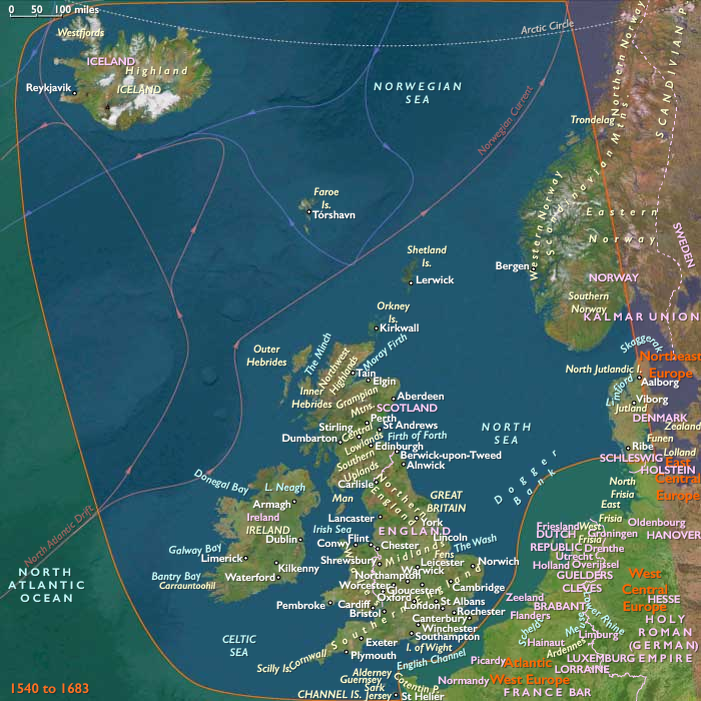
Arbella dresses as a man and escapes to Lee (in Kent), but Seymour does not meet her there before their getaway ship is to sail for France.
Sara Jayne Steen records that Imogen, the virtuous, cross-dressed heroine of William Shakespeare's play Cymbeline (1610-1611) has sometimes been read as a reference to Arbella.
Seymour had escapes from the Tower, but by the time he reached Lee, Arbella was gone, so he caught the next ship to Flanders.
Arbella's ship is overtaken by King James's men just before it reaches Calais, France, and she is returned to England and imprisoned in the Tower of London.
She never sees her husband again and in 1615 will starve herself to death in the Tower.
Locations
Groups
Regions
North Europe
View →Subregions