Aretino had prospered, living from hand to…
1524 CE
Aretino had prospered, living from hand to mouth as a hanger-on in the literate circle of his patron, sharpening his satirical talents on the gossip of politics and the Papal Curia, and turning the coarse Roman pasquinade into a rapier weapon of satire, until his sixteen ribald Sonetti Lussuriosi (Lust Sonnets) written to accompany Giulio Romano's exquisitely beautiful but utterly pornographic series of drawings engraved by Marcantonio Raimondi under the title I Modi finally causes such outrage that he has to temporarily flee Rome.
Raimondi had based his sixteen images of sexual positions on, according to the traditional view, a series of erotic paintings that Giulio Romano was doing as a commission for Federico II Gonzaga’s new Palazzo Te in Mantua.
Raimondi had worked extensively with Romano's master Raphael, who had died in 1520, producing prints to his design.
The engravings were published by Raimondi in 1524, and led to his imprisonment by Pope Clement VII and the destruction of all copies of the illustrations.
Romano had not become aware of the engravings until Aretino came to see the original paintings while Romano was still working on them.
Romano is not prosecuted since—unlike Raimondi—his images were not intended for public consumption.
Aretino then composed sixteen explicit sonnets to accompany the paintings/engravings, and secured Raimondi’s release from prison.
After Leo's death in 1521, his patron had become Cardinal Giulio de' Medici, whose competitors for the papal throne feel the sting of Aretino's scurrilous lash.
The installation of the Dutch pope Adrian VI ("la tedesca tigna" in Pietro's words) had instead encouraged Aretino to seek new patrons away from Rome, mainly with Federico II Gonzaga in Mantua, and with the condottiero Giovanni de' Medici ("Giovanni delle Bande Nere").
He is a lover of both women and men; having declared himself a sodomite since birth.
In a letter to Giovanni de' Medici written in 1524 Aretino encloses a satirical poem saying that due to a sudden aberration he had "fallen in love with a female cook and temporarily switched from boys to girls..." (My Dear Boy).
In his comedy Il marescalco, the lead man is overjoyed to discover that the woman he has been forced to marry is really a page boy in disguise.
While at court in Mantua he develops a crush on a young man called Bianchino, and annoyed Duke Federico with a request to plead with the boy on the writer's behalf.
Images
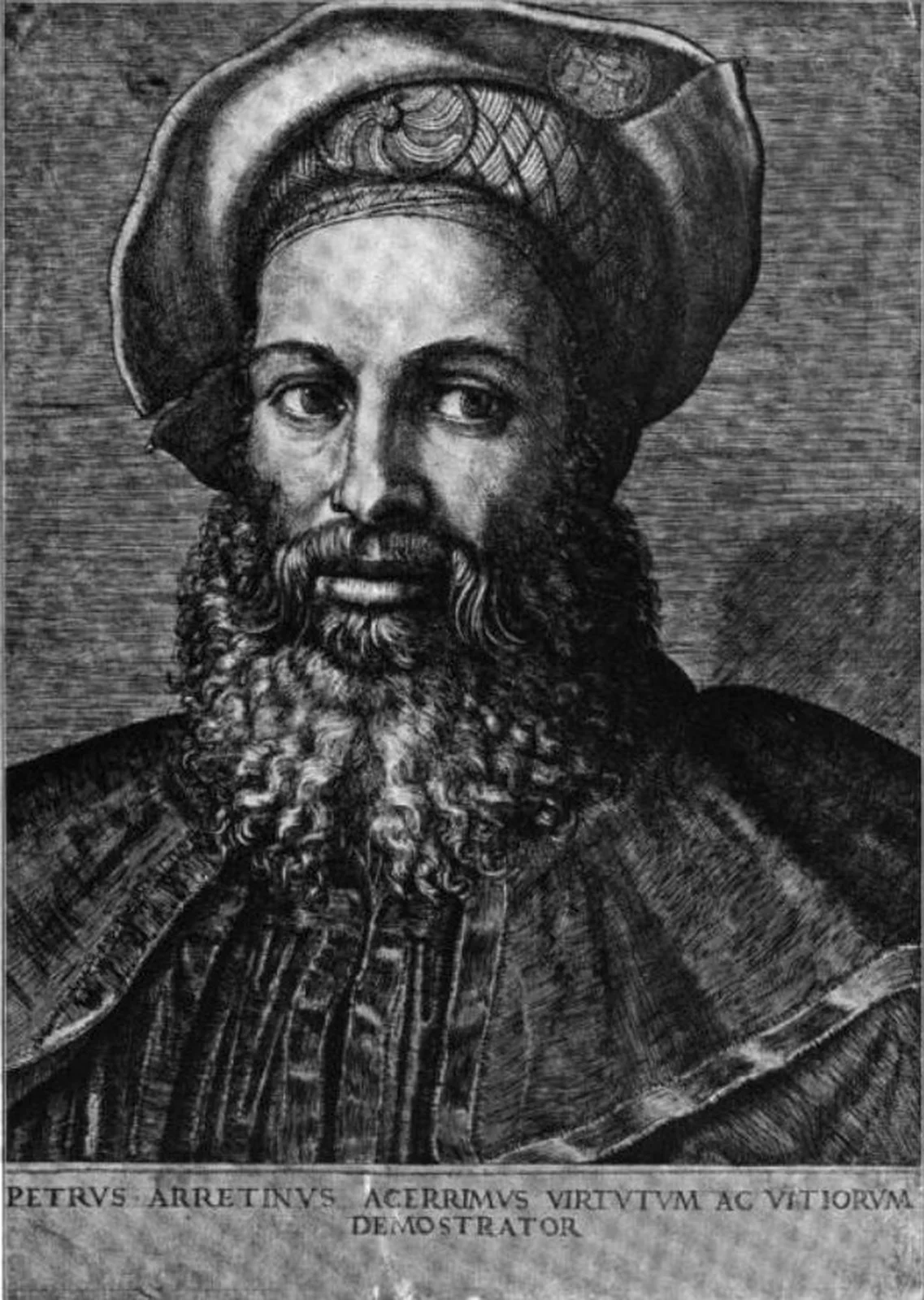
Image of engraving of Pietro Aretino by Marcantonio Raimondi (Bryan's dictionary of painters and engravers. (1904) Page 186. Michael Bryan, George Charles Williamson. Images published in the U.S. befo
Locations
People
Subjects
Regions
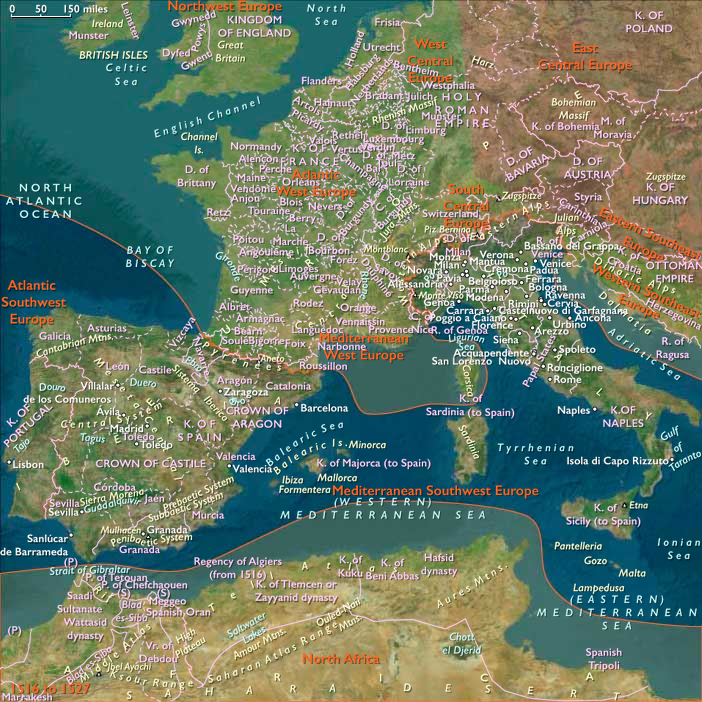
Southwest Europe
View →Subregions