Two ports, Tianjin and Shanghai, had been…
December 1864 CE
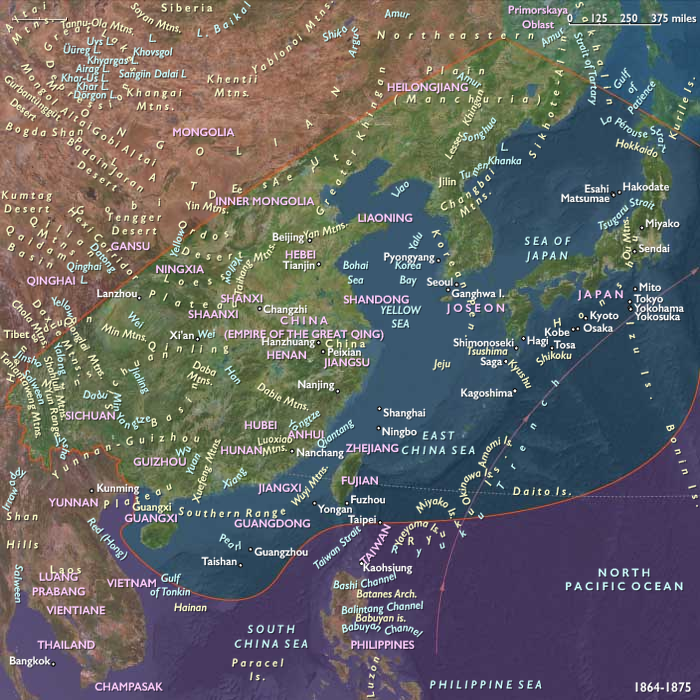
Two ports, Tianjin and Shanghai, had been opened to Western trade as a result of treaties with the Western powers.
In Shanghai, the British settlement to the south of Suzhou Creek (northern Huangpu District) and the American settlement to the north (southern Hongkou District) had joined in 1863 in order to form the Shanghai International Settlement.
France, having opted out of the Shanghai Municipal Council, maintains its own concession to the south and southwest.
Two officials titled Commissioner of Trade for the southern and northern ports, respectively, have been appointed to administer foreign trade matters at the newly opened ports.
Although the ostensible reason for the establishment of these two government offices had been to administer the new treaty ports, the underlying reasons for their establishment are more complicated: these superintendents are supposed to confine to the ports all diplomatic dealings with foreigners, rather than burdening Peking with them.
The authority of the commissioners will also come to include the overseeing of all new undertakings utilizing Western knowledge and personnel; thus, they will become the coordinators of most self-strengthening programs.
The concern with "self-strengthening" of China had been expressed by Feng Guifen (1809-1874) in a series of essays presented by him to Zeng Guofan in 1861.
Zeng, in his diaries, mentions directing his self-strengthening rhetoric to the call for modernization.
The movement can be divided into three phases.
The first, which will last from 1861 to 1872, emphasizes the adoption of Western firearms, machines, scientific knowledge and training of technical and diplomatic personnel through the establishment of a diplomatic office and a college.
Feng, who had gained military experience commanding a volunteer corps in the anti-Taiping campaign, in 1860 had moved to Shanghai, where he had been greatly impressed by Western military techniques.
The most important goal of the Self-Strengthening Movement is the development of military industries; namely, the construction of military arsenals and of shipbuilding dockyards to strengthen the Chinese navy.
This program is spearheaded by regional leaders like Zeng Guofan who, employing Yung Wing, establishes the Shanghai arsenal, ...
Groups
Commodities
Regions
East Asia
View →Subregions