
Scotland had managed to retain its status…
1400 CE
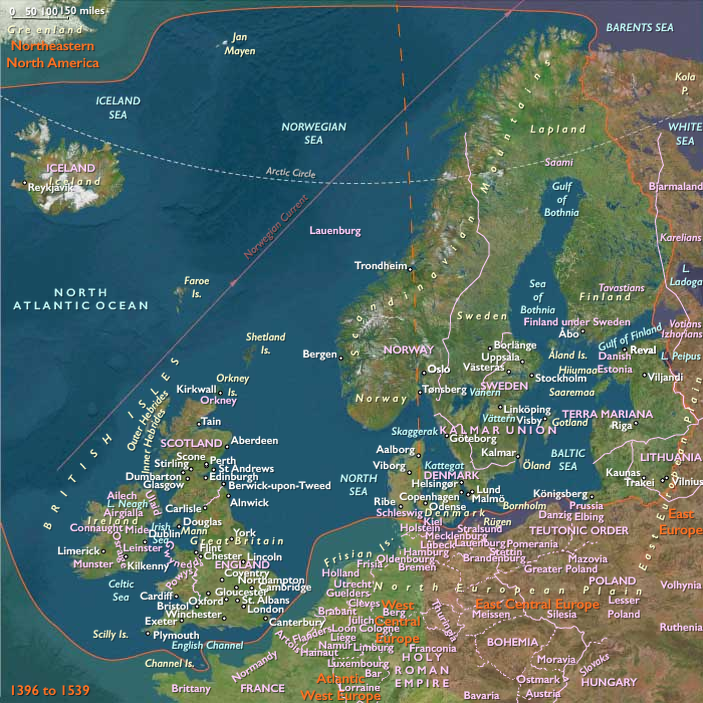
Scotland had managed to retain its status as an independent nation in 1357 at the close of the Wars of Scottish Independence, a series of military campaigns fought between the Kingdom of Scotland and the Kingdom of England in the late thirteenth and early fourteenth centuries,.
The Bruce dynasty had been successful in the civil war with their long-term Comyn-Balliol rivals, but David II's lack of an heir had allowed his nephew Robert II, King of Scots from 1371 until his death in 1390, to come to the throne and establish the Stewart Dynasty, which is to rule an increasingly prosperous Scotland for the remainder of the Middle Ages.
John Stewart, the eldest son of King Robert II by his mistress, Elizabeth Mure, had become legitimized in about 1349 with the formal marriage of his parents. (They had previously married in 1336, but some had criticized that ceremony as uncanonical.)
His granduncle King David II of Scotland in 1368 had created him Earl of Carrick, and he had taken some part in the government of the kingdom until about 1387, when a kick from a horse had disabled him.
Probably in consequence of this accident, his brother Robert, Earl of Fife, and not the crown prince himself, had become guardian of the kingdom in 1389; but the latter in May 1390 succeeded to the throne on his father's death.
At this time he had changed his baptismal name of John—unpopular owing to its connection with John de Baliol; he had also wished to avoid being called John II, as recognition of Balliol's kingship would have weakened the Bruce title to the throne—for that of Robert, and became crowned at Scone in August 1390 as King Robert III.
Although he has probably attended several parliaments, the new king is seen only nominally as the ruler of Scotland, the real power remaining in the hands of his brother, the Earl of Fife.
Owing to the king's "sickness of the body", however, his elder son, David, Duke of Rothesay, gains appointment in 1399 as lieutenant of the kingdom.
Locations
Commodities
Subjects
Regions
North Europe
View →Subregions
