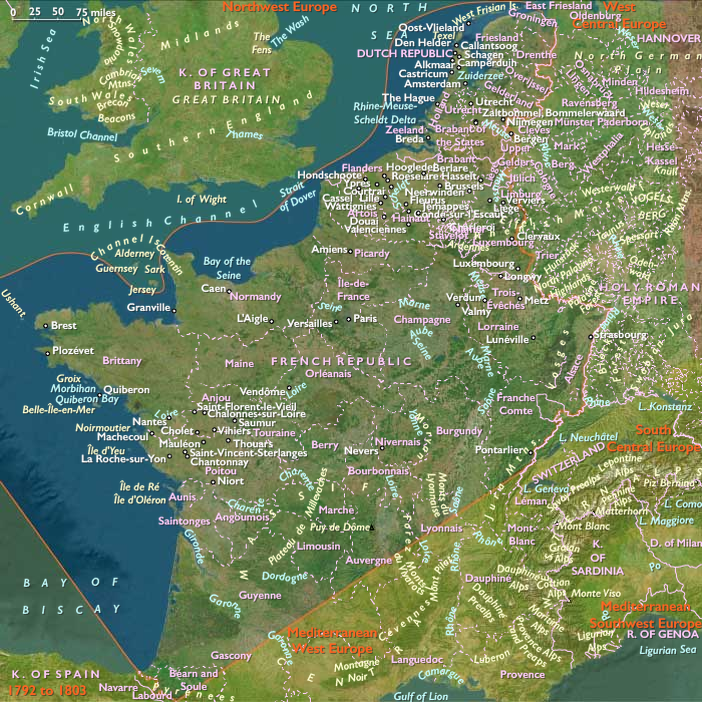
The increasing power of radicals in Paris…
March 1793 CE
The increasing power of radicals in Paris incites revolt in the provinces, with the the Vendée raising an army to attack the central government and open communications with Britain at the same time as the Central European armies are pushing the French invaders back across the Rhine.
Class differences are not as great in the Vendée as in Paris or in other French provinces.
In the rural Vendée, the local nobility seems to have been more permanently in residence and less bitterly resented than in other parts of France.
Alexis de Tocqueville noted that most French nobles lived in cities by 1789.
An Intendants' survey had shown one of the few areas where they still lived with the peasants was the Vendée.
The conflicts that have driven the revolution are also lessened in this particularly isolated part of France by the strong adherence of the populace to their Catholic faith.
In 1791, two "representatives mission" informed the National Convention of the disquieting condition of Vendée, and this news had been quickly followed by the exposure of a royalist plot organized by the Marquis de la Rouerie.
It is not until the social unrest combined with the external pressures from the Civil Constitution of the Clergy (1790) and the introduction of a levy of three hundred thousand on the whole of France, decreed by the National Convention in February 1793, that the region erupts.
The Civil Constitution requires all clerics to swear allegiance to it and by extension to the increasingly anti-clerical National Constituent Assembly.
All but seven of the one hundred and sixty bishops have refused the oath, as have about half of the parish priests.
Persecution of the clergy and of the faithful is the first trigger of the rebellion; the second being conscription.
Nonjuring priests are exiled or imprisoned.
Women on their way to Mass ware beaten in the streets.
Religious orders are suppressed and Church property confiscated.
On March 3, 1793, virtually all the churches are ordered closed.
Sacramental vessels are confiscated by soldiers and the people are forbidden to place a cross on their graves.
Nearly all the purchasers of church land are bourgeois, very few peasants benefit.
The March 1793 conscription requiring Vendeans to fill their district's quota of the national total of three hundred thousand enrages the populace, who take up arms instead as "The Catholic Army", "Royal" being added later, and fight for "above all the reopening of their parish churches with their former priests."(Joes, Anthony James. Resisting Rebellion: The History and Politics of Counterinsurgency (2006) University Press of Kentucky)
To be sure, town dwellers are more likely to support the Revolution in the Vendée.
Another isolated group of patriots are peasants on former monastery land, who overwhelmingly favor the Revolution.
There are other levy riots across France, after regions start to draft men into the army in response to the Levy Decree in February.
The reaction in the northwest in early March is particularly pronounced, with large scale rioting verging on insurrection.
Groups
Topics
Subjects
Regions
West Europe
View →Subregions