
Atlantic West Europe (1768–1779): Enlightenment Reforms, Economic …
Years: 1768 - 1779
Atlantic West Europe (1768–1779): Enlightenment Reforms, Economic Revival, and Rising Revolutionary Sentiment
From 1768 to 1779, Atlantic West Europe—spanning northern France, the Low Countries (Belgium, Netherlands, Luxembourg), and regions along the Atlantic and English Channel coasts—experienced a crucial period of intellectual vibrancy, economic recovery, administrative reform, and escalating revolutionary ideas. This era set important foundations for the profound social and political transformations that would soon follow.
Political and Administrative Developments
Bourbon Reforms and Administrative Centralization
-
Under King Louis XV (r.1715–1774) and then Louis XVI (r.1774–1792), France pursued administrative reforms inspired by Enlightenment rationalism, attempting to streamline government efficiency, reduce corruption, and stabilize the economy.
-
Ministers such as Anne Robert Jacques Turgot (Controller-General from 1774–1776) enacted policies aimed at fiscal restructuring, reducing noble privileges, and rationalizing trade and agriculture, although conservative opposition severely limited their effectiveness.
The Low Countries under Habsburg Rule: Reforms of Maria Theresa
-
Austrian-controlled Belgium and Luxembourg experienced significant administrative and economic reforms under Empress Maria Theresa (r.1740–1780). Efforts to modernize infrastructure, education, and fiscal policy enhanced efficiency and prosperity, particularly in cities like Brussels, Antwerp, and Ghent.
-
Joseph II, Maria Theresa’s co-regent from 1765, began introducing Enlightenment-inspired reforms—religious toleration, judicial modernization, and reduced censorship—paving the way for tensions between progressive ideals and conservative institutions.
Dutch Republic: Political Stagnation and Economic Revival
-
The Dutch Republic entered a period of relative political stagnation, marked by tensions between Orangists (supporters of the House of Orange) and Republican factions. Yet economic recovery began to stabilize following earlier setbacks from Anglo-Dutch rivalries, aided by renewed international trade and finance in cities such as Amsterdam and Rotterdam.
Economic Developments: Recovery and Innovation
Maritime Trade Revival and Colonial Commerce
-
Post-war economic recovery gained momentum, particularly in northern French ports like Bordeaux and Nantes, which revitalized trade networks, notably in wine, textiles, sugar, and Atlantic fisheries. Bordeaux emerged as a premier wine-exporting hub, particularly to Britain, significantly enhancing regional prosperity.
-
Antwerp and Amsterdam regained importance as international trade and financial centers, benefiting from colonial commerce and innovative financial institutions, such as enhanced banking and insurance systems, reinforcing their global economic influence.
Agricultural and Industrial Innovations
-
Enlightenment-era agricultural reforms in northern France and the Low Countries aimed at increasing productivity, introducing crop rotation, land reclamation, and improved cultivation techniques. These developments significantly enhanced food production and rural prosperity.
-
Proto-industrialization advanced markedly, especially in the textile industries of Flanders, northern France, and Brabant. Cities like Ghent, Lille, and Bruges saw significant growth in linen and wool manufacturing, employing rural labor and fueling urban economic expansion.
Intellectual and Cultural Developments
Enlightenment Expansion: Philosophy and Critique
-
Enlightenment ideas flourished through philosophers like Voltaire, Rousseau, Condorcet, and Beaumarchais, whose works openly criticized aristocratic privilege, religious intolerance, and absolutist governance.
-
Rousseau's writings—particularly his influential novel Émile (1762) and Confessions (1770–1778)—inspired profound introspection about education, individual liberty, and social justice, shaping public consciousness in France and beyond.
Scientific and Educational Advances
-
Significant progress in sciences continued with figures like Antoine Lavoisier revolutionizing chemistry and fostering empirical methods. Universities in Paris, Leiden, and Louvain reinforced scientific rationalism, disseminating Enlightenment principles widely.
-
Educational reforms broadened public access to learning, supported by initiatives to establish schools, academies, and scientific societies, significantly raising literacy and critical inquiry across the region.
Religious and Social Developments
Religious Toleration and Secular Trends
-
Toleration advanced markedly in the Low Countries, especially in urban centers such as Amsterdam and Brussels, enabling diverse religious and intellectual communities—Catholic, Calvinist, Jewish, and freethinking—to coexist productively, fostering cosmopolitan cultural vitality.
-
In France, despite state-supported Catholic orthodoxy, Enlightenment critiques increasingly challenged church authority, fueling secular tendencies and religious skepticism among urban intellectual elites.
Social Criticism and Emerging Revolutionary Sentiment
-
Social inequalities, excessive taxation, and political abuses provoked escalating criticism. Urban intellectuals, merchants, and the emerging bourgeoisie openly challenged feudal privileges, advocating principles of meritocracy, civil equality, and representative governance.
-
Salons, cafés, and reading societies proliferated in Paris, Brussels, and Amsterdam, becoming vibrant forums for revolutionary debate and civic participation, profoundly influencing public opinion and social consciousness.
Cultural and Artistic Flourishing
Transition from Rococo to Neoclassicism
-
Artistic expression in this period shifted decisively toward Neoclassicism, reflecting Enlightenment ideals of reason, symmetry, and classical harmony. Prominent artists like Jacques-Louis David emerged in Paris, while influential architects and sculptors transformed the urban landscape in Brussels, Amsterdam, and Antwerp with elegant, classically inspired designs.
-
Decorative arts flourished, notably French porcelain production at Sèvres, setting European tastes through sophisticated craftsmanship and refined aesthetics.
Literary and Musical Innovations
-
Literary culture thrived with socially critical writers like Voltaire and playwright Pierre Beaumarchais (Le Barbier de Séville, 1775), whose satirical works sharply critiqued societal injustices and aristocratic corruption.
-
Musical culture saw continued growth, with burgeoning concert life in Paris, Brussels, and Amsterdam. Composers and performers introduced new styles bridging late Baroque and early Classical forms, enriching urban cultural life.
Urban and Social Transformations
Urban Growth and Merchant Prosperity
-
Economic recovery facilitated substantial urban expansion. Northern French ports such as Bordeaux, Nantes, and Rouen expanded trade infrastructure, growing economically prosperous merchant and artisan communities.
-
Amsterdam and Antwerp regained economic vitality, reinforcing their global trade prominence, contributing significantly to urban modernization, enhanced civic institutions, and improved public infrastructure.
Social Dynamics and Reformist Movements
-
Increasing urban social mobility allowed merchant and bourgeois classes greater political influence, intensifying demands for representation, administrative efficiency, and reduced privileges for traditional aristocratic elites.
-
Heightened social awareness, driven by Enlightenment ideals, fostered civic engagement, municipal reforms, and strengthened communal identities, particularly evident in urban centers across Atlantic West Europe.
Legacy and Historical Significance
The period 1768–1779 critically influenced Atlantic West Europe's historical trajectory:
-
Politically, Bourbon and Habsburg administrative reforms, though limited, demonstrated early attempts at modern governance, highlighting tensions between Enlightenment ideals and entrenched conservative resistance.
-
Economically, significant recovery, maritime expansion, and industrial innovation positioned the region favorably for future industrialization and global economic integration.
-
Intellectually and culturally, the era deepened Enlightenment influences, promoting revolutionary ideas that would profoundly shape subsequent political transformations.
-
Socially, urban growth, merchant prosperity, and rising civic activism fostered demands for reform and greater political participation, establishing conditions ripe for revolutionary upheaval.
Ultimately, the era significantly set the stage for the Atlantic revolutions and profound changes that would redefine the region’s social and political landscape in the decades ahead.
People
- Anne Robert Jacques Turgot
- Antoine-Laurent de Lavoisier
- Denis Diderot
- François Boucher
- Jacques-Louis David
- Jean-Honoré Fragonard
- Jean-Jacques Rousseau
- Joseph II, Holy Roman Emperor
- Louis XV of France
- Louis XVI of France
- Maria Theresa
- Nicolas de Condorcet, Marquis de Condorcet
- Pierre Beaumarchais
- Pierre-Louis Maupertuis
- Voltaire
Groups
- Jews
- Flanders, County of
- Normandy, Duchy of
- Liège, Prince-Bishopric of
- Namur, County of
- Christians, Roman Catholic
- Limburg, Duchy of
- Austria, Archduchy of
- Luxemburg, Duchy of
- Holy Roman Empire
- Lutheranism
- Protestantism
- Huguenots (the “Reformed”)
- Spain, Habsburg Kingdom of
- Netherlands, Southern (Spanish)
- Netherlands, United Provinces of the (Dutch Republic)
- France, (Bourbon) Kingdom of
- Dutch East India Company (Vereenigde Oostindische Compagnie or VOC in Dutch, literally "United East Indies Company")
- Dutch West India Company
- Prussia, Kingdom of
- Britain, Kingdom of Great
Topics
Commodoties
Subjects
- Writing
- Watercraft
- Painting and Drawing
- Labor and Service
- Conflict
- Scholarship
- Custom and Law
- Finance
- Human Migration
- religious movement
Regions
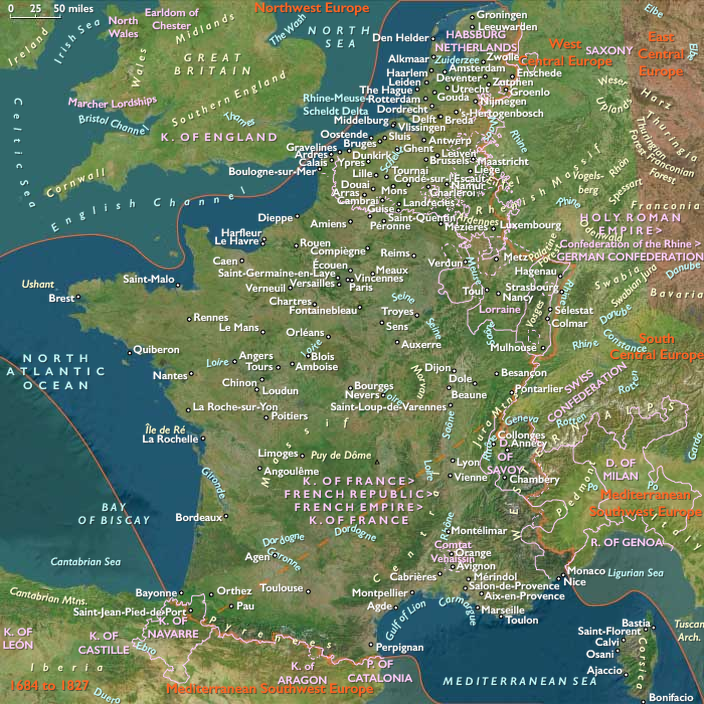
Subregions
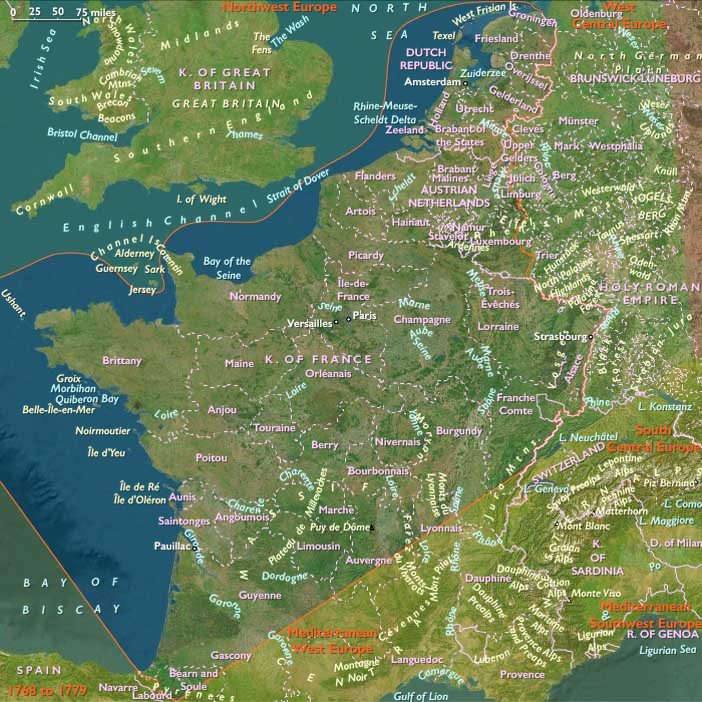
Years: 1768 - 1779
People
- Anne Robert Jacques Turgot
- Antoine-Laurent de Lavoisier
- Denis Diderot
- François Boucher
- Jacques-Louis David
- Jean-Honoré Fragonard
- Jean-Jacques Rousseau
- Joseph II, Holy Roman Emperor
- Louis XV of France
- Louis XVI of France
- Maria Theresa
- Nicolas de Condorcet, Marquis de Condorcet
- Pierre Beaumarchais
- Pierre-Louis Maupertuis
- Voltaire
Groups
- Jews
- Flanders, County of
- Normandy, Duchy of
- Liège, Prince-Bishopric of
- Namur, County of
- Christians, Roman Catholic
- Limburg, Duchy of
- Austria, Archduchy of
- Luxemburg, Duchy of
- Holy Roman Empire
- Lutheranism
- Protestantism
- Huguenots (the “Reformed”)
- Spain, Habsburg Kingdom of
- Netherlands, Southern (Spanish)
- Netherlands, United Provinces of the (Dutch Republic)
- France, (Bourbon) Kingdom of
- Dutch East India Company (Vereenigde Oostindische Compagnie or VOC in Dutch, literally "United East Indies Company")
- Dutch West India Company
- Prussia, Kingdom of
- Britain, Kingdom of Great
Topics
Commodoties
Subjects
- Writing
- Watercraft
- Painting and Drawing
- Labor and Service
- Conflict
- Scholarship
- Custom and Law
- Finance
- Human Migration
- religious movement
Regions
Subregions