
Atlantic West Europe (1792–1803): Revolutionary Upheaval, War, …
Years: 1792 - 1803
Atlantic West Europe (1792–1803): Revolutionary Upheaval, War, and the Birth of the Modern Era
Between 1792 and 1803, Atlantic West Europe—encompassing northern France, the Low Countries (modern Belgium, Netherlands, Luxembourg), and Atlantic-facing and English Channel coastal regions—experienced a transformative era dominated by the French Revolution, subsequent revolutionary wars, and the rise of Napoleon Bonaparte. Marked by political upheaval, economic turmoil, military conflict, and cultural dynamism, this period decisively reshaped Europe, laying the foundations of modern political and social structures.
Political and Military Developments
Radicalization of the French Revolution (1792–1794)
-
Following the monarchy’s abolition (1792), France proclaimed the First French Republic (September 21, 1792), transitioning rapidly toward radical republican governance.
-
The execution of King Louis XVI (January 1793) symbolized the revolutionary break from the Old Regime, triggering domestic counterrevolutions, notably in the Vendée region (western France), where royalist insurgents fiercely resisted revolutionary authority.
-
Radical revolutionaries (Jacobins) under Maximilien Robespierre briefly dominated France during the Reign of Terror (1793–1794), employing ruthless measures—mass executions, political purges, and severe suppression of dissent—to defend revolutionary ideals and consolidate power.
Revolutionary Wars and Military Expansion
-
Revolutionary France declared war against European monarchies, initiating the French Revolutionary Wars (1792–1802). Northern France and the Low Countries became primary battlegrounds, reshaping regional geopolitics.
-
French forces, driven by revolutionary zeal and innovative mass conscription (levée en masse, 1793), rapidly expanded, annexing territories, including the Austrian Netherlands (modern Belgium) in 1795, forming the French-dominated Batavian Republic in the Netherlands (1795–1806), and profoundly altering political boundaries.
Napoleon’s Rise to Power (1799–1803)
-
Military successes propelled General Napoleon Bonaparte into prominence. His victories in Italy and Egypt elevated his reputation, allowing him to stage the Coup of 18 Brumaire (November 9, 1799), replacing the unstable Directory (1795–1799) with the French Consulate (1799–1804).
-
Napoleon consolidated internal governance, enacted centralizing reforms, and prepared the groundwork for his imperial ambitions, profoundly influencing Atlantic West Europe's political trajectory.
Economic Developments: Crisis and Transformation
War Economy and Economic Disruption
-
Revolutionary wars severely disrupted regional economies, interrupting trade routes, causing inflation, and destabilizing markets. Northern France and the Low Countries experienced significant economic hardships, marked by shortages, price volatility, and disrupted maritime commerce, particularly impacting port cities such as Antwerp, Nantes, and Bordeaux.
-
Despite disruptions, revolutionary regimes initiated early industrial and infrastructural innovations (canals, roads, standardized weights/measures), setting foundations for future industrialization.
Agricultural Struggles and Urban Challenges
-
Continuous warfare and conscription reduced agricultural labor availability, exacerbating food shortages, especially during 1793–1795. Urban centers (Paris, Brussels, Lille, and Amsterdam) experienced acute shortages, heightening social unrest.
-
Revolutionary governments attempted agricultural reforms, including land redistribution (abolishing feudal privileges), though immediate productivity gains were limited due to ongoing warfare and instability.
Intellectual and Cultural Developments
Revolutionary Ideologies and Political Thought
-
Revolutionary ideals—liberty, equality, fraternity—spread rapidly across Europe, profoundly reshaping political consciousness. Revolutionary literature, propaganda, newspapers, and public debate significantly influenced public opinion and political ideologies.
-
Intellectual circles in Paris and Amsterdam continued robust discussions on republicanism, citizenship, human rights, and governance, disseminating revolutionary ideas widely.
Cultural Innovations and Revolutionary Art
-
Revolutionary France enthusiastically promoted the Neoclassical aesthetic, exemplified in the works of Jacques-Louis David. His iconic paintings (The Death of Marat, 1793) symbolized revolutionary virtue, sacrifice, and civic duty, deeply influencing European visual culture.
-
Public festivals, revolutionary ceremonies, and civic rituals reinforced republican ideals and national consciousness, significantly impacting cultural life in Paris, Brussels, and other urban centers.
Social and Urban Transformations
Revolutionary Urbanism and Civic Mobilization
-
Cities, especially Paris, emerged as crucibles of revolutionary activism. Revolutionary organizations, political clubs (Jacobins, Cordeliers), and popular mobilization profoundly reshaped urban political landscapes, influencing governance, municipal policies, and civic identity.
-
Revolutionary authorities undertook ambitious urban planning projects, demolishing medieval structures and redesigning public spaces (notably Parisian squares and boulevards), symbolizing new revolutionary ideals of rationality, secularism, and civic order.
Social Upheaval and Shifts in Class Structures
-
Revolutionary upheaval significantly disrupted established social hierarchies. Aristocratic privileges were abolished; middle-class professionals, merchants, and intellectuals gained unprecedented political influence, reshaping governance and policy.
-
Radical republican ideals temporarily promoted social mobility and egalitarian principles, although persistent economic crises, war hardships, and political instability limited sustained progress toward social equality.
Religious and Educational Developments
Revolutionary Secularization and Religious Policy
-
Revolutionary France aggressively pursued secularization, exemplified by the radical campaign of dechristianization (1793–1794), including closing churches, persecuting clergy, and promoting secular civic cults (Cult of Reason, Cult of the Supreme Being).
-
Although Napoleon’s Concordat (1801) restored relations with the Catholic Church, revolutionary secularism significantly reshaped religious dynamics, weakening church authority and promoting secular governance throughout Atlantic West Europe.
Educational Reforms and Revolutionary Schools
-
Revolutionary governments enacted significant educational reforms, promoting secular, rationalist curricula aimed at producing informed citizens. Establishment of new institutions, including the École Polytechnique (1794) and revolutionary lycée system, profoundly impacted educational standards and structures.
-
Northern European universities (Leiden, Ghent, Brussels) saw expanded intellectual debate, integrating revolutionary political thought into curricula, influencing generations of European scholars.
Legacy and Historical Significance
The period from 1792 to 1803 fundamentally transformed Atlantic West Europe, profoundly impacting its political, economic, social, and cultural trajectories:
-
Politically, revolutionary upheaval, republican governance, and Napoleon’s rise to power permanently reshaped governance models, promoting centralized state authority, republican ideals, and democratic aspirations.
-
Economically, wartime disruptions set back trade and agriculture temporarily but laid groundwork for future infrastructural and industrial modernization.
-
Socially, revolutionary ideals challenged traditional hierarchies, promoting unprecedented civic participation, social mobility, and redefining citizenship.
-
Culturally, revolutionary innovations reshaped artistic, educational, and intellectual landscapes, establishing enduring legacies in European political and cultural thought.
Ultimately, this era established critical foundations for Europe’s transition into modernity, profoundly influencing subsequent European and global developments.
People
Groups
- Jews
- Christians, Roman Catholic
- Austria, Archduchy of
- Luxemburg, Duchy of
- Holy Roman Empire
- Lutheranism
- Protestantism
- Huguenots (the “Reformed”)
- Spain, Habsburg Kingdom of
- Netherlands, Southern (Spanish)
- Netherlands, United Provinces of the (Dutch Republic)
- Dutch East India Company (Vereenigde Oostindische Compagnie or VOC in Dutch, literally "United East Indies Company")
- Prussia, Kingdom of
- Britain, Kingdom of Great
- France, Kingdom of (constitutional monarchy)
- French First Republic
- Batavian Republic
Topics
- Enlightenment, Age of
- French Revolution
- French Revolutionary Wars, or “Great French War”
- Reign of Terror
Commodoties
Subjects
- Writing
- Watercraft
- Painting and Drawing
- Labor and Service
- Conflict
- Scholarship
- Custom and Law
- Finance
- Human Migration
- religious movement
Regions
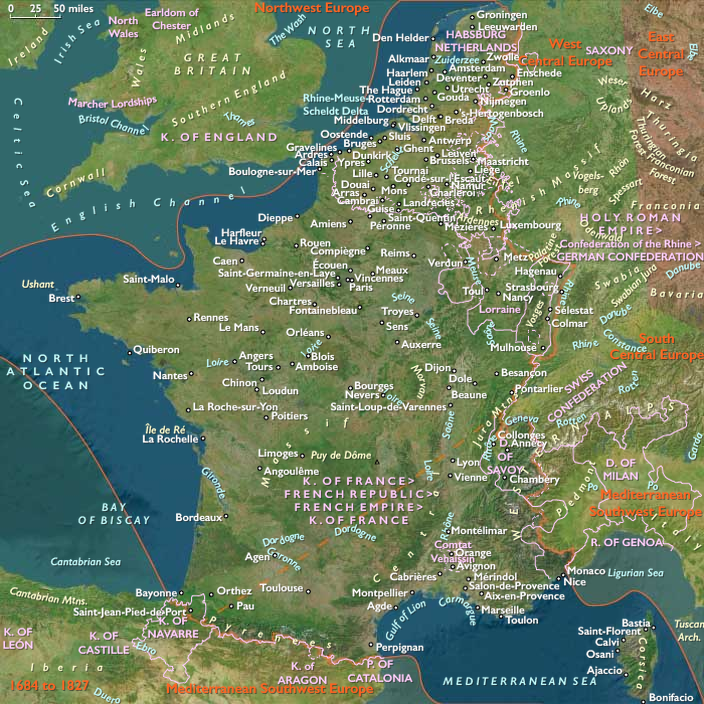
Subregions
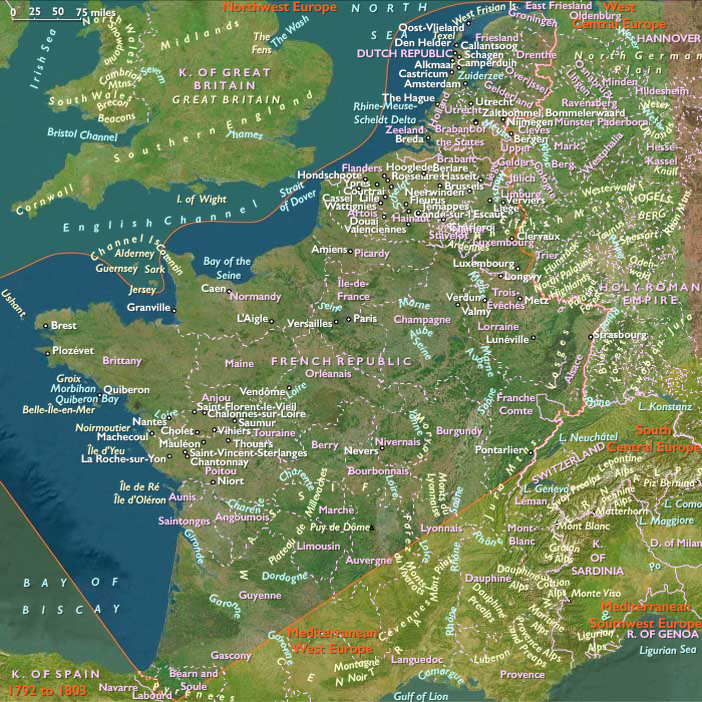
Years: 1792 - 1803
People
Groups
- Jews
- Christians, Roman Catholic
- Austria, Archduchy of
- Luxemburg, Duchy of
- Holy Roman Empire
- Lutheranism
- Protestantism
- Huguenots (the “Reformed”)
- Spain, Habsburg Kingdom of
- Netherlands, Southern (Spanish)
- Netherlands, United Provinces of the (Dutch Republic)
- Dutch East India Company (Vereenigde Oostindische Compagnie or VOC in Dutch, literally "United East Indies Company")
- Prussia, Kingdom of
- Britain, Kingdom of Great
- France, Kingdom of (constitutional monarchy)
- French First Republic
- Batavian Republic
Topics
- Enlightenment, Age of
- French Revolution
- French Revolutionary Wars, or “Great French War”
- Reign of Terror
Commodoties
Subjects
- Writing
- Watercraft
- Painting and Drawing
- Labor and Service
- Conflict
- Scholarship
- Custom and Law
- Finance
- Human Migration
- religious movement
Regions
Subregions