
Atlantic West Europe (1816–1827): Restoration, Economic Recovery, …
Years: 1816 - 1827
Atlantic West Europe (1816–1827): Restoration, Economic Recovery, and the Rise of Liberalism
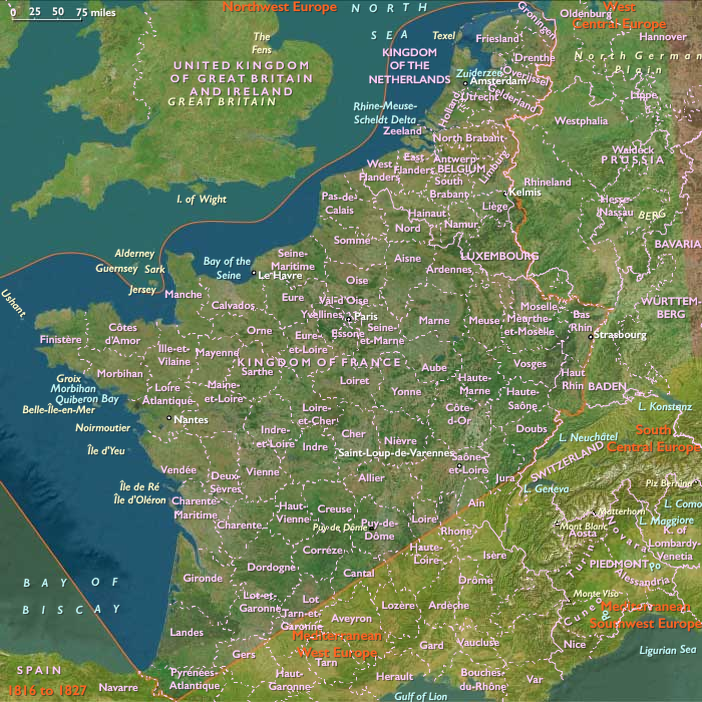
From 1816 to 1827, Atlantic West Europe—covering northern France, the Low Countries (modern Belgium, the Netherlands, and Luxembourg), and regions along the Atlantic and English Channel coasts—underwent a period of political restoration, economic reconstruction, and burgeoning liberal and nationalist sentiments following the upheaval of the Napoleonic Wars. This era saw conservative attempts to re-establish traditional monarchies and social orders clashing increasingly with rising demands for constitutional reform, economic liberalization, and national self-determination.
Political and Military Developments
Post-Napoleonic Restoration (1815–1818)
-
Following Napoleon’s defeat at Waterloo (1815), the Congress of Vienna (1814–1815) reshaped Europe, emphasizing balance of power and legitimacy, leading to the re-establishment of Bourbon monarchy in France under Louis XVIII (r. 1814–1824).
-
The Low Countries were united into the newly formed United Kingdom of the Netherlands under King William I (r. 1815–1840), intended as a buffer state against French aggression. Belgium, dominated by Catholic, French-speaking elites, was merged uneasily with Protestant, Dutch-speaking northern provinces.
French Monarchical Consolidation and Challenges
-
Louis XVIII established a constitutional monarchy with the Charter of 1814, providing limited parliamentary governance while preserving royal authority. His reign saw efforts to balance conservative royalists and liberal factions.
-
After Louis XVIII’s death in 1824, Charles X (r. 1824–1830) attempted stronger conservative restoration, antagonizing liberals through press restrictions and increased clerical influence, laying foundations for future conflicts.
Growing National and Political Tensions in the Netherlands
-
Belgium’s forced union with the Netherlands created political, religious, and cultural friction, as southern (Belgian) provinces increasingly resented Dutch political dominance and Protestant policies. Initial liberal resistance emerged strongly in Brussels and other Belgian cities by the late 1820s, foreshadowing eventual revolution (1830).
Economic Developments: Recovery and Early Industrialization
Post-War Economic Recovery
-
Following severe wartime economic disruptions, Atlantic West Europe experienced gradual economic recovery, aided by peace, agricultural revival, and renewed commercial activity through ports such as Antwerp, Rotterdam, Nantes, and Bordeaux.
-
Infrastructure restoration became essential, notably improving canal and road networks to facilitate regional and international trade, stimulating commerce and urban revival.
Early Industrial Growth
-
Northern France, particularly Lille, Rouen, and areas around the Loire and Seine valleys, saw early industrial growth in textiles, coal mining, and iron production. This marked the beginning of significant industrialization that later accelerated mid-century.
-
In the Low Countries, Belgium’s industrialization rapidly expanded, notably around Liège and Ghent, focused on textiles, iron, and machinery, setting the stage for Belgium’s prominent industrial role in continental Europe.
Maritime Commerce and Atlantic Trade
-
Atlantic and Channel ports regained importance, notably Bordeaux’s wine exports, Antwerp’s re-established trade networks, and Amsterdam’s revival as a financial and mercantile hub. These developments significantly boosted regional prosperity.
Social and Cultural Developments
Liberalism and Nationalism
-
Intellectual and political liberalism gained strength, influenced by Enlightenment ideas, emphasizing constitutional government, civic freedoms, press liberties, and parliamentary representation. These ideals gained support in urban centers across northern France and Belgium.
-
Nationalist sentiment grew, especially in Belgium, where distinct cultural identity strengthened opposition to Dutch rule. Increasingly vocal demands for political autonomy and cultural recognition became prominent.
Urban Revival and Social Change
-
Urban centers, particularly Paris, Brussels, Antwerp, and Amsterdam, experienced rapid growth, driven by industrialization and trade. A dynamic urban middle class emerged, advocating for economic liberalization and political reforms.
-
Improved educational institutions and expanding literacy facilitated greater political consciousness among urban populations, laying the groundwork for future political activism and cultural vibrancy.
Intellectual and Religious Developments
Revival of Catholic Influence
-
Post-Napoleonic restorations revived Catholic institutional strength, particularly evident in Belgium and northern France, influencing social policies, education, and cultural life. This resurgence sometimes fueled conflicts between liberal secularists and conservative Catholics.
-
Belgium became a key center of Catholic cultural revival, reflecting broader European patterns of post-revolutionary religious revival.
Liberal Intellectual Movements
-
Liberal intellectual circles in Brussels, Ghent, Paris, and Amsterdam advocated constitutional reform, freedom of expression, and economic liberalization, influencing public debates and setting the stage for political changes in subsequent decades.
-
Prominent figures such as François Guizot in France began formulating doctrines combining conservative order with liberal governance principles, significantly shaping political thought in France and beyond.
Legacy and Historical Significance
The era 1816–1827 represented a crucial transitional phase for Atlantic West Europe, bridging the turbulent Napoleonic era and the subsequent revolutionary period:
-
Politically, it established fragile restorations of conservative monarchies, which encountered mounting challenges from liberal and nationalist forces.
-
Economically, it marked initial recovery and significant early industrialization, laying essential foundations for future economic transformation and prosperity.
-
Socially and culturally, rising liberalism and nationalism increasingly shaped political identities, influencing societal values, political organization, and intellectual debates.
Ultimately, this period set the stage for major revolutionary and constitutional upheavals, notably Belgium’s independence (1830) and France’s July Revolution (1830), critically defining the region’s path toward modern nation-states, constitutional governance, and industrial economies.
People
- Charles X of France
- François Guizot
- Jacques-Louis David
- Louis XVIII of France
- Napoleon
- William I of the Netherlands
Groups
- Jews
- Christians, Roman Catholic
- Austria, Archduchy of
- Holy Roman Empire
- Lutheranism
- Protestantism
- Huguenots (the “Reformed”)
- Dutch East India Company (Vereenigde Oostindische Compagnie or VOC in Dutch, literally "United East Indies Company")
- Dutch West India Company
- Prussia, Kingdom of
- Britain, Kingdom of Great
- Netherlands, Southern (French)
- France, constitutional monarchy of
- Netherlands, Kingdom of The United
Topics
Commodoties
Subjects
- Writing
- Watercraft
- Painting and Drawing
- Labor and Service
- Conflict
- Scholarship
- Custom and Law
- Finance
- Human Migration
- religious movement
Regions
Subregions
Years: 1816 - 1827
People
- Charles X of France
- François Guizot
- Jacques-Louis David
- Louis XVIII of France
- Napoleon
- William I of the Netherlands
Groups
- Jews
- Christians, Roman Catholic
- Austria, Archduchy of
- Holy Roman Empire
- Lutheranism
- Protestantism
- Huguenots (the “Reformed”)
- Dutch East India Company (Vereenigde Oostindische Compagnie or VOC in Dutch, literally "United East Indies Company")
- Dutch West India Company
- Prussia, Kingdom of
- Britain, Kingdom of Great
- Netherlands, Southern (French)
- France, constitutional monarchy of
- Netherlands, Kingdom of The United
Topics
Commodoties
Subjects
- Writing
- Watercraft
- Painting and Drawing
- Labor and Service
- Conflict
- Scholarship
- Custom and Law
- Finance
- Human Migration
- religious movement
Regions
Subregions