
Atlantic West Europe (1852–1863): Imperial Ambitions, Industrial …
Years: 1852 - 1863
Atlantic West Europe (1852–1863): Imperial Ambitions, Industrial Expansion, and Social Change
From 1852 to 1863, Atlantic West Europe—including northern France, Belgium, the Netherlands, Luxembourg, and the Atlantic and Channel coasts—experienced an era of profound economic growth, imperial ambitions, social reforms, and shifting political dynamics. This period marked the ascendance of France under Napoleon III’s Second Empire, further industrial and infrastructural growth across the region, and increasing social consciousness driven by labor activism and emerging socialist ideologies.
Political and Military Developments
France: The Second Empire under Napoleon III
-
Following a coup d'état in December 1851, Louis-Napoléon Bonaparte established the Second French Empirein 1852 as Emperor Napoleon III, promising political stability, economic growth, and national prestige.
-
Under Napoleon III, France pursued active imperialist policies, engaging in international diplomacy and conflicts such as the Crimean War (1853–1856), which temporarily bolstered France’s European prestige and military influence.
Belgium: Stability, Neutrality, and Economic Prosperity
-
Belgium, under King Leopold I (r. 1831–1865), maintained political stability and economic prosperity, emphasizing constitutional monarchy and international neutrality. The country strengthened its economy through industrial and commercial expansion.
-
Although politically stable, Belgium faced internal tensions due to linguistic divides and emerging demands for social and electoral reforms.
Netherlands and Luxembourg: Moderate Liberalism and Stability
-
Under King William III (r. 1849–1890), the Netherlands solidified its liberal constitutional monarchy, fostering political moderation and gradual democratic reforms. The Dutch economy prospered due to colonial trade (notably in the Dutch East Indies) and domestic industrialization.
-
Luxembourg remained stable, preserving its autonomy within the German Confederation and Dutch rule, pursuing economic modernization through railway expansion and industrial growth.
Economic Developments: Industrial Expansion and Innovation
France: Industrial Growth and Infrastructure Expansion
-
Napoleon III strongly promoted economic modernization and infrastructure development, significantly expanding railways, ports, and urban improvements, notably in Paris, Lille, and northern industrial centers.
-
Key northern cities such as Lille, Roubaix, Calais, and Le Havre saw robust growth in textile, steel, and shipbuilding industries, enhancing Atlantic trade and commercial networks.
Belgium: Industrial Powerhouse and International Trade Hub
-
Belgium solidified its status as one of Europe's leading industrial nations. Cities such as Liège, Ghent, and Antwerp thrived on coal mining, iron production, textiles, and international commerce.
-
The port of Antwerp flourished as a crucial trade center, further integrating Belgium into the broader European and global economic systems.
Netherlands: Commercial Expansion and Maritime Trade
-
The Netherlands, leveraging its maritime heritage, significantly expanded its international trade networks, benefiting from Dutch colonial enterprises and trade in goods such as coffee, spices, and tobacco.
-
Amsterdam and Rotterdam emerged as vital European commercial hubs, driving economic prosperity and facilitating industrial growth.
Social Developments: Rising Labor Movements and Social Reforms
Growth of Labor Activism
-
Rapid industrialization and urbanization intensified social inequalities and labor unrest, especially in Belgian and northern French industrial centers such as Lille, Roubaix, and Liège.
-
Early socialist and labor organizations grew stronger, advocating improved working conditions, higher wages, shorter workdays, and increased political representation for working-class communities.
Social and Educational Reforms
-
Governments responded to social challenges by introducing moderate reforms in labor conditions, public health, and education. France under Napoleon III expanded public works, urban sanitation, and educational access, notably influenced by Baron Haussmann’s transformative urban reforms in Paris.
-
Belgium advanced public education and early social welfare measures, addressing growing public demand for improved living conditions and social justice.
Cultural and Intellectual Developments
Realism and the Emergence of Modern Literature
-
Literary realism matured in this period, with influential French authors such as Gustave Flaubert (Madame Bovary, 1857) and Victor Hugo (Les Misérables, 1862), critically depicting contemporary society, social injustices, and moral complexities.
-
Realist painting also flourished, notably with artists such as Gustave Courbet in France, challenging traditional aesthetics and addressing social realities directly.
Scientific and Technological Advancements
-
The era saw notable scientific progress, particularly through advancements in chemistry, metallurgy, and medicine, significantly contributing to improved industrial productivity, healthcare, and urban sanitation systems.
Religious Developments
Ongoing Secularization and Religious Reactions
-
The trend toward secularization persisted, notably in France and Belgium, where liberal governments increasingly limited church influence in public education and governance, prompting strong conservative Catholic reactions.
-
In the Netherlands, Protestant liberalism continued to support moderate social and educational reforms, though religious tensions persisted, especially in predominantly Catholic regions.
Urbanization and Social Dynamics
Urban Expansion and Population Growth
-
Urban centers such as Brussels, Antwerp, Lille, Roubaix, Ghent, and Amsterdam continued rapid expansion, driven by industrial employment opportunities and improved transportation networks.
-
This accelerated urbanization brought significant challenges, including overcrowding, poor sanitation, housing shortages, and increased demand for public services.
Growing Middle-Class Influence
-
The middle class expanded significantly, benefiting from economic prosperity and industrial growth. Merchants, industrialists, and professionals increasingly influenced political and social reforms, advocating liberal economic policies, political moderation, and social stability.
Long-Term Consequences and Historical Significance
The period 1852–1863 represented a crucial phase in Atlantic West Europe’s transition toward modernity:
-
Politically, the consolidation of the Second Empire in France and continued stability in Belgium and the Netherlands established enduring governance frameworks, though tensions over liberalization and labor rights grew.
-
Economically, the region saw dramatic industrial growth, infrastructural expansion, and increased integration into global trade networks, positioning it as a vital economic center.
-
Socially, this era intensified labor activism, accelerated urban growth, and introduced critical early reforms addressing working conditions and public health, laying foundations for future social welfare policies.
-
Culturally, the flourishing of realism in literature and art reflected deeper societal engagement with modern life, influencing European culture profoundly into the late 19th century.
By 1863, Atlantic West Europe had firmly established itself as a prosperous, industrially dynamic region, grappling actively with emerging social challenges and setting essential foundations for future democratic and social transformations.
People
- Gustave Courbet
- Gustave Flaubert
- Honoré de Balzac
- Johan Thorbecke
- Leopold I of Belgium
- Louis Blanc
- Napoleon III
- Victor Hugo
- William III of the Netherlands
Groups
- Christians, Roman Catholic
- Lutheranism
- Protestantism
- Huguenots (the “Reformed”)
- Britain, Kingdom of Great
- Netherlands, Kingdom of The United
- Belgium, Kingdom of
- Netherlands, Kingdom of The
- France, Second Republic of
- France, Second Empire of
Topics
Commodoties
- Fish and game
- Grains and produce
- Textiles
- Slaves
- Salt
- Sweeteners
- Beer, wine, and spirits
- Fuels, lubricants and sealants
- Stimulants
- Spices
Subjects
- Writing
- Watercraft
- Painting and Drawing
- Public health
- Labor and Service
- Conflict
- Scholarship
- Custom and Law
- Medicine
- Chemistry
- Finance
- religious movement
- Metallurgy
- Human Migration
Regions
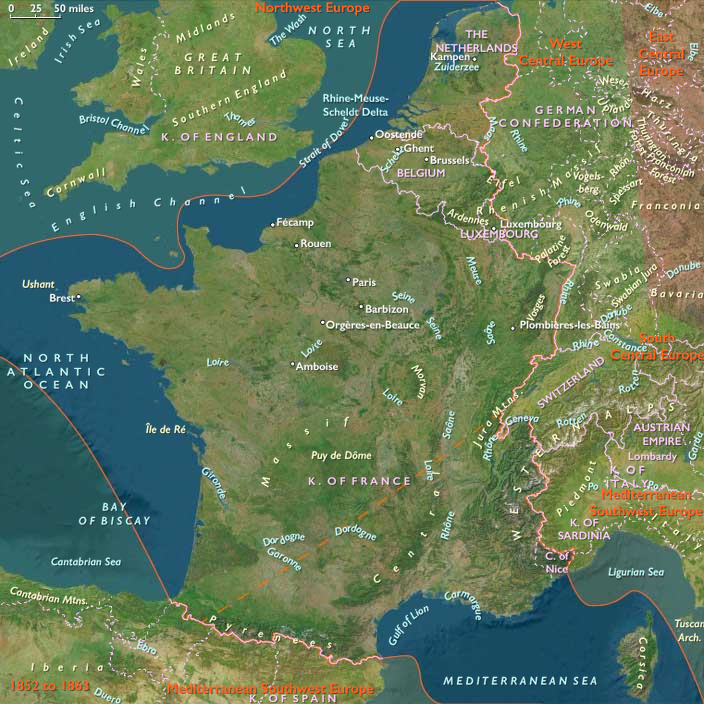
Subregions
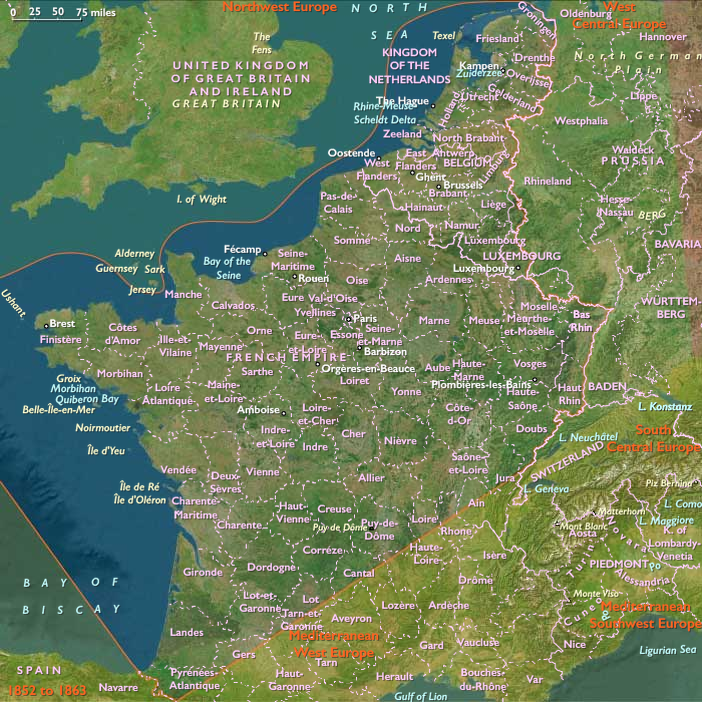
Years: 1852 - 1863
People
- Gustave Courbet
- Gustave Flaubert
- Honoré de Balzac
- Johan Thorbecke
- Leopold I of Belgium
- Louis Blanc
- Napoleon III
- Victor Hugo
- William III of the Netherlands
Groups
- Christians, Roman Catholic
- Lutheranism
- Protestantism
- Huguenots (the “Reformed”)
- Britain, Kingdom of Great
- Netherlands, Kingdom of The United
- Belgium, Kingdom of
- Netherlands, Kingdom of The
- France, Second Republic of
- France, Second Empire of
Topics
Commodoties
- Fish and game
- Grains and produce
- Textiles
- Slaves
- Salt
- Sweeteners
- Beer, wine, and spirits
- Fuels, lubricants and sealants
- Stimulants
- Spices
Subjects
- Writing
- Watercraft
- Painting and Drawing
- Public health
- Labor and Service
- Conflict
- Scholarship
- Custom and Law
- Medicine
- Chemistry
- Finance
- religious movement
- Metallurgy
- Human Migration
Regions
Subregions