
Atlantic West Europe (1876–1887): Republican Stabilization, Imperial …
Years: 1876 - 1887
Atlantic West Europe (1876–1887): Republican Stabilization, Imperial Ambitions, and Industrial Prosperity
From 1876 to 1887, Atlantic West Europe—encompassing northern France, Belgium, the Netherlands, Luxembourg, and regions facing the Atlantic and English Channel coasts—experienced political stabilization, deepening industrialization, expansive colonial ambitions, and critical social and cultural transformations. The period notably saw the solidification of the French Third Republic, Belgium's rapid colonial expansion in Africa, the continued rise of labor and socialist movements, and a flourishing of artistic and intellectual innovation.
Political and Military Developments
Consolidation of the French Third Republic
-
The French Third Republic stabilized politically during this period, notably under presidents Jules Grévy (1879–1887) and prime ministers such as Jules Ferry, who enacted crucial educational and civic reforms.
-
The republic firmly established secular governance through landmark education laws (1881–1882), mandating free, compulsory, and secular education, significantly curtailing the Catholic Church's influence on public life.
Belgian Colonial Expansion under Leopold II
-
King Leopold II of Belgium pursued aggressive colonial expansion in Central Africa, notably establishing the Congo Free State (1885) as his personal colony following the Berlin Conference (1884–1885).
-
This imperial ambition greatly impacted Belgium's economy and national prestige, but it also began to draw international scrutiny due to exploitation and severe humanitarian abuses in the Congo.
Stable Constitutional Governance in the Netherlands and Luxembourg
-
Under King William III (1849–1890), the Netherlands continued stable parliamentary governance. The Liberal and Conservative parties alternated power, implementing social reforms and further developing democratic institutions.
-
Luxembourg enjoyed political stability and economic prosperity, strengthened by continued neutrality and advantageous positioning between Germany, France, and Belgium.
Economic Developments: Industrial Prosperity and Global Trade
Expansion of Industrial Capacity and Trade Networks
-
Industrial production surged throughout the region. Northern France's textile mills, coal mines, and steel factories flourished, with cities like Lille, Roubaix, and Dunkirk benefiting from expanding railway networks and global trade connections.
-
Belgium's industrial regions (especially Wallonia) expanded coal and steel production, reinforcing its economic stature in Europe.
Maritime and Commercial Growth in the Netherlands
-
Dutch ports, particularly Rotterdam and Amsterdam, experienced sustained commercial growth, becoming central hubs for global trade. Rotterdam, in particular, significantly expanded its port facilities, laying foundations for its 20th-century prominence.
-
Agriculture continued as an economic backbone, with improved technology and land reclamation efforts significantly increasing Dutch productivity.
Increased Colonial Trade and Exploitation
-
Colonial markets expanded considerably, particularly Belgium’s exploitation of Congolese resources (rubber, ivory), enriching the nation at substantial human cost.
-
France, with existing colonial holdings in Africa and Asia, intensified economic exploitation of colonies, notably in Algeria, Indochina, and West Africa, fueling economic growth and industrial investment back home.
Social Developments: Labor Activism and Class Tensions
Growing Labor and Socialist Movements
-
Socialist and labor movements gained momentum, reflecting persistent industrial unrest and demands for improved working conditions, higher wages, and broader political rights. France’s workers increasingly rallied around socialist figures such as Jules Guesde and organizations like the Parti Ouvrier Français (POF), founded in 1882.
-
Belgium’s industrial regions (Liège, Charleroi) similarly witnessed significant labor organization, strikes, and socialist advocacy, pressing for broader social reforms.
Improved Social Legislation and Worker Rights
-
Social legislation began to improve labor conditions modestly, influenced by socialist pressures. Belgium and the Netherlands introduced early social insurance schemes, shorter working hours, and improved workplace safety laws.
Cultural and Intellectual Developments
Impressionism and Artistic Innovation
-
The Impressionist movement matured in France, profoundly influencing European art. Painters such as Claude Monet, Edgar Degas, Pierre-Auguste Renoir, and Camille Pissarro transformed artistic expression by capturing contemporary life, urban landscapes, and transient moments.
-
This movement significantly influenced subsequent generations, laying the groundwork for Post-Impressionism and early Modernist art movements.
Literary Realism and Naturalism
-
French literature continued its exploration of realism and naturalism, notably through works by Émile Zola, whose novel Germinal (1885) vividly portrayed working-class struggles in northern France’s coalfields.
-
Such literature deeply influenced European thought, highlighting the harsh realities of industrialization and class disparities.
Scientific and Technological Advances
-
Major advances occurred in technology, chemistry, and engineering, especially in the chemical industries of Belgium and the Netherlands. Innovations in chemical production, metallurgy, and manufacturing processes enhanced industrial efficiency and economic growth.
-
Technological advancements in transportation—expanding railway networks, improved steamships—further integrated the region economically and socially.
Religious and Educational Developments
Secularization and Church-State Conflict
-
Continued secularization, particularly in France, intensified tensions between the state and the Catholic Church. The 1880s educational reforms significantly reduced religious influence in public education, fostering stronger secular civic identities.
Education Expansion and Intellectual Growth
-
Education expanded significantly across Atlantic West Europe, driven by state-funded secular schooling in France, Belgium, and the Netherlands. Increased literacy and education profoundly impacted social mobility and intellectual life, stimulating greater cultural vibrancy and democratic engagement.
Urbanization and Social Dynamics
Accelerated Urban Growth
-
Major cities such as Paris, Brussels, Antwerp, Rotterdam, Amsterdam, Lille, and Roubaix experienced substantial urban expansion, driven by industrialization and immigration from rural areas.
-
Improved infrastructure—transportation, sanitation, housing—supported this urban growth, reflecting significant investments aimed at managing increasing populations.
Persistent Social Inequality and Class Struggles
-
Economic growth disproportionately benefited industrial and merchant elites, exacerbating social disparities. Urban working classes faced harsh living conditions, spurring continued social unrest, labor activism, and demands for greater social justice and political representation.
Long-Term Consequences and Historical Significance
The period 1876–1887 represented a critical juncture in Atlantic West Europe's modern development:
-
Politically, France’s Third Republic solidified its institutions, Belgium embarked on imperial expansion, and the Netherlands and Luxembourg maintained stable parliamentary governance.
-
Economically, rapid industrial expansion, global trade integration, and colonial exploitation secured long-term prosperity, albeit with deepening social inequalities.
-
Socially, the rise of labor movements, socialism, and early welfare reforms began reshaping class relations and democratic institutions.
-
Culturally, artistic movements like Impressionism and literary naturalism profoundly shaped European cultural identity, fostering innovative artistic and intellectual traditions.
By 1887, Atlantic West Europe stood firmly integrated into global economic networks, politically stable but socially divided, culturally influential yet confronting complex internal tensions, laying essential foundations for the intense modernization and dramatic upheavals of the late 19th and early 20th centuries.
People
- Camille Pissarro
- Claude Monet
- Edgar Degas
- Jules Ferry
- Jules Grévy
- Jules Guesde
- Leopold II of Belgium
- Pierre-Auguste Renoir
- William III of the Netherlands
- Émile Zola
Groups
- Christians, Roman Catholic
- Lutheranism
- Protestantism
- Huguenots (the “Reformed”)
- Britain (United Kingdom of Great Britain and Ireland)
- Belgium, Kingdom of
- Netherlands, Kingdom of The
- France (French republic); the Third Republic
- Congo Free State (King Leopold's Congo)
Topics
Commodoties
- Fish and game
- Grains and produce
- Textiles
- Slaves
- Salt
- Sweeteners
- Beer, wine, and spirits
- Fuels, lubricants and sealants
- Stimulants
- Spices
Subjects
- Writing
- Watercraft
- Painting and Drawing
- Public health
- Labor and Service
- Conflict
- Scholarship
- Custom and Law
- Medicine
- Chemistry
- Finance
- religious movement
- Metallurgy
- Human Migration
Regions
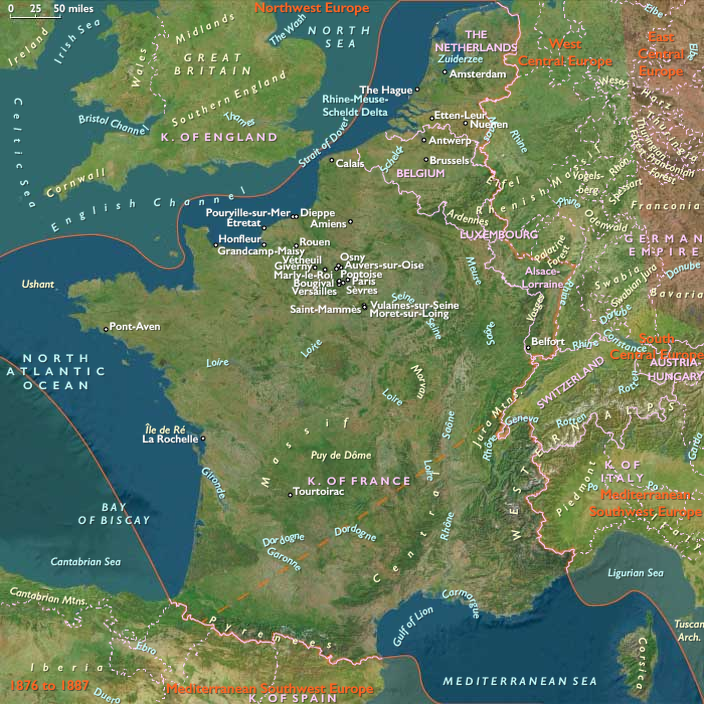
Subregions
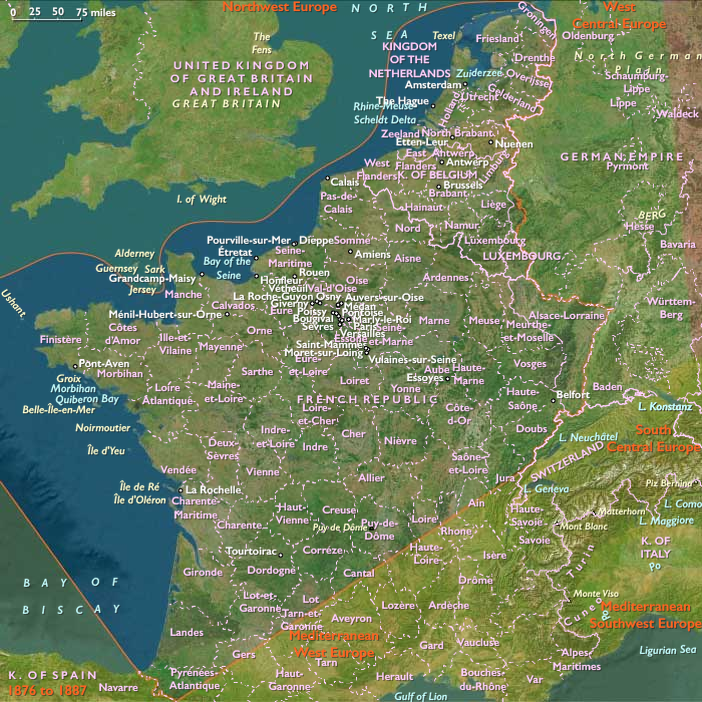
Years: 1876 - 1887
People
- Camille Pissarro
- Claude Monet
- Edgar Degas
- Jules Ferry
- Jules Grévy
- Jules Guesde
- Leopold II of Belgium
- Pierre-Auguste Renoir
- William III of the Netherlands
- Émile Zola
Groups
- Christians, Roman Catholic
- Lutheranism
- Protestantism
- Huguenots (the “Reformed”)
- Britain (United Kingdom of Great Britain and Ireland)
- Belgium, Kingdom of
- Netherlands, Kingdom of The
- France (French republic); the Third Republic
- Congo Free State (King Leopold's Congo)
Topics
Commodoties
- Fish and game
- Grains and produce
- Textiles
- Slaves
- Salt
- Sweeteners
- Beer, wine, and spirits
- Fuels, lubricants and sealants
- Stimulants
- Spices
Subjects
- Writing
- Watercraft
- Painting and Drawing
- Public health
- Labor and Service
- Conflict
- Scholarship
- Custom and Law
- Medicine
- Chemistry
- Finance
- religious movement
- Metallurgy
- Human Migration
Regions
Subregions